
Posts Tagged ‘Gloria Feldt’
Population Institute’s 31st Annual Global Media Awards
Thank you to Peter Bruce Photo and Video for the beautiful photos from this event.
 |
 |
 |
Left: Distinguished journalist Rahul Singh has been chair of the Global Media Awards for 30 years!
Center: Population Institute president Billl Ryerson presenting the award for best article or series of articles to Steve Katz, publisher of Mother Jones magazine.
Right: Jennifer Brown accepting the award for best TV show on behalf of Australian documentary, “Dick Smith’s Population Puzzle.”
Read MoreIt Takes Persistence to Move a Mountain
Blogger Beth Terry of Fake Plastic Fish is an amazing woman. I was so moved by her how she used the three principles of movement building: be a sister by reaching out to others with similar concerns, have the courage to raise issues that you feel are important, and put the two together systematically to create movement. Watch the video of Beth telling her story of why and how she persuaded Brita to offer recyclable water filters to US consumers. I knew I had to highlight it in No Excuses the moment I heard about her.
What’s your story? How have you been able to use movement building principles to achieve a goal? What was the issue you wanted to take on? What was the result?
Read MorePower Tool #7: Create a Movement
In this video, women wearing their virtual shirts put their convictions into action. But they didn’t do it alone.
In No Excuses, I show how to apply movement building principles to any area of life. Those principles can be described as Sister Courage: be a sister. Reach out and ask for help when you need it. give help when someone else needs it. Have the courage to raise issues. Put the two together with action and you have a movement.
Think about it. When you needed to plan Thanksgiving dinner, didn’t you call on your sisters to help you plan the menu and distribute the workload? Those same skills can be incorporated into the workplace and in politics.
Read MoreEnter the Wear the Shirt Photo Contest
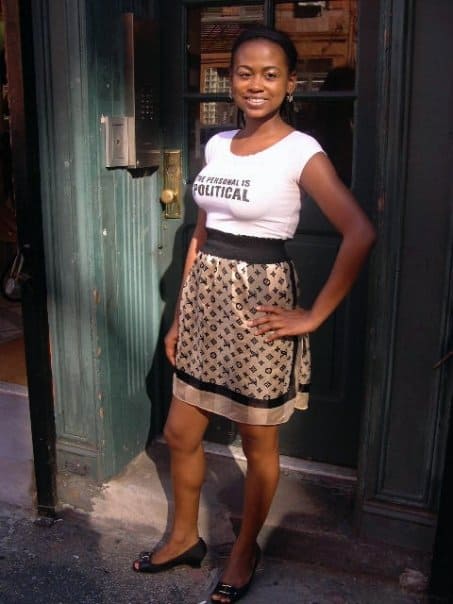 No Excuses Power Tool #6 is “Wear the Shirt.” It’s a metaphor for sharing your convictions with others. Whether it’s a slogan, a DIY ensemble, or your Feminist Majority “this is what a feminist looks like” shirt, it’s important that we wear our shirts proudly. That’s why I’m hosting a Wear the Shirt photo contest.
Send me a photo of you in your favorite message shirt, and I’ll include you in the slide show on my homepage. One lucky winner will receive an autographed set of my four books, including No Excuses.
I would love for you to participate in this opportunity to socialize and share your favorite shirts! There are three ways to participate:
1. Take a picture of yourself in your favorite shirt and send it to me in an email.
2. Post the picture on your blog and let your readers know about this contest! E-mail me and I’ll link to the post and also put it on my Twitter and Facebook page.
3. Tweet your shirt and about the wear the shirt campaign, linking to @GloriaFeldt.
Wear the Shirt Can Spur a Movement
 Last Monday night, thanks to my great friend Dede Bartlett’s orchestration, I had the pleasure of speaking about No Excuses at the New Canaan (CT) Public Library. What made the event really special was that two of the women I interviewed for the book were present.
So I invited Sophfronia Scott, writer and founder of Done for You (a service that helps authors write and package their books) and executive coach Bonnie Marcus, who also hosts the “Head Over Heels” radio show, to share their stories with the audience.
Both demonstrated power tool #6: wear the shirt, by revealing their authentic selves, their passions, their aspirations.
Marcus described how she went to a job interview at a cardiac center with no management experience– in fact, no business experience whatsoever, and yet by showing her passion she got the job. “I talked about my passion for cardiac fitness,” she said. “I had been teaching aerobics. I talked about how the mission of their company resonated with me because my dad had a heart attack at fifty-seven and my family completely changed our lifestyle at home, becoming more active and eating heart-healthy foods. I showed the cardiac center how their mission and message was my way of life. They hired me! Certainly not because of anything but my passion and energy for the company and their mission.”
Scott told us how she decided to tell the world (via a powerful blog post January 1) that 2010 would be her year of living fearlessly.
Read More2010 Election is Over; Seven-Point Plan for 2012
This was published earlier today on Truthout. I’d love for you to join the discussion, either here on Heartfeldt or over on Truthout.
 Election day 2010 is so yesterday. Today and tomorrow, progressive women – who constitute up to 60 percent of the Democrats’ base – had better regroup and start a vigorous push not just to regain ground lost, but to take back the message and advance a strong agenda for 2012.
Let’s face it – Democrats (do they ever learn?) and all progressives are in for a very rough ride again, after only the briefest of post-Bush respites.
But we have to remember that the political process is an oscillation, not a straight line between two points. Count on it: Every political defeat sows the seeds of the next victory, and every victory sows the seeds of the next defeat. This year’s defeat was sown not by moving too fast or thinking too big, but because Democratic leaders with President Obama at the top failed to keep the electorate thinking expansively and courageously enough.
Contrast this with Republican performance during the last two years. Did they wait even one minute to begin their battle to regain control of Congress? No, they redoubled their efforts. Instead of licking the wounds of their 2008 defeat, they set about opposing Obama, vilifying Nancy Pelosi, and obstructing the legislative progress. They unabashedly blamed the Democrats in power for not passing the very legislation they themselves killed – and worse yet, the Democrats let them get away with it.
Here’s a seven-point plan so progressive voters can celebrate like it was 2008, come November, 2012.
Read MoreNew Canaan Public Library: New Canaan, Connecticut
 |
 |
Left: At the podium in New Canaan
Right: Bonnie Marcus, Gloria Feldt, and Sophfronia Scott at the New Canaan Public Library sharing with the audience how they “wear the shirt.”
Read MorePower Tool #6: Wear the Shirt
 “I love your T-shirt,” chuckled Jenny, my twenty-something personal trainer, as she stretched my aching legs. “I never saw that before.”
I hadn’t noticed which of my many message T-shirts I had thrown on when I rolled out of bed before sunrise. Most of the folks who populate New York’s Columbus Circle Equinox gym sport workout clothes that bear designer labels, but seldom do I see any that pack a message punch. I figure my chest is valuable real estate—why not use it to communicate my convictions?
I looked down and saw that I’d grabbed one of my favorites: Well-Behaved Women Rarely Make History. Historian Laurel Thatcher Ulrich’s wry observation became one of the guiding principles of the women’s movement during the 1970s, and living it seems as natural to me now as balance ball crunches do to my lithe trainer.
Perhaps because of their delicious candor laced with felicity of expression, these words have become a slogan for boundary-breaking women everywhere. But just because it’s proudly emblazoned on mugs and bumper stickers and, yes, T-shirts, doesn’t mean we should let the message be reduced to merely a personal assertion of gutsiness. The context of Ulrich’s observation, the thing that actually makes it true, is both personal and political. Although history is often taught in schoolbooks as a sequence of significant acts by Important Men (and the occasional important woman), what Ulrich recognized is that making history is a communal act, requiring us to break the boundaries of what is considered proper behavior.
Read MorePower Tool #5: Carpe the Chaos
 Political talking heads slicing and dicing Nov. 2’s election results had previously declared this to be the year of the Republican rightwing woman. It wasn’t quite. Still, it’s a dagger to the heart of social justice feminism that the nation’s first two women of color elected governor are not women who support women’s rights to economic and reproductive justice–the two fundamental building blocks of women’s power and agency in this world. We have a lot of work to do.
It’s our job to find the opportunity–to carpe the chaos. To be a beacon of light when so many of our leaders are co-opted rather than courageous, and to take the initiative without delay. Post-election regrouping with its inevitable jockeying for power is the perfect launching pad for future victories. On the positive side, the Colorado ballot initiative that would have given personhood rights to the fertilized egg but not to the woman failed by a three-to-one margin. So let’s build on that to foster the paradigm shift in gender power that is sorely needed.
Read MoreDifferent Approaches to Controversy Yield Different Results
 I can’t think of a better example of controversy well-taken than then-presidential candidate Barack Obama’s thoughtful speech exploring the role of race in American history, delivered in Philadelphia in the spring of 2008. In response to exploding controversy around his relationship with his pastor and mentor, Reverend Jeremiah Wright, who had made inflammatory (and frankly racist) remarks in his sermons, Obama rode directly into the wave of controversy. He didn’t deflect or minimize it, but took the festering issue of race in America head-on, thus defusing criticism, positioning himself as a courageous truth-teller, and building respect and enthusiasm for his candidacy among voters hungry for change. He turned a powder keg of a controversy that could have exploded his presidential campaign into a brilliant platform to teach about a subject so sensitive that it is often avoided in public discourse.
I sincerely doubt Obama or his campaign advisers would have sought out this controversy, but when it came up, they realized they had been handed a priceless moment to demonstrate genuine leadership. I believe this was the turning point that led him to victory, and that if Clinton had treated the equally vicious sexism thrown at her with the same directness and candor that Obama confronted race, the outcome might well have been different.
Sometimes we embrace controversies that have turned up on their own. And at other times, we need to create our own controversies in order to get things moving. In other words, there are controversies we make and controversies we take.
What are your own examples of embracing controversy? Did you make the controversy or did you take a controversy that came to you? What did you learn from your experiences?
Read More