
Women's History Open Thread: Honoring Our Mentors
 Mentors are particularly important for helping us develop a leadership style, and to shape our professional development. Who have been your mentors? What role have they played in your life? A new study released by Catalyst suggests that women need more than mentors, they need people who will sponsor them proactively into top leadership roles.
Do you agree? Have you had a sponsor? Have you been a sponsor?
Read MoreElite Women Around the World
Check out the pictures from this Elite event!
Cleveland, OH
Fri. 3/18 @ 9:00 am Scaling Up . . . Can I Dream Big?
Part of the Women Empowering Women Series by Elite Women Around the World Crown Plaza Cleveland South
Women's History Roundup: The Lesser Knowns Edition
Yesterday I mentioned that I feel like Women’s History Month is a good opportunity to shine a light on lesser know women – such as Lisa Rabinowitz, the woman ejected from court for daring to wear pants. In that frame of mind, here are some links to help give some more lesser known women their moment in the spotlight.
Here’s a list from Huffington Post of Female Firsts to give you a good timeline of women’s historical achievements.
California NOW has launched a 30 Women You Should Know series on their blog this month, highlighting some women who don’t always get the time they deserve in the spotlight. Check out their post about Women in Military History.
And to wrap up our list of women whose time in the spotlight is overdue, check out the bios of these interesting women:
Astronaut Ellen Ochoa
Egyptian protester Asma Mahfouz
If you missed the guest post from Jezebel’s Anna North about writer Octavia Butler, be sure to check it out and leave Anna some comment love.
Read MoreLois Rabinowitz: Now You Can Wear Slacks
Today’s guest post is from women’s success coach Bonnie Marcus. Bonnie takes a candid look at how attitudes towards women’s attire have often had serious consequences. Shining the light on lesser known women is what Women’s History Month is all about in my opinion. Enjoy!
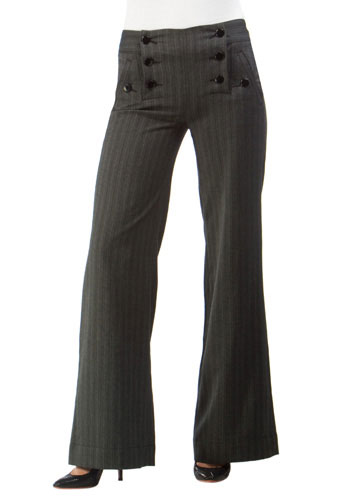 It’s hard to imagine the days when women were frowned upon for wearing slacks in public. In the 1960’s, however, this was the case. Women were expected to wear a hat, gloves, high heels, nylons and a girdle. It was commonly accepted behavior for women to dress up every day before they left the house.
In the summer of 1960, Lois Rabinowitz went to traffic court in New York City to pay a speeding ticket for her boss. Lois was a 28-year-old secretary for an oil company executive. She was a newlywed and her husband of just two weeks drove her to the courthouse that morning. Lois was neatly dressed in slacks and a blouse.
Upon seeing Lois in slacks, the Magistrate of the court was outraged and sent her home.
Read MoreBook Signing at Women and Children First Bookstore
Chicago, IL Wed. 3/16 @ 7:30 pm Book signing Women & Children First Bookstore
Read MoreBeyond the Headlines: How to Find Role Models with Expertise
Emily Jasper writes this guest post for 9 Ways. Emily Jasper’s blog was chosen as one of ForbesWoman’s top 100 websites for women. Here’s the bio she sent to accompany this inspiring guest post:
Known to rip apart magazines to write in the white space, I’m constantly thinking about what to write next. I write about my own observations at my blog From the Gen Y Perspective. In addition to questioning the various perspectives different from my own and those of my generation, I am passionate about filling my time with ways to connect with the world.

Women’s History Month always gets me thinking about role models. It’s been argued that finding women who are role models for our future female leaders can be a little tricky. When reports include the fact that women still make up only 3% of Fortune 500 CEOs, I see what the proverbial they are saying. Most of us look to our mothers, teachers, and community leaders if we feel like it’s hard to find someone else in the limelight who really is a role model.
I realized about a year ago, however, the women who are my role models are leaders because of their expertise and what they do with it.
Most of my role models are female journalists and writers. While they are successful at reporting, I’m really attracted to their proficiency and passion. These women take all the education and wisdom they’ve learned from being on the leading edge of news or research, and they share it with us in the telling of stories.
Read More9 Ways You Can Find No Excuses in Your Neighborhood
Remember studying Shakespeare’s Julius Caesar in high school? Did you go around warning your friends to “Beware the Ides of March!” like I did?
Fortunately, I have lots of good news this March 15. There are at least 9 Ways I might get to see you at a book reading or other event soon. I extend a warm invitation to you to attend events in your area. And will you help me out by sharing this information with your contacts and on social media? Thank you!
This Week in the Midwest:
I just love Women and Children First bookstore in Chicago. One of the great independent, feminist bookstores. Join me there this Wednesday, March 16, at 7:30pm, at 5233 N. Clark Street. Click here or call 773-769-9299 for more info.
 Cleveland is next up: Friday, March 18. I’m excited to keynote and conduct a 9 Ways Power Tools workshop for Rita Singh’s Elite Women Around the World conference, “Scaling Up…Can I Dream Big?” The answer is “Yes!” 8:30am – 2pm at the Crown Plaza Cleveland South. Register here.
How Can Women Reach Parity in Elected Office?
I just finished recording this Blogtalk Radio program “Feisty Side of Fifty” hosted by the wonderful Eileen Williams. The other guest was Terry Nagel, currently mayor of Burlingame CA, now running for San Mateo County Supervisor–a woman who walks her talk.
Feisty Side of Fifty Blogtalk Radio 3/15/11
Give it a listen and let me know your thoughts on Eileen’s main question: How can the U.S. get more women in elected office?
Read MoreRemembering Jeannette Rankin, First US Congresswoman
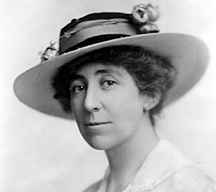 If women had held the preponderance of political leadership roles for the last few millennia, would peace have become more of a central organizing theme of history than war?
Jeannette Rankin, a Montana Republican and lifelong pacifist, was elected to Congress in 1916; that’s four years before the Constitution gave all women the right to vote. Not only did Rankin lead the way as a first for women, she defied all semblance of political tradition by opposing both World War I and World War II.
Rankin’s leadership style has many lessons for us today, especially since she did not shy away from controversy. The subject of Rankin’s very first Congressional vote (against President Wilson’s WWI war resolution) set the stage for her destiny. Rankin lost the support of most of the women’s suffragists who had campaigned for her, because they feared her anti-war vote made women look weak and hurt the suffrage movement. Embracing controversy can be tough when we ruffle the feathers of our opponents, but it’s even tougher when we lose the support of our closest friends and allies.
Read MoreOctavia Butler, A Pioneer In Science Fiction
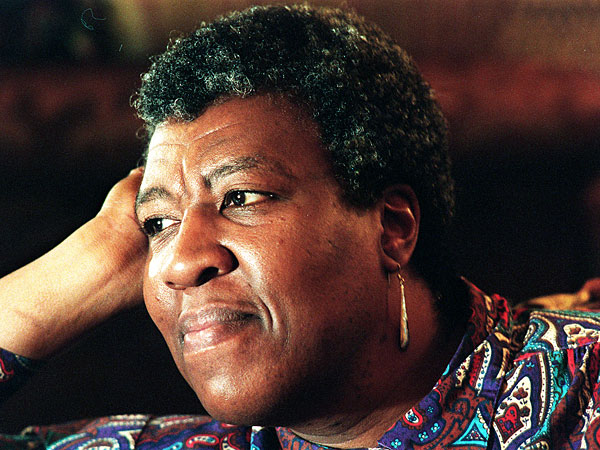 When an interviewer asked Hugo- and Macarthur-winning novelist Octavia Butler what she thought of her books being classed as science fiction, she said, “Really, it doesn’t matter. A good story is a good story.” Here is (some of) the story of Butler’s life.
Butler grew up in Pasadena, raised by a single mother who’d had to leave school after the third grade. Of her own early years, Butler has written,
At school I was always taller than the rest of my class, and because I was an only child I was comfortable with adults, but shy and awkward with other kids. I was quiet, bookish, and in spite of my size, hopeless at sports. In short, I was different. And even in the earliest grades, I got pounded for it. I learned that five- and-six-year-old kids have already figured out how to be intolerant.
But she also discovered writing at the age of 10 – she chose science fiction, she says, because “because it was so wide open. I was able to do anything and there were no walls to hem you in and there was no human condition that you were stopped from examining.” Her books – the first, Patternmaster, was published in 1976, and the last, Fledgling, came out in 2005 – did more than examine. They also reflected the deep inequalities plaguing America – and humanity as a whole — and sounded a warning for the future. Butler said her novel Parable of the Sower “calls people’s attention to the fact that so much needs to be done and obviously [there] are people who are running this country who don’t care.”
Read More