
Tucson Festival of Books
Tucson, AZ Sat. 3/12 @ 1:00 pm Panel discussion: “Women of National Influence” with Dr. Connie Mariano at the Tucson Festival of Books Taped by C-Span Books! My speech begins at 20:04. University of Arizona Campus Student Union Gallagher Theater
Read MoreWomen's History Open Thread: Fictional Role Models
 I’m thinking a lot about literature this weekend because I’m presenting on “Women in Leadership” on a panel with former White House doctor, Connie Mariano at the Tucson Festival of Books. Fictional characters can play a big part in our lives. Are there fictional women who have been fantasy role models for you?
Best of International Women's Day: Be a Front Porch Lady
How did you recognize the 100th anniversary of International Women’s Day March 8? If you haven’t yet signed the “Million for a Billion” petition to tell Congress you want them to fund international family planning and save the lives of so many women and children around the world, please do so here. This is one meaningful way to honor the women who founded IWD to promote equality for women, including the right to vote and hold public office. Another is to reach out to help another woman. Today’s guest post from Kathy Korman Frey, entrepreneur in residence at George Washington University School of Business and founder of The Hot Mommas Project tells just such a story. Read on, and keep reading for a roundup of some of the best of IWD posts:
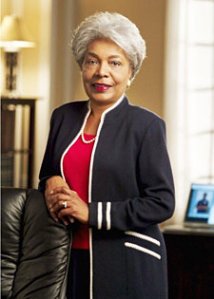 A dignified, beautiful, African-American woman stood at the podium during the Wake Forest Women’s Weekend. All eyes were on Esther Silver-Parker, one of the most senior former executives at Wal-Mart and now president of the Silver-Parker Group. Would she talk about women’s advancement to the C-suite? Would she share her secrets to success? That, she did. And one of them was not at all what we expected.
Silver-Parker grew up in rural North Carolina, in a two-bedroom house, with her parents and many siblings. She recounted a screenplay-like story about a group of women she called: The Front Porch Ladies. “The Front Porch Ladies were the women who sat on their front porches as we came home from school,” Silver-Parker said. “They would treat our business like it was their business.”
When Silver-Parker was accepted to college, imagine her surprise when the Front Porch Ladies showed up on her front porch. There they all stood, having brought with them a full set of blue luggage for her to take off to school. “From time to time at college, I would get letters from the Front Porch Ladies,” Silver-Parker told the audience. “They would write words of encouragement, and sometimes include a dollar or two.”
Read MoreThe Value of Women's Work
There has been a marked change in the estimate of [women’s] position as wealth producers. We have never been “supported” by men; for if all men labored hard every hour of the twenty-four, they could not do all the work of the world. A few worthless women there are, but even they are not so much supported by the men of their family as by the overwork of the “sweated” women at the other end of the social ladder. From creation’s dawn. our sex has done its full share of the world’s work; sometimes we have been paid for it, but oftener not.
Any idea when this statement was made? OK, a clue: I recently ran across it in a speech given by Harriot Stanton Blatch at a suffragist convention–in 1898.
 Isn’t it amazing that Blatch made this argument 113 years ago? Her point still resonates today. A study released by the Center for American Progress shows that in the down economy, women increasingly became the sole breadwinners, despite the persistent wage gap, since men were being laid off at higher rates to trim companies’ bottom line. More and more men became “stay-at-home fathers.” And yet we aren’t seeing a change in workplace culture as a result.
Edna St. Vincent Millay, First Woman Pulitzer Poetry Winner
 My parents started sending me to Mrs. Fred Day’s charmingly named “Expression” classes when I was three years old. There, over a period of seven or eight years, I learned at least one new word each week, practiced exercises intended to improve my posture and diction, was schooled (or at least she tried to school us) in the social graces of serving refreshments to my classmates, and memorized a variety of poems. Some of the lines that have lodged most memorably in my mind are those of Edna St. Vincent Millay. There was the cheery:
I will be the gladdest thing
Under the sun!
I will touch a hundred flowers
And not pick one.From “Afternoon on a Hill”
…and the dramatic:
All your lovely words are spoken.
Once the ivory box is broken,
Beats the golden bird no more.From “Elegy”
So when Bonnie McEwan of Make Waves sent me Millay’s poem, “Recuerdo,” along with a note that the poet who liked to call herself “Vincent” and took many lovers during her life, had been the first woman to receive a Pulitzer prize for poetry in 1923, I immediately conjured the sights and floral smells of Mrs. Day’s rather formal home in Temple, Texas – walking distance from my elementary school. She always wore her perfectly coiffed grey hair up and fastened with combs, and practiced the graciousness she patiently tried to teach all of us rowdy kids. She would have been Millay’s contemporary–a shocking thought to me now, since I think of the poet as fuzzy history while the teacher remains sharply drawn in my mind.
Read MoreOn International Women’s Day, Tell Congress to Fund International Family Planning

Check out today’s guest post on 9 Ways. It comes to us from The Population Institute. I highlight it because the 100th anniversary of International Women’s Day is being celebrated at events around the world today. The best way I can think of to celebrate IWD is to petition the U.S. Congress and other world leaders to make good on their commitments to fund international family planning. In No Excuses, I show why reproductive self-determination is essential for women to have any other kind of power. But the Republicans are trying to eliminate or drastically cut family planning funds in the U.S. and globally. The political and social justice consequences of such a short sighted policy are stunning.
Even if you don’t have time to read the whole post, please click here to sign the petition now. You’ll be saving women’s lives.
Watch this video called “Empty Handed” to see just some of the reasons why you’ll want to join me in signing the petition and become one of a million for a billion–telling Congress to fully fund international family planning:
Read MoreWe Need a Million for a Billion
Today’s guest post comes to us from The Population Institute. I highlight it because the 100th anniversary of International Women’s Day is being celebrated at events around the world today. The best way I can think of to celebrate IWD is to petition the U.S. Congress and other world leaders to make good on their commitments to fund international family planning. In No Excuses, I show why reproductive self-determination is essential for women to have any other kind of power. But the Republicans are trying to eliminate or drastically cut family planning funds in the U.S. and globally. Even if you don’t have time to read the whole post, please click here to sign the petition now. You’ll be saving women’s lives.
It’s time to hold world leaders accountable for their promises. Seventeen years ago world leaders gathered in Cairo, Egypt, and declared access to reproductive health care to be a universal right, but for many that right has not been realized. An estimated 215 million married women in the developed world want to avoid a pregnancy, but are not using a modern method of birth control. Tens of millions of young men and women are at risk of acquiring HIV/AIDS and other sexually transmitted diseases.
It’s time to make access to contraceptives and reproductive health care a reality, not just a right. Need another reason? By giving women the power to prevent unwanted and unintended pregnancies we save lives. Every year 365,000 women, many of them too young to bear children, die as a result of pregnancy-related causes.
“It’s Her Choice” – Really?
Thanks to Ann Crittenden for submitting this guest post, which was originally published at Moms Rising Ann shows that the politics and personal aspects of motherhood are very intertwined. Be sure to check out Ann’s book The Price of Motherhood for a more in depth look.
 I was struck recently by the persistence of an old argument used to kill the Fair Pay Act – and every other measure that would make life easier for mothers. You know it by heart: many women “choose” to earn less than men, and if they choose to earn less, then what’s the big deal about a little wage inequality?
This so-called “choice” argument can be superficially persuasive. Most women probably do prefer cleaner, relatively lower-paying jobs. Most women would rather be beauticians than coal miners, art teachers than mechanics. (Although this begs the question why teachers and beauticians earn so much less than mechanics and miners). Women working full-time often work fewer hours (for pay) than full-time working men. And in recent surveys, far more working women than men say they would prefer to work part-time.
Women, in short, are different from men. They’re just not as into dirt, long hours and making money. Maybe they are just …. more French!
But before you buy into this one, remember that those who benefit from the status quo always attribute inequities to the choices of the underdog. And women are still underdogs in the job market. Women working 40 hours a week still earn 86 cents for every dollar a man earns, a bigger gap than in many developed countries with more family-friendly policies. But if American women accept this willingly, then there’s nothing to worry about. It’s their choice. No one “made them do it.” So no one has to do anything about it.
Read MoreBreaking Barriers: Kentucky’s First Female African American Senator, Georgia Davis Powers
Kathy Groob, former elected city council member, publisher of ElectWomen Magazine, and partner at November Strategies political consulting firm contributed this inspiring article about Georgia Davis Powers, the first woman and first African American elected to the Kentucky state senate. It’s the first of a number of Women’s History Month guest posts I’m excited to share with 9 Ways readers.
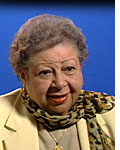 At the time, Georgia Davis Powers had no idea she had made history in 1968 by becoming the first woman AND the first African-American elected to Kentucky’s State Senate. All she knew was that she wanted to make a difference in her community.
It was never her intention to become a politician, or even to work in government, but in the spring of 1962 Powers was introduced to politics upon the suggestion of fellow church member Verna Smith. Upon Ms. Smith’s advice she joined the U.S. Senatorial campaign staff of Wilson Wyatt. This led to six more years of managing mayoral, gubernatorial, and congressional campaigns. She also became heavily involved in the civil rights movement, leading the Allied Organization for Civil Rights in promoting statewide public accommodations and fair employment law in the early 1960’s. In 1964, she was one of the organizers of a march on the capital in Frankfort in support of equity in public accommodations, in which Dr. Martin Luther King and baseball legend Jackie Robinson participated.
In 1964 she was the first black woman elected to the Jefferson County Democratic Executive Committee. But after two years she resigned after becoming discouraged by the fact that the Committee had not discussed a single one of her proposals.
In 1966 she worked in the bill room during the legislative session for the Kentucky House of Representatives. This gave her the opportunity to see first hand how government functioned; as a result her political ambitions grew.
Read MoreWomen's History Month Open Thread: Family Ties
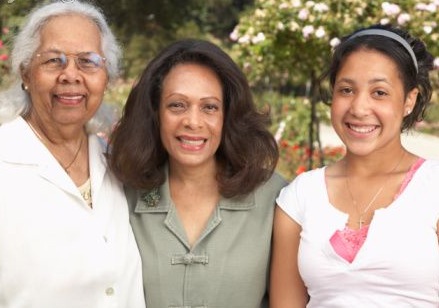 Many of us look to women in our family as our sheroes. Who are the women in your family who have helped shape you and how did they do it?