
Friday Round Up on Monday: What Was Your Anita Hill Moment?

It’s the 20th anniversary of Anita Hill’s truth-to-power moment (I’ll dub it Hill’s personal “power to” moment) confronting then U.S. Supreme Court Nominee, now Justice Clarence Thomas, that changed the culture’s understanding about sexual harassment forever. I delayed the Friday Round Up in order to share two important events that I participated in last week, along with a selection of related news reports and commentary.
Murmurs of recognition rippled across the sold out “Anita Hill 20 Years Later” conference in New York’s Hunter College Auditorium October 15 when conference organizer Letty Cottin Pogrebin (read her thank you message to Anita here) opined that every woman old enough to remember the Clarence Thomas confirmation hearings had probably experienced her own Anita Hill moment. (Stop here, readers, and conjure yours.)
- The moment when she realized there was something fundamentally wrong with the uninvited groping, touching, or sexualized comments she was being subjected to at work, on the street, at family gatherings.
- The moment when such behavior shifted in her mind from “just the way things are” to “sexual harassment.”
- The moment when she decided not to take it any more. For me it was not just one moment but a slow-growing awareness that I had cultivated the art of slithering away from unwanted male touches when I would be better served to call them out on the spot. And that I had the power to do just that.
- Here’s a sports journalist’s moment I encourage you to post yours in the comments section below.
- And I could not be prouder of young feminists Jamia Wilson (now Vice President of Programs at the Women’s Media Center) and Julie Zeilinger (founder of the f-Bomb blog) declared that the next generation carries on the fight for social justice across gender and race.
 Hill’s “Power To” Moment Changed Everything
The term “sexual harassment” as a legitimate subject for prosecution entered the public lexicon because Anita Hill courageously described to the Senate Judiciary Committee and, via television to a riveted world, unseemly behavior she had experienced while working for George H. W. Bush’s nominee for the highest court in the land, Clarence Thomas.
INTENTIONING
Sex, Power, Pandemics, and How Women
Will Take The Lead for (Everyone’s) Good
The new book from Gloria Feldt about the future, taking the leadership lessons learned from this disruption and creating a better world for all through the power of intention.

The shabbiness of Hunter’s auditorium contrasted with the elegance I remembered Hill exhibiting when she calmly faced the then all-male (it was 1991 after all!) and seemingly all-powerful Judiciary committee. Watch the hearing clips near the beginning of the c-Span conference video above. The senators behaved even more assholishly toward Hill than I remembered.
 What Has Been the Impact of Anita Hill?
This piece in The Root by Robin D. Stone describes the impact of Hill’s battle on the next generations of women.
Linda Meric, Executive Director of 9to5, National Association of Working Women, says harassment persists despite the advances.
Even Saturday Night Live got into the act — parody being a sure sign that something big is taking place in the culture. .
I told over 200 women lawyers and judges assembled at the South Carolina Women Lawyers Association “Women Lawyers and Leadership” Conference last Friday (check out the amazing panel I was on with Vickie Pynchon, Gloria Steinem, Jamia Wilson, and Shelby Knox), that Joe Biden would not be vice president today if he had not mended the egregiously sexist behavior he exhibited as Judiciary Committee chair. Political pressure from women’s groups in the wake of the Thomas hearings led directly in my view to Biden’s sponsorship of the 1994 Violence Against Women Act.
Because that’s how things work in politics. Like the laws of physics, every action creates an equal and opposite reaction, and Biden knew his political future depended on mending fences with the women and politically organized women’s groups that were beyond outraged at how Hill, and by extension, they, had been treated by the committee. In fact, the blowback was so immediate and strong that within a month after the hearing, Congress passed a law allowing sexual harassment victims to seek reparations including damages, back pay, and reinstatement if they had been let go.
 We Still Believe Anita Hill—and Take Action
Though Biden voted no on Thomas’s nomination he had pushed the hearings to a quick conclusion without allowing testimony from additional women who wanted to testify that they had also been sexually harassed by Thomas.
I sat with friends Nancy Becker and Ruth Mandell at the Hunter conference. They said that many women had told them things are worse due to Anita Hill raising the issue of sexual harassment. That’s a common fear-based reaction.
But one measure of progress is documented in the 10/21/11 New York Times editorial “Sexual Harassment 20 Years Later.” Despite warning that because of how Hill had been publicly treated by the senators, fewer women would come forward to report sexual harassment, claims increased by 50 % the year after the hearings.
And in FY 2010, claims of sexual harassment brought to the E.E.O.C. and state and local fair employment commissions were almost double that of 1991. And new organizations like Hollaback! are springing up to empower women—and men—who are sexually harassed on the street or elsewhere.
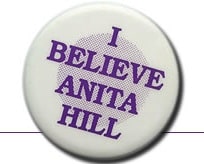 In South Carolina, the night before the SC Women Lawyers’ conference, I had the pleasure of attending the 20th annual “We Believe Anita Hill” party that started the year of the Thomas hearings and this year was headlined by Hill herself and drew over 500 women and a few men. These words from their history are the important part—a call to action which is the best way to honor Anita Hill’s legacy:
A group of local women who shared the outrage wanted to channel the energy of those many powerful women. Early efforts involved women’s policy work, lobbying on women’s issues, and political campaign organization…The Anita Hill Wake-Up Call Anniversary Celebration is an annual reminder of the outrage, of the effect of the different perspectives of men and women, of the need for more women in politics and other policy-making positions, and of the need to get involved, to stay involved, and to stay in contact with other strong women of all ages and backgrounds.

GLORIA FELDT is the New York Times bestselling author of several books including No Excuses: 9 Ways Women Can Change How We Think About Power, a sought-after speaker and frequent contributor to major news outlets, and the Co-Founder and President of Take The Lead. People has called her “the voice of experience,” and among the many honors she has been given, Vanity Fair called her one of America’s “Top 200 Women Legends, Leaders, and Trailblazers,” and Glamour chose her as a “Woman of the Year.”
As co-founder and president of Take The Lead, a leading women’s leadership nonprofit, her mission is to achieve gender parity by 2025 through innovative training programs, workshops, a groundbreaking 50 Women Can Change The World immersive, online courses, a free weekly newsletter, and events including a monthly Virtual Happy Hour program and a Take The Lead Day symposium that reached over 400,000 women globally in 2017.
No Comments
Leave a Comment
You must be logged in to post a comment.
Thanks for the great write up, Gloria. My Anita Hill moment occurred in my law firm as lawyers, secretaries, paralegals, word processors (the human kind) and other legal staff filtered in and out of a partner’s office where the television was delivering the hearings to us all day long. As women and men broke up into separate conversations in the firm, the usual legal “class” boundaries in law firms (partners w/ partners, associates w/ associates, secretaries with secretaries) broke down completely. All women were on the same page and whispering the same stories to one another. All women believed Anita and all of the men thought the hearings themselves were an outrage. That was the first time I realized that we women were living in an entirely different world from the men with whom we worked every day.
It wasn’t just the few predatory harassers, but ALL of the men who believed our complaints were “silly,” “disrespectful,” beneath contempt. I’d been harassed but I’d never realized just how little the men respected us, still, as late as 1991, eleven years after I entered the legal profession as a lawyer. That moment didn’t change much in the law firm, I have to tell you, other than a wall of bitterness and forced sexual harassment training that no one respected. Now, I encourage everyone, men and women, to ask themselves whether they’re happy with the way they are disrespected or mis-identified in the workplace.
Having a law and workplace policies in place for the worst offenders is necessary and good. But until we start talking with one another about these now taboo subjects (race, gender) in the workplace, we’ll never move beyond the grade school level exhortations (don’t bully Janie, Billy) that pass for sexual harassment education for adults.
Vickie, I so concur with your conclusion:
“Having a law and workplace policies in place for the worst offenders is necessary and good. But until we start talking with one another about these now taboo subjects (race, gender) in the workplace, we’ll never move beyond the grade school level exhortations (don’t bully Janie, Billy) that pass for sexual harassment education for adults.”
But I’d add “sex” to those taboo subjects.
Thank you so much for including me in the SC Women Lawyers conference panel. It was an amazing experience all around. And you were/are a superb panel facilitator.
It still galls me that Clarence Thomas sits on the Supreme Court. This criminal had the gall to trash Anita Hill in his memoirs as a tool of liberal activists, while his wife had the gall to ask Ms. Hill for an apology! Evidently neither even thinks he did anything wrong. Unfortunately in the eyes of too many men, sexual harassment, like rape, is only wrong if they do not get away with it, and Clarence Thomas did.
Thumbs up, Aletha.
I loved this comment from Madge Stein Woods on my Facebook fanpage, who said her Anita Hill moment was: “That she was telling the truth.”
Thank you Gloria. 🙂 YOU are the inspiration! Your example has had a tremendous effect on me and many others. Thank you for your fierce fearlessness. Love, Jamia
Aw shucks, Jamia! You are an inspiration to me, and I can’t tell you how many women came up to me after the panel and said how inspired they were to see young women like you and Shelby who are so passionate about social justice.