
Dueling Reviews of No Excuses: Which Do You Think Has It Right?
 Within hours of one another, two Google alerts bearing reviews of No Excuses hit my inbox. One reviewer lauded it, and the other skewered it.
“That’s what makes horse races,” I shrugged, recalling my father’s way of telling me differences of opinion are to be expected.
Then I reread both articles. And I realized that their diametrically different worldviews of women’s relationship with power reflect precisely the historic crossroads moment that had inspired me to write the book in the first place.
I was excited when asked to be interviewed for the Feminist Review, now known as Elevate Difference, by lawyer and global crusader to eliminate violence against women. Dianne Post and I originally met decades ago, because of our respective Arizona residency and involvement in women’s social justice issues. I recalled her as a bit of a contrarian but a passionate advocate for women. I was delighted to reconnect with her–so much so that after we spoke, I invited her to address my Arizona State University class on “Women, Power, and Leadership.”
During the interview, Post challenged my thesis that while some external structural barriers remain, women in the U. S. are at a moment in history where doors are open and it’s up to us to walk ourselves through them; that to embrace our power to do so, we must—and are able to–consciously overcome the remaining barriers, many of which are culturally learned, internalized ones.
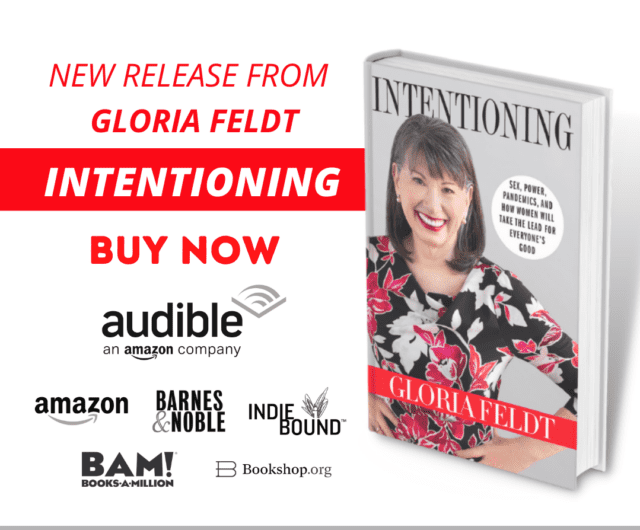
INTENTIONING
Sex, Power, Pandemics, and How Women
Will Take The Lead for (Everyone’s) Good
The new book from Gloria Feldt about the future, taking the leadership lessons learned from this disruption and creating a better world for all through the power of intention.
So I wasn’t surprised when her acknowledged bias turned up in the review—understandably, seeing women as victims is an occupational hazard. And it’s a perspective that was accurate during the heady days of second wave feminist revolution, in which we both participated. Forty years ago, there were so many unjust laws to change and policy barriers to break.
The second review Google popped out was posted on the Changing People blog of Jane C. Woods, a women’s personal development specialist who viewed the world from a completely different lens.
Woods—whom I do not know, but who appears to be from a younger generation than I–got precisely what I was talking about when I said the revolution is unfinished, but has brought many profound changes which in turn open up an era of opportunity such as women have never had before. And thus it is our responsibility to use the power in our hands for good—ours and society’s.
She resonated with my optimistic approach, and appreciated the specific 9 Ways tips and tools in No Excuses, gleaned from my own experience as well as interviews with dozens of women and current research. Again, not surprising since she describes her professional aim to “help you deal with whatever life throws at you, whatever changes there may be, and know that you can always be in control!”
Where Post perceived blame, Woods perceived inspiration. Where Post perceived external barriers, Woods perceived possibilities.
Ironically, the representation of No Excuses by an esteemed colleague in feminist arms emanates from an outdated male-dominated, hierarchical, power-over framework. In that view of the world, power is finite. If I take a slice of pie, there’s less for you. So I have to stay in adversarial mode all the time or I will be a victim.
In contrast, Woods seems to share my more expansive idea, of redefining power as the power-to: to accomplish great things in the world, an infinite resource, enlarged rather than diminished by being shared.
These dueling book reviews, both from people I admire and respect, perfectly illustrate the crossroads women stand at today. What direction will we take? Will we remain mired in a victimhood self-perception and spend our energies in a Kabuki drama with shadow enemies from the past? Or will we take another path, with a vision of women becoming unlimited, in a place where we can stand comfortably in our power and walk with intention toward a better world for ourselves and others?
My passionate hope is that we will take the second, more powerfull road. Because in the end, whether you think you can make fundamental social and personal change or not, you are probably correct.
I encourage you to read both reviews and let me know what you think. Am I overly optimistic? Not radically optimistic enough? What encourages and inspires you to embrace your power? Which way do you think women will women choose to go at the crossroads?
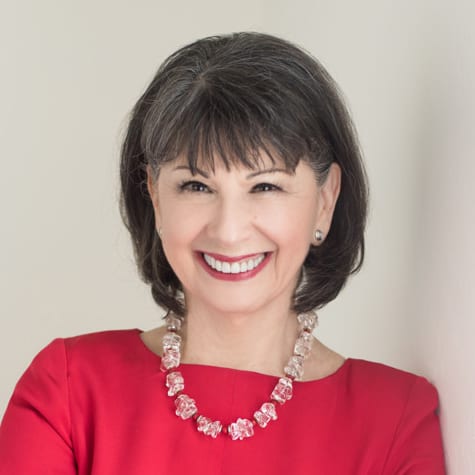
GLORIA FELDT is the New York Times bestselling author of several books including No Excuses: 9 Ways Women Can Change How We Think About Power, a sought-after speaker and frequent contributor to major news outlets, and the Co-Founder and President of Take The Lead. People has called her “the voice of experience,” and among the many honors she has been given, Vanity Fair called her one of America’s “Top 200 Women Legends, Leaders, and Trailblazers,” and Glamour chose her as a “Woman of the Year.”
As co-founder and president of Take The Lead, a leading women’s leadership nonprofit, her mission is to achieve gender parity by 2025 through innovative training programs, workshops, a groundbreaking 50 Women Can Change The World immersive, online courses, a free weekly newsletter, and events including a monthly Virtual Happy Hour program and a Take The Lead Day symposium that reached over 400,000 women globally in 2017.
No Comments
Leave a Comment
You must be logged in to post a comment.
Thumbs up for posting opposing reviews – way to “embrace controversy.”
I think that the Woods review mirrored my opinion of No Excuses pretty closely. I thought the books had really practical strategies for implementing a “power-to” approach. Some of the power tools resonated with me more than others – know your history, define your terms, use what you’ve got, and employ every medium were the tools that I found the most useful.
Yes, there are still structural issues that need to be addressed (reproductive health care is the biggest issue that pops into mind) – but I think it would be disempowering to say that women haven’t made progress.
It’s very hard to change a culture while you’re living in it. I think that’s what makes it so challenging for people who have been fighting the good fight for so many years to change their patterns and realize they now have more power than they think. For me, researching and writing No Excuses was very helpful in that way. I’m curious to know how much of a generational divide there might be in these perceptions. Thoughts?
Ms. Post made some observations that resonated with me, and others that did not at all, for instance her example of a “practical method” you did not mention, “fighting for quotas in political parties.” That might be of value in nations with more than two major parties, but here? I think it is far more practical for women to have a party of our own. I know, you did not mention that either, but my point is that the goal of a quota in political parties presupposes that it is possible for women to achieve parity by working within the existing political structure. In terms of numbers, perhaps, but the existing political structure will not transform anything unless forced to do so, and until the culture itself is transformed, its guiding principles will not be changed.
I also thought Ms. Post drew some false dichotomies and confused herself (for instance, about collaboration). However, I do recall wondering about your analysis of the relationship between Philip Roth and Claire Bloom, and smiling. I consider smiling a double-edged sword.
Well hello Gloria! ‘Woods’ here.
I think there is a difference between US and UK but I had always thought US maybe was more advanced with the feminist cause than us? Apart from the terrible maternity leave arrangements you have!(Although I am too old to have ever qualified for any of ours-each time I had to leave and start again.
I think the reviews and your book mirror the current state of feminism. It feels to me like we are at a tipping point. I work with many younger women (I am not sure what age you are but I am 55) who tell me there is not a problem now and sometimes, I suspect, regard me rather as a rather quaint old feminist. They tell me there is no longer a problem, they feel very equal; I wish that were true. The stats tell us otherwise.
I didn’t agree with everything in your book but I loved that it challenged me to think again. I am with Avivah Wittenberg-Cox in that I think for too long we women have tried to fit a mould designed for us by men. What I took from your book was time to challenge that, or maybe stop hiding behind that? Grab what we can and run with it.
I am particularly intrigued by latest research from UK that shows a lack of confidence is holding women back from grabbing a seat on the board. In my work I find that to be true but I also think women don’t like the way boards are structured, how they function. Is that true in US? You are a much younger country than us http://www.changingpeople.co.uk/2011/if-women-ruled-the-world/
So, how much of a generational divide and how much of a cultural divide?
Jane, thanks for weighing in! I’m 68, so I’m smack in the middle of second wavers. In my reading of the popular literature these days, I get the impression that you in Britain are way ahead of U.s. feminism, that the ideas and ideals of women’s equality are more integrated into the culture. A comparison with some data would be intriguing. It might just be the grass is greener on the other side of the pond effect.
The lack of confidence is probably quite similar among women in both countries. In No Excuses, I argue that this is more likely lack of intention, not having been socialized with the same sense of intentionality about making a mark in the world, and in fact being the rightful owners of the world, as men are.
I understand how younger women can think problems are all solved, because they have seen a first woman almost everything and women have made such strides. They will soon come face-to-face with a system that as you say, they did not create. And they will start searching for authenticity when they hit middle age. Then what?