
Posts Tagged ‘leadership’
“Real” TED and TEDWomen: What’s Next?
I’ve been meaning to cross post CV Harquail’s excellent wrap up of the TEDWomen conference and the panel held in New York to discuss ways of fostering greater inclusion for women, people of color, and ideas that have not traditionally been chosen by the TED curators. Here is it is, full force and unedited.
My only additional comment is to suggest that the value of the controversy that emerged from TEDWomen has been significant. I hope that by raising consciousness we have opened up a path for gender parity in all such conferences and other “thought leader” events. Because after all, women do have at least half of the big ideas!
I’d love to know your thoughts now that the conference is over and we’ve all had some time to process it.
“Building on TED and the TEDWomen Conference: How Can We Make Conferences More Inclusive?”
We made a big start towards answering this question at our roundtable conversation after the TEDx636 NYC/ TEDWomen simulcast event. Our panel, organized by Natalia Oberti Noguera and sponsored by NYWSE, included Brittany McCandless (moderator), Adaora Udoji, Liza Sabater, Ritu Yadav, and me.
 This post offers my personal, subjective summary of the conversation and the actions steps that were recommended. As my fellow participants, organizers, and allies share their perceptions of the event and ‘next steps’, I’ll share these ideas and resources too.
Although our panel was diverse in terms of age, expertise, professional domain, culture, and racioethnicity, we shared the same over-arching goal: inclusivity and diversity not only at conferences, but also in the larger ‘world of ideas’.
Read MoreEmbracing Controversy Means Standing By Your Convictions
 Tuesday’s elections were disappointing, to say the least, for me as a progressive woman. But this isn’t the time to throw up our hands in defeat. It’s time to regroup and lead ourselves forward. Today I listened and tweeted up with the Name It Change It campaign. I learned that their polling data backs up my contention that it’s a good thing to embrace controversy, rather than run away from it, if you’re a woman in politics (Republican or Democrat–as pollster Celinda Lake commented “Sexism is one of the very few bipartisan things”).:
Read MoreCelinda Lake, of Lake Research Associates, spearheaded research measuring how gender-based attacks negatively affect voter perception of female candidates…Lake explains, “Up until this research was conducted, I often advised women to ignore toxic media sexism. But now, women candidates are equipped with evidence that shows they can recover voter confidence from sexist media coverage by directly addressing it, and standing up for all current and future women leaders.”
It’s Time for Women to Step Up

Nicole Baute from The Star asked me to share some of the central messages of No Excuses when she interviewed me last week. Here is an excerpt from that interview.
You called your book No Excuses. Do you think that women are coming up with excuses for why we aren’t getting a little more power and a little more pay?
The honest truth is that my title was Unlimited and the publishers made me change it. They wanted something more controversial. I tend to take the positive approach. I think this is the moment for women, but I did want to sound a clarion call to women to say, this is a moment, but you have to take it. Things won’t just happen.
Why would you have preferred Unlimited?
Because I am hopeful, I am optimistic and I believe that this is just an incredible time for women.
Why is now an incredible time?
Well, the rest of the world knows it. I’m not sure we always do. For example, the World Bank has done studies that found that Parliaments that have 30 or 40 per cent women on them make better decisions, they have less corruption, the performance is better. Marketers know that women buy 85 per cent of the goods.
That old thinking, why is it still persisting?
Read MorePower Tool #3: Use What You’ve Got
 In No Excuses, I share this dream I had one night. I was in my out of control speeding car, and I couldn’t stop it. I slowly realized the keys to the car were in my hand, and they had been all along.
You don’t have to sit in the shrink’s office to figure out the metaphor in that dream! Have you ever had a similar experience?
To be able to use power, the first thing you’ve got to do is realize that you have it. I’ve found in personal life and in meeting challenges at work that what you need is usually there if you can only see it and have the courage to use it.
Here are just a few examples women shared with me about how to use what you’ve got:
Read MoreWomen’s Leadership Takes Center Stage at 2010 Bioneers Conference
It was such an honor to speak at the 2010 Bioneers conference, where I presented my keynote address, entitled “Riding the Leadership Wave.” I also participated in two panel discussions about women and leadership, which is no surprise, since women’s leadership took center stage at this year’s conference.
 |
 |
 |
 |
Top Left: Author and Jungian analyst Jean Shinoda Bolen, leading the charge for a 5th World Conference on Women
Top Right: Gloria and my shero Jane Goodall, legendary primatologist and anthropologist
Bottom Left: Bioneers co-founder Nina Simons, Kirwan Institute executive director John A. Powell, and Gloria–relaxing after the keynotes
Bottom Right: The illustrious Bioneers panel on Women, Gender and the Media: (left to right) Rose Aguilar, Aimee Allison, Gloria Feldt, Dori Maynard–all of us Women’s Media Center Progressive Women’s Voices alumnae
Read MoreWhat Does Power-To Look Like?
On Monday I asked you when you first realized that you had the power to . . . And I gave you a brief glimpse at my definition of what power-to looks like. Here’s another look at what power-to means:
Power-over focuses on tactics for gaining compliance, while leadership focuses on getting answers and solutions in order to be able to accomplish something for mutual good.
Power-over makes people feel powerless. Even if it isn’t force or brute power, but a manipulative power such as political dominance, the feeling that one has no control over one’s choices makes her disgruntled, angry, or passive-aggressive.
Power-to makes us feel powerfull.
Power-to supports and enhances whatever power the individual brings to a project, workplace, relationship, or civic activity. It abhors coercion. It opens up the possibility of choices; the ability to choose is what makes us human. Choosing is the basis of morality.
Power-over is amoral. Power-to is responsibility.
Power-over is oppression. Power-to is leadership.
What are your thoughts about this definition? How does it change your ideas about power and leadership? Can you give examples of the use of either definitioneof power?
Read MoreWhat Does Power-To Look Like?
On Monday I asked you when you first realized that you had the power to . . . And I gave you a brief glimpse at my definition of what power-to looks like. Here’s another look at what power-to means:
Power-over focuses on tactics for gaining compliance, while leadership focuses on getting answers and solutions in order to be able to accomplish something for mutual good.
Power-over makes people feel powerless. Even if it isn’t force or brute power, but a manipulative power such as political dominance, the feeling that one has no control over one’s choices makes her disgruntled, angry, or passive-aggressive.
Power-to makes us feel powerfull.
Power-to supports and enhances whatever power the individual brings to a project, workplace, relationship, or civic activity. It abhors coercion. It opens up the possibility of choices; the ability to choose is what makes us human. Choosing is the basis of morality.
Power-over is amoral. Power-to is responsibility.
Power-over is oppression. Power-to is leadership.
What are your thoughts about this definition? How does it change your ideas about power and leadership? Can you give examples of the use of either definitioneof power?
Read MoreWas There a Moment When You Knew You Had the Power To?
Most high school debaters can tell you that the first person to set the terms of the debate usually wins. That’s because when we allow someone else to define the terms, we allow them to set the framework that constructs our thoughts. Just think about how power has typically been defined, as an oppressive power-over model. If we shift the definition of power to a power-to model, suddenly the discussion is about leadership, and the ability to get things done. As I say in No Excuses.
Almost anyone can employ power-over, but it takes skill to employ power-to. It takes a skill to lead others rather than to force, requires, coerce, or lord over them. Leadership power is much different from the use of force to gain acceptance of a goal.
Watch feminst icon Gloria Steinem, CODEPINK founder Jodie Evans, young feminist leader Shelby Knox, El Diario/La Prensa editor-in-chief Erica Gonzalez, and others talking about their power-to moments, both personal and interpersonal.
Was there a moment when you knew that you had the power to . . .(you fill in the blank)? What was it? And how did you feel? What did you do? If you didn’t have one moment, was there a process that led you to that awareness? What can you share with other women that might help them on their journey?
Read MoreThe Stanton-Anthony Lecture Series
 |
I had the great honor of keynoting the Susan B Anthony/Elizabeth Cady Stanton Lecture at the University of Rochester’s Meliora weekend, October 15, 2010. As you can see, I got into the spirit by wearing my Susan B. Anthony outfit, black clothing with a red shawl. The 19th century women’s civil rights leader always wore black and her red shawl became her identifying trademark. |
Blogher 2010 Conference
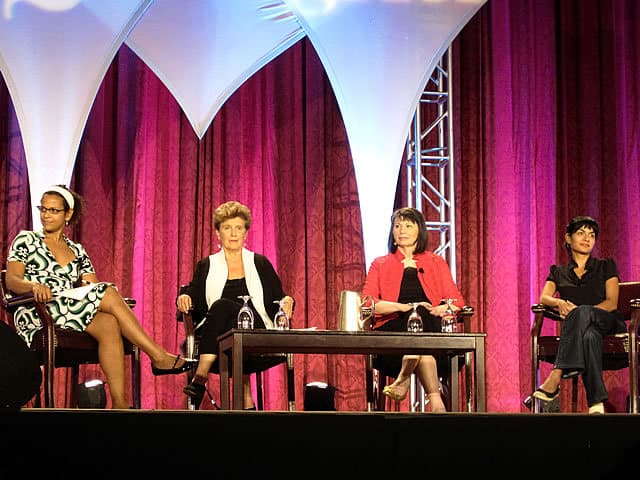 At the 2010 Blogher Conference, I was a keynote speaker on closing panel, called “How to Use Your Voice, Your Platform and Your Power.” Need to Know PBS anchor Alison Stewart moderated a powerhouse panel: Marie Wilson, Founder and President of The White House Project (and creator of Take Our Daughters to Work Day), and P. Simran Sethi, Emmy Award-winning journalist, blogger and environmentalist.
Empowerment is a constant theme at and on BlogHer. All signs point to others recognizing our power – as a group and as a demographic. How are we leveraging that power as individuals? How should we be?
Now that we know marketers and advertisers seek the opinions of women (who make over 80% of consumer purchases) and their blogs, how can we control what we are being sold? Now that we know having a unique presence online has turned us into “personal brands,” how can we use it to our best professional advantage? Now that we’re each part of the large BlogHer community and many sub-communities, how can we harness and strategically focus that collective power? How and when and for what can and should we turn on the power spigot?
Read More