
Politics
The Young Politica: After the Fiscal Cliff, What?
For now, it seems that the fiscal cliff crisis has been temporarily adverted. The Senate and House approved the American Taxpayer Relief Act of 2012, which has prevented old budgeting from sending the country hurtling down the Fiscal Cliff.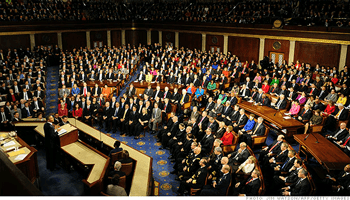
But don’t get too excited. The battle isn’t over and in some ways it’s just beginning. The new deal, which is designed to keep our economy from another recession, increases taxing on the wealthy but has temporarily halted many changes in government spending.
In further detail, here’s what some of the new bill entails:
- Tax rates will increase for taxpayers with incomes higher than $450,000
- Changes in estate taxing was adverted
- Middle class has an extension on stimulus tax cuts
- Capital gains taxes increase to 20% for high earners
- Some estimates say the deal will provide bout $600 B in revenue over the next 10 years.
However, there’s been no real agreement on what should be done about government spending cuts.
Read MoreThe Young Politica: Five Wishes for the New Year
As we sing the last hoorahs of 2012, young politicas and politicos everywhere may feel a bit of uncertainty over where the next year is headed. We’ve seen many victories for our interests, but what will newly elected policy makers do to ensure that they earn their keep? 
And what’s next for us?
Here are my five hopes for young people and politics in 2013.
1. For young people to go from special report to necessary demographic in national media.
It seems that the results of the November election came as a shock to the media and pollsters. We have proved that we swing elections and that we here to stay. And our age group piques the interests of many demographics.
I hope that instead of getting a special write up in Huff Post College, we will make it to the front page.
2. For young people to remain politically active.
In the coming year, young people must remain engaged with the political process in order to remain relevant. Just as the media remembered us in the 2012 election, they can as soon forget about us in 2013!
Read MoreThe Young Politica: Dissecting The Susan Rice Conundrum
Before the November elections, Secretary of State Hillary Clinton had already forthrightly assumed responsibility for the Benghazi debacle that resulted in the death of four Americans including much-admired Ambassador Chris Stephens’
But neither her statements nor subsequent departures of State Department officials has quieted the echo chamber of blame. The buck stops at the top, and an independent panel report found plenty of buck to lay on Clinton’s desk. She must own and start to fix the problems of inadequate security at US embassies before she departs.
Still, it’s hard to see the trashing of Susan Rice and the subsequent GOP drumbeat about Hillary Clinton as anything other than blatantly intended to discredit her stellar performance on the world stage this past four years and to mortally wound her candidacy (previously declared unbeatable by Newt Gingrich should she make a second presidential run in 2016.
As Meagan Vazquez points out in her “Young Politica” column below about Susan Rice, the facts are never just the facts but rather come laden with political and cultural meaning.
And by the way, I’m thrilled to tell you that Maegan is going to continue her column into the new year! So if you are one of the many followers of this smart column from a student’s point of view, we’ll return to publishing it on Mondays in 2013. See you then!

After the initial boredom post-election, the political media immediately focused on the eminence of the fiscal cliff. Since those talks are still going nowhere, media sought a new subject to sink their teeth into: Susan Rice and the secretary of state bid. Rice, who was being vetted to take over Hilary Clinton’s role as Secretary of State, has been the subject of scrutiny by some for being the ill-informed messenger to national media after the Benghazi terrorist attacks.
Read MoreThe Young Politica: Why Be Politically Active After Elections
Now that the election is over, many young voters will likely retire their ‘concerned citizen’ badge until presidential primaries start up again. Being a politically active young person, however, is more than just voting for a president. There have been dramatic repercussion in the last four years due to youth voter inactivity between presidential elections.

In our own instant gratification generation psyche, many of us thought we had already created change by electing one man into the U.S. presidential seat. When it came to the midterm races in 2010, there was a 60% youth voter decline from 2008.
If more of us would have voted in 2010, perhaps there would have been tremendous changes. Perhaps the youth vote would have decided the election like it did in 2012.
Isn’t the rip-and-tear of the House over the past two years, all the ‘gridlock’, worth taking a stance?
Read MoreThe Young Politica: Dropping Down the Fiscal Cliff
Since the U.S. reached the debt ceiling in late 2012 and the country’s credit rating was downgraded for the first time in history, talks of reaching a fiscal cliff have loomed.
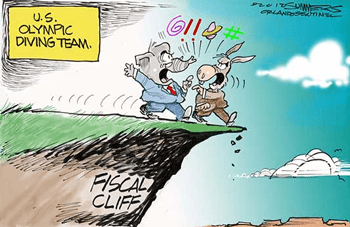
The fiscal cliff is a term used to describe what will happen after the start of the new year if there is no budget reform. If Congress does not reach a deal extending tax cuts by the time the Budget Control Act of 2011 goes into effect, taxes will be raised for anyone in the workforce. The result may be another recession.
How can it affect you?
If congress does not reach a deal, $661 billion in new tax hikes will start affecting your first paycheck (a two percent increase) after January 1st. On January 2nd, $78 billion in sequester hikes will begin cutting on some government and private sector workforces, likely causing layoffs and budget cuts.
How can this problem be solved?
Read MoreThe Young Politica: The Generational Communication Gap
In recent U.S. presidential elections, there has been a bipartisan effort to engage youth voters. The effort has been seen in candidates’ web/social media efforts, the recent upsurge of multi-party activism on campus, and the growth of youth organizations promoting youth political involvement.
It’s quite a change, given that we college students were more likely to be shooed away from the speaking platform in the 1960’s and 1970’s.
Read MoreMargaret and I Did It: My Interview with Sanger Papers Project
The post-election buzz is all about how 2012 was a pivotal year, the demographic shift toward non-white voters and millennials finally kicked in, women finally exercised their electoral power, and yada yada. This is true, and we deserve to celebrate for a few minutes.
But elections come and go, pendulums swing, and no shift happens by itself—people have to make it happen.
That’s why social movements are forever, if they remain relevant and keep them. I was honored to be interviewed by NYU’s Margaret Sanger Papers Project regarding my views of the woman who started the American Birth Control Movement and the organization that would become Planned Parenthood, her work, and what I learned from her leadership. Here you go—let me know what you think.
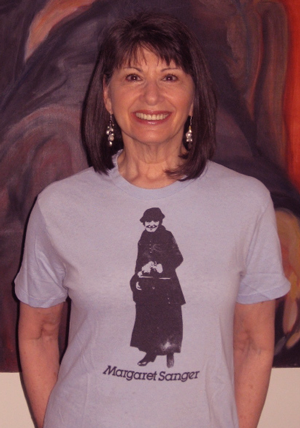
Gloria Feldt: I relate to the hardships of young parents. I have been driven by a passion that my daughters and all future generations of women should have the information, aspiration, and access to birth control and abortion services that give them the ability to determine the course of their own lives. Like Margaret Sanger, I believe biology should not be destiny and no woman can call herself free till she can own and control her own body. The birth control pill represented that liberation for me. It enabled me to start college and build a career. And to become financially independent–economic justice is the second factor, after reproductive rights, women must have to be full and equal citizens, but you can’t have that unless you can make your own sexual and childbearing decisions.
Read MoreThe Young Politica: The 2012 Youth Vote
After a low youth voter turnout in 2010, projections for the youth vote in 2012 seemed to be less than that of the momentous turnout in 2008. 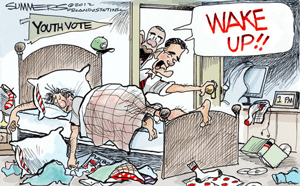 Democrats made it a point to make the youth vote become an important factor in the 2008 election, but as many students, saw soon after inauguration day, change didn’t come as easily as we had expected. To many voters’ surprise, the youth vote was higher in 2012 than it was in 2008.
Paul Ryan’s dig on fading Obama posters may have been a bit extreme, but it did shed light on the election’s youth voter’s perspective, and the voter climate overall. Would the next four years be worth the another Obama term? Would change for our generation be financially sustainable?
This election was far different from the 2008 election that promised some generic change. It wasn’t about who had the spiffiest graphics or best campaign t-shirts. It was about our future, about how much we would have to pay in loans after college, about what jobs we could find, and about what our futures would shape into.
Read MoreSex and the Married General: 3 Reasons Petraeus Had to Go
When CIA director David Petraeus stepped down from his post, citing an extramarital affair, the political birds of prey immediately started talking about who should replace him. And the usual battleground map was drawn.
On the one side are those who say any leader caught in such a compromising position has to go. On the other side are those who contend private consensual sexual behavior is just that and as long as it is not interfering with a leader’s ability to do the job, it should not factor into whether he or she remains in power.
Petraeus’s romance with his biographer and former military officer, Paula Broadwell, is hardly a new circumstance in American politics.
General Dwight Eisenhower had a well-known affair with his driver while commanding the US Army in Europe, and this did not prevent him from becoming president. Franklin Roosevelt had a long-running affair with Lucy Mercer while he was president without any hints that he should resign the presidency. JFK was a well-known womanizer, including in the White House. And then of course there is Bill Clinton who despite his foolish high risk dalliance with Monica Lewinsky handily won reelection and remains (perhaps second only to his wife) the most popular politician in the country.
So you might think I am going to defend Petraeus. Most definitely not, for three reasons.
Read MoreTwo Generations Dissect Election 2012 and What’s Next for Women’s Rights
On election night, journalism major Maegan Vazquez joined about one hundred fellow New York University students over the beer soaked floorboards of Brad’s, a popular site for locals and college 20-somethings alike. Keenly interested in politics, she’s been writing a terrific weekly column for my Heartfeldt Blog, titled “The Young Politica.”
Across town, I chatted with a couple dozen men and women at my friend Loretta’s Upper East Side apartment. As guests slipped into spaces on the elegant couch and chairs, like the old game of Sardines, each sighed, “I’m so nervous about the outcome of this election.”
Nov. 7, 2012 – New York, USA – Young women celebrate the result of the 2012 US Presidential election at Times Square in New York, USA, 07 November 2012. Democratic President Obama defeated Republican candidate Mitt Romney in the US elections. Photo: Rainer Jensen (Credit Image: © Rainer Jensen/DPA/ZUMAPRESS.com)
The pundits had us convinced that what turned out to be a rout would be a cliffhanger.
Read More