
Gender
Dali Time Happy New Year
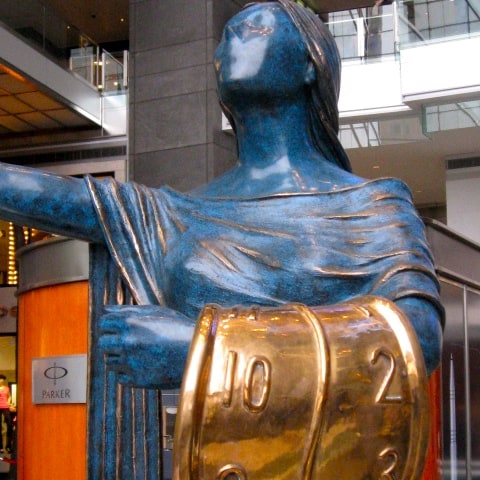 There’s a wonderful exhibit of surrealist Salvador Dali paintings and sculptures in New York’s Time Warner Center. They’re so alluring, they’re even upstaging the huge Botero Adam and Eve sculptures that attract much photo-snapping of people grinning slyly at Adam’s eye-level penis.
I am mesmerized by Dali’s clock sculptures. They drip time, melt time, warp time. Juxtapose fast and slow passage of time, or rather tease us for thinking such mundane distinctions exist. Apparently Dali agreed with Albert Einstein that time exists only so that everything doesn’t happen at once.
Read MoreStories Heal, Stories Connect, Stories Matter
Your heartfelt responses to Amy Ferris’s extraordinary post “I Matter” tell me I’m not alone in being moved by it. Amy’s plunge into the coldest, deepest wells of pain–her courage to swim around in those emotionally drenching experiences, then emerge to share them– and at the same time to share her liberation from the most…
Read More“Real” TED and TEDWomen: What’s Next?
I’ve been meaning to cross post CV Harquail’s excellent wrap up of the TEDWomen conference and the panel held in New York to discuss ways of fostering greater inclusion for women, people of color, and ideas that have not traditionally been chosen by the TED curators. Here is it is, full force and unedited.
My only additional comment is to suggest that the value of the controversy that emerged from TEDWomen has been significant. I hope that by raising consciousness we have opened up a path for gender parity in all such conferences and other “thought leader” events. Because after all, women do have at least half of the big ideas!
I’d love to know your thoughts now that the conference is over and we’ve all had some time to process it.
“Building on TED and the TEDWomen Conference: How Can We Make Conferences More Inclusive?”
We made a big start towards answering this question at our roundtable conversation after the TEDx636 NYC/ TEDWomen simulcast event. Our panel, organized by Natalia Oberti Noguera and sponsored by NYWSE, included Brittany McCandless (moderator), Adaora Udoji, Liza Sabater, Ritu Yadav, and me.
 This post offers my personal, subjective summary of the conversation and the actions steps that were recommended. As my fellow participants, organizers, and allies share their perceptions of the event and ‘next steps’, I’ll share these ideas and resources too.
Although our panel was diverse in terms of age, expertise, professional domain, culture, and racioethnicity, we shared the same over-arching goal: inclusivity and diversity not only at conferences, but also in the larger ‘world of ideas’.
Read MoreSHE Should Talk At TED: 5 Ways to Get Started
I get so excited I can hardly stand it when I see women embracing their “power-to” leadership and using the 9 Ways power tools I share in No Excuses.
When it comes to defining our own terms and creating a movement to take action for TEDparity, my “heartfeldt” belief is that women are beyond merely offering an opinion that TED should be more inclusive. We are the majority of population, voters, people with college degrees, and purchasers of consumer goods. We don’t need to be supplicants. And for sure there are plenty among us who have big and exciting ideas. Please share yours here and on twitter @SheTalkTed and the She Should Talk at Ted Facebook page.
If you’re in NY, there’s still time today to register for and attend the TEDWomen/TEDx636_11thAve follow up round table this evening, sponsored by the New York Women Social Entrepreneurs, to discuss action steps with panelists
Read MoreDo Mainly Men Have Ideas Worth Spreading?
Since my friend Ruth Ann Harnisch told me about it a few years ago, I’ve thought that attending a TED conference should be on my bucket list. I LOVE big ideas and great speeches about them. So why did I decide not to go to one when the opportunity was offered to me to attend TEDWomen in Washington D.C. December 7 and 8?
I vaguely wondered if the TED folks thought the little women still needed a conference of their own because women’s ideas aren’t as big as men’s. Organizational reputation scholar and consultant CV Harquail raised the same concerns more powerfully in this post when TEDWomen was announced. Nevertheless, I filled out the forms and proposed myself as a speaker on the very big idea of what specifically it will take for women to “reshape the world,” as TEDWomen’s tagline proffers. That was rejected based on some pretty lame reasoning, in my opinion. Then, frankly, I got so busy with my own speeches and interviews after No Excuses: 9 Ways Women Can Change How We Think About Power was published in October that I forgot all about the conference and let the slot I’d been offered go.
This past week, the topic of TEDWomen and TED in general heated up so much in the blogosphere and on listservs I’m on that it came back into my consciousness. About that time,
Read MoreAre These GOP Women Candidates Good for Women?
 This Time Magazine article— “A Breakthrough for the GOP: More Women Running”– is prime proof of why the Democrats must prioritize recruiting and supporting progressive women candidates.
These “Mama Grizzly” GOP women candidates are co-opted into being just like their right-wing male counterparts–doing nothing to help women. Like Sarah Palin, most oppose the Fair Pay act and economic policies that would enable women to have equal opportunities in the workplace. They oppose a woman’s right to reproductive self-determination even as they claim their own. Women make up to 60% of the Democrats’ voter base. Will the Dems step up to the plate?
Watch this video of the panel I moderated at Netroots “Why Women are the Key to Progresive Electoral Victories” to see what panelists Joanne Bamberberger, Pam Spaulding, Barbara Lee, Roxanne Conlin, and Maria Teresa Kumar had to say on the topic.
Read MoreHow an Insult Led to Title IX Law Giving Girls Equal Education Access
I’m a day late recognizing the 38th anniversary of Title IX.
But it’s never too late to give a big shout out to Bernice Sandler, the woman responsible for initiating the law that for almost four decades now–long enough to see significant benefits to girls and the women they become–from removing barriers to access to equity in school sports and educational opportunities that used to be denied to females based solely on gender.
Read MoreAre You a Virgin?
With the New Year about to begin, I thought you’d enjoy seeing this video trailer by Therese Shechter, called “How to lose Your Virginity.”
You know, like Madonna sings, we’re all new again in the New Year–“like a virgin for the very first time.”
Virginity is a social construct that has been use to disempower women through the ages. I can’t wait till Therese gets the film finished and encourage you to help her do so. Check out her blog and while you’re there take the quiz to see how honest you are about sex. if you really want to know that is 🙂
Our new trailer! “How To Lose Your Virginity” from Trixie Films on Vimeo.
Read MoreHappy With Your Bikini Wax?
Today this commentary was posted here on Truthout.
Last week there was a huge discussion about women and happiness that I thought missed the mark in two ways. First it misinterpred the data in so as to reinforce the preferred myth that equality makes women unhappy, and second it assumes happiness is about seeking it for it own sake. So here’s my take on the matter. What makes you happy? Inquiring minds (mine at least) want to know.
Please tell me below or/and on Truthout.
When my son David was a gangly 14-year-old with a class assignment to research his ancestral roots, we drove 360 flat miles from Odessa, Texas, to Dallas to visit my grandmother. After she’d hugged and pinched us to determine if we’d been eating properly, David pulled out his scribbled questions. “Bubba,” he asked, “What did you do for fun when you were a teenager?”
“Fun?” She looked perplexed.
Read MoreTigers and Tigresses: 40th Anniversary of Coeducation at Princeton

This post is generously shared by its author, former New York Times reporter (she was their first female sports reporter) Robin Herman. It was originally published Sept. 12 on her blog girlinthelockerroom. Robin was also in the first class of women at Princeton University.
Forty years ago this September, on the first weekend after Labor Day, a group of just over 170 young women set foot on the Princeton campus as bona fide members of the University’s 3,400-strong student body. Their steps onto the ivied campus and into the old stone classrooms constituted an historic milestone for the more than 200-year-old Princeton, but it was also recognized as a symbolic act for a nation that was grappling with issues of equity in civil rights and women’s rights. For until that fall of 1969, young women, no matter their intelligence and potential, were still excluded from some of the greatest centers of learning in the United States — Princeton, Yale and Dartmouth — while several others of the Ivy League colleges maintained a technical distance from women by admitting them only through “sister schools”.
Although Yale University also went coed that same fall, it was Princeton that attracted television cameras, high jinx and hoopla as we arrived at the designated women’s dormitory, Pyne Hall, on a sunny afternoon, the yellow bees buzzing around the juice and cookies that had been placed on tables in the courtyard. Princeton and its Gothic architecture, beauty and fraternal traditions had been advertised for decades to thousands of high school English classes through its best publicist, Princeton alumnus F. Scott Fitzgerald, in his semi-autobiographical novel “This Side of Paradise.”
Princeton’s decision had come haltingly and hastily in the spring of 1969 as a means to blur its “old boy” image and stay competitive, recognizing that top high school students were showing Woodstock-era preferences for coed colleges. By admitting just a sprinkling of young women, Princeton became a coed institution that year in name only, our presence serving as a test case. Would we make it?
And so that September we were greeted by a welcoming committee of male student guides who gallantly carried our luggage up the steep flagstone steps to our dorm rooms. But we also soon heard about the outraged alumni who saw in us teenaged girls the slipping away of the all-male Princeton paradise that they’d known. In letters to the University and to the alumni magazine, furious male alumni baldly suggested that Princeton was wasting student slots on women — who would only get married and tend house afterwards — even mounting a discredited movement some 10 years later to “Bring Back the Old Princeton.”
Read More