
Election Watch
Part 4 of my 3-part Series: How Kamala Harris Uses the 9 Power Tools (though she probably never heard of them)

Issue 278 — November 4, 2024 I’m having a heck of a time concentrating on writing this nail-biting last day of the momentous 2024 election. Trying hard to “keep calmala and carry onala.” If you haven’t voted yet, would you please get thyself to the polls on November 5th and make your voice heard at…
Read More3 Reasons Why Voting Is Leadership
Issue 277 — October 28, 2024 This is a nonpartisan statement, and I believe it to the core of my being. Voting is #leadership. Do you agree? Or does it sound far-fetched? Maybe you think my mind is simply addled from the media barrage of political ads and stories leading up to Election Day, November…
Read MoreHow Kamala Harris Aces the 9 Leadership Power Tools (Even if She Doesn’t Know It)

Issue 274 — September 30, 2024 Love politics? Hate it? Whatever your POV is, in today’s chaotic political landscape, people are yearning for effective leaders. I began this 3-part series last week with a look at the difference between Power Over and Power TO leadership styles. I called it “Hammering Power” to reflect the metaphor I…
Read MoreVoting Power 2014
When Shirley Chisholm broke both racial and gender barriers to become the first Black woman elected to Congress in 1968 and later the first Black woman to run for U. S. president, she leapfrogged over more barriers to power than any woman considering a run today can even imagine. Was she conflicted in her relationship…
Read MoreThe Young Politica: The Generational Communication Gap
In recent U.S. presidential elections, there has been a bipartisan effort to engage youth voters. The effort has been seen in candidates’ web/social media efforts, the recent upsurge of multi-party activism on campus, and the growth of youth organizations promoting youth political involvement.
It’s quite a change, given that we college students were more likely to be shooed away from the speaking platform in the 1960’s and 1970’s.
Read MoreThe Young Politica: The 2012 Youth Vote
After a low youth voter turnout in 2010, projections for the youth vote in 2012 seemed to be less than that of the momentous turnout in 2008. 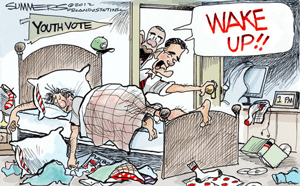 Democrats made it a point to make the youth vote become an important factor in the 2008 election, but as many students, saw soon after inauguration day, change didn’t come as easily as we had expected. To many voters’ surprise, the youth vote was higher in 2012 than it was in 2008.
Paul Ryan’s dig on fading Obama posters may have been a bit extreme, but it did shed light on the election’s youth voter’s perspective, and the voter climate overall. Would the next four years be worth the another Obama term? Would change for our generation be financially sustainable?
This election was far different from the 2008 election that promised some generic change. It wasn’t about who had the spiffiest graphics or best campaign t-shirts. It was about our future, about how much we would have to pay in loans after college, about what jobs we could find, and about what our futures would shape into.
Read MoreTwo Generations Dissect Election 2012 and What’s Next for Women’s Rights
On election night, journalism major Maegan Vazquez joined about one hundred fellow New York University students over the beer soaked floorboards of Brad’s, a popular site for locals and college 20-somethings alike. Keenly interested in politics, she’s been writing a terrific weekly column for my Heartfeldt Blog, titled “The Young Politica.”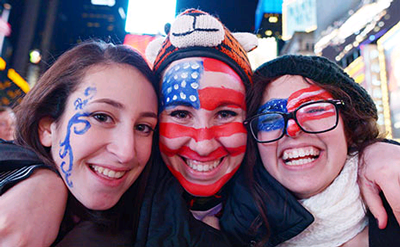
Across town, I chatted with a couple dozen men and women at my friend Loretta’s Upper East Side apartment. As guests slipped into spaces on the elegant couch and chairs, like the old game of Sardines, each sighed, “I’m so nervous about the outcome of this election.”
Nov. 7, 2012 – New York, USA – Young women celebrate the result of the 2012 US Presidential election at Times Square in New York, USA, 07 November 2012. Democratic President Obama defeated Republican candidate Mitt Romney in the US elections. Photo: Rainer Jensen (Credit Image: © Rainer Jensen/DPA/ZUMAPRESS.com)
The pundits had us convinced that what turned out to be a rout would be a cliffhanger.
Read MoreIn Which I Answer POLITICO Arena’s Election Day Question: What were the campaigns’ biggest mistakes?
A friend posted a photo on Facebook of a long line at her polling place this morning with the comment that “it’s a good sign when voters are treating an election like Black Friday at Walmart.” Now we have to wait all day to learn which of the candidates brought forth this outpouring of interest: do voters think Obama or Romney is the better bargain?
Both campaigns have made mistakes galore, balancing each other out in about the same horserace numbers as the daily polls have recently shown the race to be. Romney’s worst was hoisting himself on his own petard of Etch-a-Sketch positions, thus eroding voter trust, then nailing his coffin with the deliberately false Jeep ad.
Obama’s worst mistake was four years in the making. He failed to run, as Harry Truman successfully did, against the “do nothing Congress” that is more at fault for the lack of economic progress than the president who at least put forward some ideas. He had to re-energize many discouraged 2008 supporters as a result. But thanks to the Republican War on Women which Romney could not separate himself from, Obama was able to seize a set of issues that resonate with progressive women who make up almost 60% of the Democratic base.
Romney’s mistakes were mistakes of character and likability; Obama’s were mistakes of leadership style.
Read MoreOutsider Fits No Political Box, but Declares Choice Because “I Hope It Gets Better”
This is a powerful personal essay guest post on American culture and politics from my colleague, Tamara Fagin. Her title was “Random Musings From the Frontline” but I don’t think it’s random at all. I believe most Americans feel like outsiders at some time in their lives, and who have had the experience of being bullied or feeling like we have been treated unfairly because of our birth origins.
We are a nation of diverse heritages, a salad bowl of tossed differences rather than a melting pot where we all blend in together.
How does Fagin tie her personal experience as a one-woman salad bowl of cultures who always felt “different” with how she came to choose a candidate for president? Read on…and tell us your experiences.

All or for much of my life I have felt like an outsider. Bullied in a sense for giving a damn. I have early memories of eye-rolling, smirks or quiet taunts. This was not the punching, hair-pulling, tripping garden variety of physical bullying and worse, rather the insidious kind that eats at one’s insides and makes one eat lunch in the high school bathroom (it was clean and a friend joined me).
It was the one-off comment from the popular, All-American high school cheerleader that goes unanswered by one’s peers and one’s teacher. When I answered a question in A.P. U.S. History class, our teacher asked the class, “Why can’t you guys answer that question? Tamara just moved here from Japan.“ The cute blonde cheerleader girl shouted, “She’s an import!” I can’t remember what happened after that.…
I just remember that I wished that we were back in Japan. And, I wished that she knew the deal. But, c’est la vie or shikataganai, as the Japanese say.
Note to Mr. M.: you should have called her on that. You should have never made that comment to the class about me being able to answer the question. I was new to the school. I was miserable. I missed my old school, my old friends, my old beaches, my old Japanese nightclubs, my old routine and I missed Okinawa, Japan.
Note to educators everywhere: you make the bullying problem worse when you do this kind of comparison thing. It doesn’t work for parents when they say to their kids, “Why can’t you be more like your big brother, Johnny?” Why the hell do you think it is going to make your domestic darlings try harder? It just doesn’t. It breeds resentment. It pits us against them. U.S. blonde, blue-eyed and beautiful against different. But, to borrow a phrase from my LGBT brothers and sisters, IT GETS BETTER.
Read MoreThe Young Politica: How to Vote During Hurricane
We Lower-Manhattanites are a scrappy bunch of people. We are starving artists, college students, writers, and Wall Street bankers. This past week, after Hurricane Sandy hit, all of lower Manhattan was out of power for days.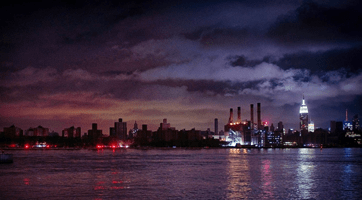
I am writing this after being evacuated from my dorm and living out of NYU’s Kimmel Center for days—a building that offered food, shelter, and power to students. For those not seeking refuge outside of their ‘South of Power’ apartments, I’ve heard stories of raw ramen for dinner and pilgrimages north for cell phone service. Luckily, power resumed for much of my neighborhood recently, so I have a bed to sleep in again.
Rather than thinking about where I would be relocated after the storm on Monday, my concerns shifted to how Sandy would affect the upcoming election. Perhaps my priorities need adjusting.
Read More