
What’s the most important presidential debate question?
Bring on the hot wings and beer. My favorite contact sport event is coming up October 3. I hope it’ll inspire tailgate parties all over the country.
 No, I haven’t become a football fan after years of avoiding it. I’m talking about the first presidential debate. It should be required watching for all voters—that would be a far better qualification for voting than requiring picture identification.
What if you were the debate moderator, what do you think would be the most important question you’d ask?
Politico’s Arena, where I post regularly, asked about that yesterday, and also quizzed the panel on whether voters should expect fireworks or calm, polished debate. I wondered, what fun would it be without some fireworks. PBS’s Jim Lehrer will moderate this debate, the first of two debates between the presidential candidates.
I’m sure there will be many questions about their respective economic plans, as there should be. But in my response, I addressed the way questions are asked as well as the content.
Most of the time when I’m cheering and booing from the debate sidelines, I’m annoyed with the moderators’ softball questions that have too little follow up to get the candidates beyond their talking points.
Read MoreShe’s Doing It: LisaBeth Weber Pins Pack Message Wallop
LisaBeth Weber tells how we met in this guest post. So I’ll tell you she is a woman with a vision. A vision that exemplifies No Excuses Power Tool # 8: Employ Every Medium.
And if a leader is someone who gets something done, then LisaBeth exemplifies leadership too. She uses the power of her artistry to make a difference for the causes she—and YOU—believe in. When you or I wear one of LisaBeth’s cause pins, we’re also using Power Tool # 6: Wear the Shirt –showing the world what we believe.
I’ll bet LisaBeth would love to know what you want on your pin, if she were to design one for you. So tell her in the comment section below.
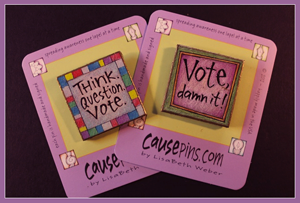
How do I know Gloria? Our paths were destined to cross, and they finally did back in 2004 at a campaign event in Pennsylvania. Having defined a mission of making a difference in the world over 20 years ago, I’ve always channeled my core beliefs into my work. It seems inevitable that my creativity and mission would manifest into a line of handmade pins for causes that began with a pin about CHOICE.
As an artist and activist, I realized that an art-pin could be like a mini-billboard for people to ‘wear their heart on their lapel’, to spark conversation, and to effect change.
Over the years, I developed cause pins for politics and voting, peace and social justice, women’s rights, the environment, animal rescue, and more. The pins found their way to many non-profit organizations that have utilized them for fundraising and awareness.
Read MoreThe Young Politica: How Obamacare Affects College-Aged Women
You may have heard the word ‘Obamacare’ spinning around the election coverage, but here’s what it’s all about and how it can affect you.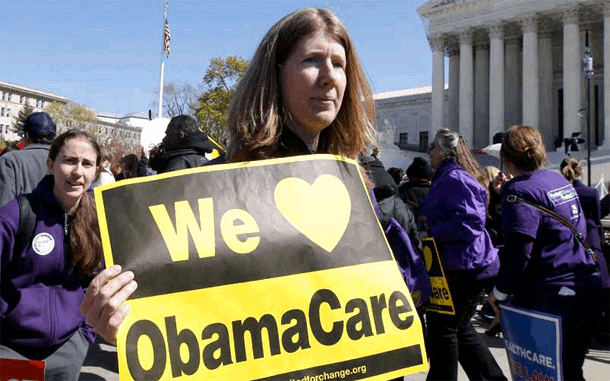
Obamacare (formally known as the Patient Protection and Affordable Care Act) is a set of newly-passed (2010) healthcare reform mandates that ultimately aim to provide insurance to the uninsured by lowering the overall costs of health care. The planned changes, which have already begun and will last until 2020, include:
- offering free preventative counseling and birth control to women (unless you work for certain religious institutions or possibly unless you work for a company that does not support birth control, depending upon how the courts interpret the Constitution on this one),
- guaranteeing that those who apply for insurance with preexisting conditions are not turned away,
- and an annual penalty to those who do not have insurance by the year 2014.
Many of the changes won’t go into effect until 2014 (or unless Mitt Romney wins the election and repeals Obamacare as he has promised, but some have already gone into action.
Here are some changes Young Politicas should expect to affect them immediately and in the future:
Read MoreOctober Surprise
Do you know the term “October Surprise”? It was coined in 1972 when 10 days pre-election, incumbent President Nixon sucked the remaining oxygen from Democratic candidate George McGovern’s anti-Viet Nam war campaign message by declaring that peace was at hand. Ever since, the term “October Surprise” has been used to describe pre-emptive strikes by one prospective leader designed to strike a powerful blow to the opponent’s election intentions. Or, as in the fun fictional case of “Wag the Dog,” to help the candidate deflect attention from his own brewing scandal.
What October Surprises do you predict this year? Let’s keep a running list here.
Read More
She's Doing It: Ora Shtull, 9 More Ways to Power Up
Executive leadership coach Ora Shtull understands the power of using your voice. In her lively guest post and the accompanying video, she tells women that it’s not enough to sit at the table; talk at the table if you want to have an impact on decisions and be recognized for your ideas. When I was writing No Excuses, I came to realize that power unused is power useless, and unless we are sharing our knowledge and ideas, they are not helping anyone, including ourselves. So, here’s how Ora tells it:
What is it about nines? Nine is the number of lives that cats are said to have. The Beatles sang “Revolution 9” on their White Album (in almost nine minutes!). And when you look pretty darn good, you’re “dressed to the nines.”
Gloria Feldt likes nines, too. She’s written a bestselling book called No Excuses: 9 Ways Women can Change How We Think About Power in which she brilliantly enumerates nine important ways women can embrace their power.
It’s no secret that I am a big admirer of Gloria’s work. Her rise from teen mom and high school dropout in rural Texas to CEO, author and acclaimed expert on women and power is nothing short of extraordinary.
Coincidentally and perhaps cosmically, I too have a belief in nine.
Read MoreThe Young Politica: What Each Presidential Candidate Has to Offer You
Researching candidates is key when deciding who you will vote for in the 2012 presidential election. However, deciphering fact from opinion about how they would lead the country on major issues can be overwhelming—especially for a first-time voter.
As I have mentioned in previous columns, our demographic (college-aged females) plays a pivotal role in this election. Our choice, come November, has the power to determine how much we owe after college, who we can marry, and how long we can stay on our parents’ insurance plan.
So what can the two major presidential candidates, Mitt Romney and Barack Obama, offer us? Here are just a few key points in the election that concern our demographic.
Read MoreWhat Would It Take for Dems to Retake the House?
House Minority Leader Nancy Pelosi said on CNN yesterday morning that Democrats have a “very excellent chance” of taking back the House in November – pointing to Mitt Romney’s selection of running mate Paul Ryan as a “pivotal” moment in the campaign.
The Democrats need to pick up 25 seats to win back the majority.
Politico’s arena asked: “Does it seem likely that the Democrats could retake the House? With a 10 percent congressional approval rating, are Americans even paying attention to House races?”
Here’s my take:
Read MoreMargaret Sanger’s Obscenity?
Happy birthday, Margaret Sanger!
This column is in honor of either the 133rd or the 130th birthday of the founder and best known leader of the American birth control movement. Ever vain, she lopped three years off her age in the family Bible.
But her strengths far outweighed her foibles. Last night, I went to a screening of “Half the Sky”, a documentary film made from Nick Krisof and Sheryl WuDunn’s blockbuster book. While Kristof and WuDunn are lauded for saying women’s rights are the great moral imperative of the 21st century in their new book, Margaret Sanger said the essentially same thing 100 years ago.
Yet the same battles over women’s bodies and lives are still being fought today.
I wrote the column below (originally published in the New York Times in 2006 ) to mark the 90th anniversary of her first birth clinic. It seems a worthy tribute to Margaret Sanger today, regardless of how many candles should be on her cake.
By the way, the Times gave the column its title, and I hated it. I added the question mark today. Let me know what you think, about that and about the rest of the story.

When you tour the Lower East Side Tenement Museum’s restoration at 97 Orchard Street, you walk through the experience of the immigrants who arrived in waves at the turn of the 20th century, often to live five or six to a tiny room. According to the 1900 census, the 18 wives in the Orchard Street building had given birth to 111 children altogether, of whom 67 were then alive.
Read MoreShe’s Doing It: Carolina Pichardo Leads Young Urban Moms to See They Are Not Alone
“Before I got pregnant, I was full-steam ahead in life,” said Carolina Pichardo, cofounder with Mary Targia of the educational and inspirational New York-based organization and website YUM (Young Urban Moms). 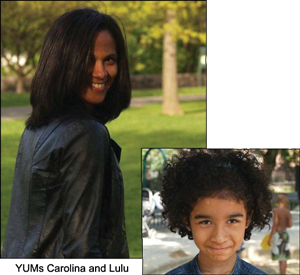
“I’d received a partial scholarship to New York University, after traveling abroad and interning at the New York City Public Advocate’s Office and Tor Books Publishing.”
But when she found out she was pregnant, the resulting harsh remarks and judgmental looks threw the slim, stately Harlem-born Pichardo off her track—for a while: “I just became angry. I didn’t know what to do with that anger, so I simply worked hard to prove those around me wrong.”
With some of the same rebel instincts that had propelled her parents to immigrate to the U.S. from the Dominican Republic—where her mother was a teacher and her father a doctor—she stayed in school through most of her pregnancy. She took a semester off after her daughter Lyanna (known as Lulu), now age 11, was born. Then she returned to earn her bachelor’s degree in communications from NYU “with leaky boob stories galore.”
Read MoreThe Young Politica: Will Your Vote Count? How to Make Sure Even if You Vote Absentee
Growing up, I always asked Mom lots of questions. Questions like “What does ‘superfluous’ mean?” and “What’s an endocrinologist?” were common, and quite commonly, Mom replied:
“Look it up in the dictionary.”
Nowadays, I still have questions. They’re a little more difficult for Mom to answer, so her reply is more like:
“Look it up on the Internet.”
It’s very easy to give up on answering a question when the answer is not easily found. From questions in an exam, to solving a problem with university administration, to learning how to vote, I’ve found myself at bottomless pits of questions that don’t have answers on SparkNotes.com or FAQ pages.
I was in this predicament when I attempted to vote through an absentee ballot. I didn’t know how to get a hold of a ballot or where to vote or what to send. I was clueless! I expected that all of the information would be readily available on one government website, which would make it easier for college students.
I was wrong.
Read More