
Posts by Gloria Feldt
“It’s Her Choice” – Really?
Thanks to Ann Crittenden for submitting this guest post, which was originally published at Moms Rising Ann shows that the politics and personal aspects of motherhood are very intertwined. Be sure to check out Ann’s book The Price of Motherhood for a more in depth look.
 I was struck recently by the persistence of an old argument used to kill the Fair Pay Act – and every other measure that would make life easier for mothers. You know it by heart: many women “choose” to earn less than men, and if they choose to earn less, then what’s the big deal about a little wage inequality?
This so-called “choice” argument can be superficially persuasive. Most women probably do prefer cleaner, relatively lower-paying jobs. Most women would rather be beauticians than coal miners, art teachers than mechanics. (Although this begs the question why teachers and beauticians earn so much less than mechanics and miners). Women working full-time often work fewer hours (for pay) than full-time working men. And in recent surveys, far more working women than men say they would prefer to work part-time.
Women, in short, are different from men. They’re just not as into dirt, long hours and making money. Maybe they are just …. more French!
But before you buy into this one, remember that those who benefit from the status quo always attribute inequities to the choices of the underdog. And women are still underdogs in the job market. Women working 40 hours a week still earn 86 cents for every dollar a man earns, a bigger gap than in many developed countries with more family-friendly policies. But if American women accept this willingly, then there’s nothing to worry about. It’s their choice. No one “made them do it.” So no one has to do anything about it.
Read MoreBreaking Barriers: Kentucky’s First Female African American Senator, Georgia Davis Powers
Kathy Groob, former elected city council member, publisher of ElectWomen Magazine, and partner at November Strategies political consulting firm contributed this inspiring article about Georgia Davis Powers, the first woman and first African American elected to the Kentucky state senate. It’s the first of a number of Women’s History Month guest posts I’m excited to share with 9 Ways readers.
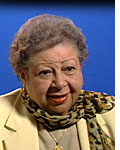 At the time, Georgia Davis Powers had no idea she had made history in 1968 by becoming the first woman AND the first African-American elected to Kentucky’s State Senate. All she knew was that she wanted to make a difference in her community.
It was never her intention to become a politician, or even to work in government, but in the spring of 1962 Powers was introduced to politics upon the suggestion of fellow church member Verna Smith. Upon Ms. Smith’s advice she joined the U.S. Senatorial campaign staff of Wilson Wyatt. This led to six more years of managing mayoral, gubernatorial, and congressional campaigns. She also became heavily involved in the civil rights movement, leading the Allied Organization for Civil Rights in promoting statewide public accommodations and fair employment law in the early 1960’s. In 1964, she was one of the organizers of a march on the capital in Frankfort in support of equity in public accommodations, in which Dr. Martin Luther King and baseball legend Jackie Robinson participated.
In 1964 she was the first black woman elected to the Jefferson County Democratic Executive Committee. But after two years she resigned after becoming discouraged by the fact that the Committee had not discussed a single one of her proposals.
In 1966 she worked in the bill room during the legislative session for the Kentucky House of Representatives. This gave her the opportunity to see first hand how government functioned; as a result her political ambitions grew.
Read MoreWomen's History Month Open Thread: Family Ties
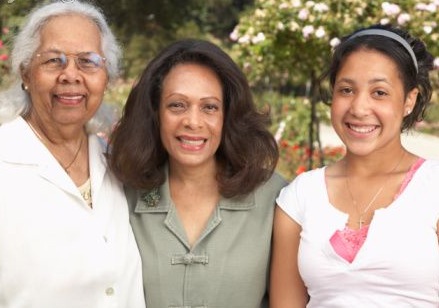 Many of us look to women in our family as our sheroes. Who are the women in your family who have helped shape you and how did they do it?
Women's History Friday Roundup: The Rally Edition
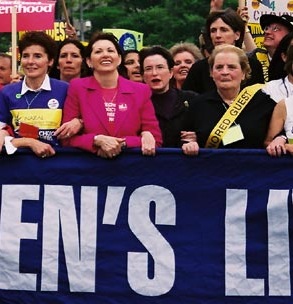 In 2004, women made history by descending on Washington in droves to March for Women’s Lives. Estimates vary about how many people attended the march, but it’s safe to say that there were over 1 million pro-choice activists in D.C. in 2004, myself included.
Last weekend a Walk for Choice was held in cities across the globe. Here is a roundup of photos from rallies across the country–the decentralized nature of the walk made it impossible to get exact numbers, but the geographic dispersion was impressive.
This Is a Sampling of What a Pro-Choice Rally Looks Like:
NYC – Feministing
Boston Walk for Choice
Walk for Choice Chicago – Feministing
Tucson Walks for Choice – Feminists for Choice
But we should not have to fight these battles over and over…
If you’ve got photos that you would like to add to our historical record (however “unofficial” it might be), please leave a link in the comments section. And by all means, take a moment to share your most proactive and innovative thoughts about what history you want to write for the future of reproductive rights, health, and justice.
Read MoreWhat Do Academy Awards and Women’s History Month Have in Common?
 No, I’m not talking about Melissa Leo’s use of that other-than-feminism “f-bomb” at the Academy Awards last Sunday evening. I want to compare two of this year’s Oscar winners and how they illustrate the way women’s history is told—or not.
Sportswomen – How Alice Marble Led the Way for Althea Gibson
Sports isn’t my strong suit. But it’s only appropriate that women who have led the way in the sports world should be highlighted within my Women’s History Month posts. So I asked my friend Beverly Wettenstein, who often writes and speaks on this topic, to guest post this article, originally published on Huffington Post.
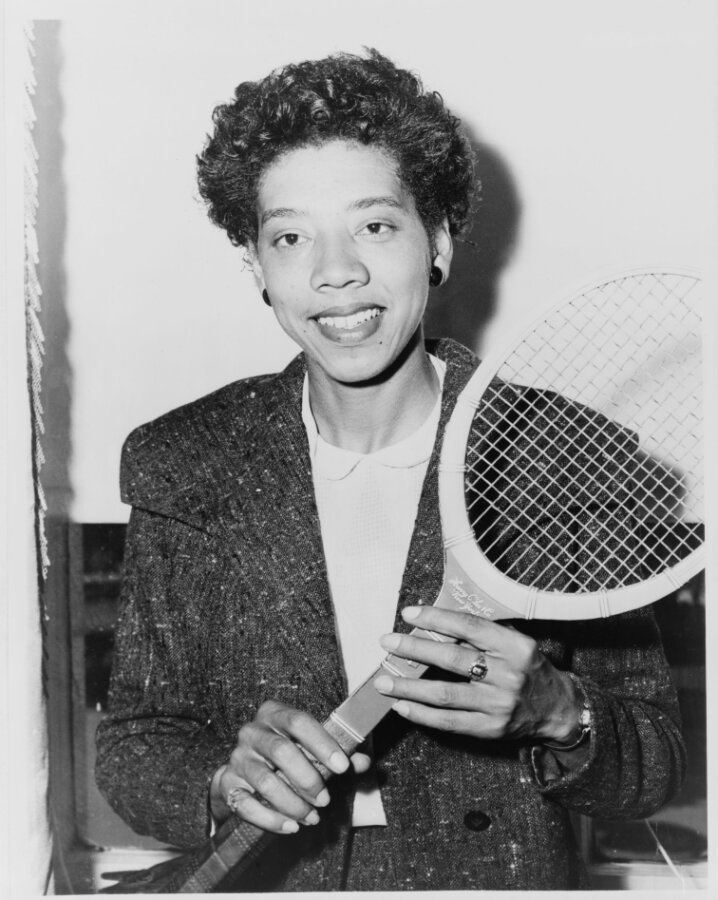 Althea Gibson’s induction into the US Open Court of Champions, on the 50th anniversary of her historic title victory, was inspiring. The Opening Night Tribute, to celebrate living African-American women who have also broken barriers in sports, entertainment, politics and the arts, was impressive. Venus and Serena Williams paid fitting tribute to Gibson by winning their opening night matches. Serena Williams became the first African-American woman since Gibson to win the US Open in 1999. The next year, Venus Williams was the first African-American woman since Gibson to win Wimbledon.
However, Alice Marble’s significant role, as the leading public proponent and catalyst for Althea Gibson to break the color barrier in U.S. tennis, should not be overlooked. Women’s contributions are often not properly credited in history and sports books and media coverage. Researching my Women in History and Making History Today — 365-Days-A-Year Database and A WOMAN’S BOOK OF DAYS, I’ve confirmed that less than ten percent of the references in new history textbooks are about women. “Anonymous” may be a woman.
Read MoreKnow Your History–Create the Future of Your Choice

“If women want any rights more than they got, why don’t they just take them, and not be talking about it.” –-Sojourner Truth, 1797-1883, former slave, abolitionist
During the last 50 years, thanks to feminism and other civil rights movements, reliable birth control, and an economy that requires more brain than brawn, women have broken many barriers that historically prevented us from partaking as equals at life’s table. I feel privileged to be part of this amazing trajectory. All of my Women’s History Month posts come from a place of profound appreciation for the shoulders I stand on. Women like Sojourner Truth who had so much courage, clarity of vision, and leadership savvy.
I found feminism when I was a desperate housewife in Odessa, Texas in the 1960’s. After volunteering for civil rights organizations, I had the epiphany that women should have civil rights too. I “discovered” the new Ms Magazine. Then, I joined the National Organization for Women a few years after its 1966 founding, as an at-large member. Soon, I’d find the half-dozen other at-large members in West Texas’ expanse. It was a heady time of firsts for women; still, few of us could have predicted either the stunning advances or the discouraging setbacks ahead.
Fast forward to Hillary Clinton’s groundbreaking presidential campaign that didn’t take women into the presidency, but came close enough that no one will ever again ask whether women are smart enough or tough enough to do the job. Today even right-wing Republicans realize putting a woman on the ticket symbolizes electrifying change. Women earn 60% of college degrees, reproductive technologies have changed the power balance in personal relationships and we’re closer to parity in earnings than any time in history.
To be sure, women still don’t have full equality in any sphere of political or economic endeavor. Women hold just 17% of seats in Congress–the 2010 elections resulted in the first decline in over a decade–and under 25% of state legislative offices; 3% of top clout positions in mainstream media corporations and 15% of corporate board positions. We’re still waging a battle for reproductive rights, both at the state and federal levels. And despite gender equity laws, women earn 3/4ths of what men do while shouldering the lion’s share of responsibility for child rearing.
Still, the most confounding problem facing women today isn’t that doors aren’t open, but that women aren’t walking through the doors in numbers and with intention sufficient to transform society’s major institutions once and for all. Probing history, there seems to be a recurrent approach-avoidance pattern.
Read MoreWhat Do Academy Awards Have to Do With Women's History Month?
No, I’m not talking about Melissa Leo’s use of that other-than-feminism “f-bomb” last night. I want to compare two of this year’s Oscar winners and how they illustrate the way women’s history is told—or not.
I’m thrilled that “The King’s Speech” won best picture. I loved this beautifully rendered piece of history. And Colin Firth’s best actor Oscar was supremely deserved for his brilliant and touching portrayal of the shy man with a stutter, the man who not be king had he had his druthers.
But when the historical fluke of his brother’s abdication from the throne propelled him onto the British throne on the eve of world War II, King George VI rose not only to fulfill the ceremonial monarchy, but more importantly, to become a great moral leader in a time of crisis.
He realized that a leader’s first task is to define the terms and then deliver the message effectively. He feared his speech impediment would prevent him doing so. We follow him through the excruciating process of learning to control his stutter in order to fulfill the obligation his office required.
This man, for all his challenges was clearly the protagonist of his story. And his story was one of leadership, courage, and triumph over adversity.
Read MoreDueling Reviews of No Excuses: Which Do You Think Has It Right?
 Within hours of one another, two Google alerts bearing reviews of No Excuses hit my inbox. One reviewer lauded it, and the other skewered it.
“That’s what makes horse races,” I shrugged, recalling my father’s way of telling me differences of opinion are to be expected.
Then I reread both articles. And I realized that their diametrically different worldviews of women’s relationship with power reflect precisely the historic crossroads moment that had inspired me to write the book in the first place.
I was excited when asked to be interviewed for the Feminist Review, now known as Elevate Difference, by lawyer and global crusader to eliminate violence against women. Dianne Post and I originally met decades ago, because of our respective Arizona residency and involvement in women’s social justice issues. I recalled her as a bit of a contrarian but a passionate advocate for women. I was delighted to reconnect with her–so much so that after we spoke, I invited her to address my Arizona State University class on “Women, Power, and Leadership.”
During the interview, Post challenged my thesis that while some external structural barriers remain, women in the U. S. are at a moment in history where doors are open and it’s up to us to walk ourselves through them; that to embrace our power to do so, we must—and are able to–consciously overcome the remaining barriers, many of which are culturally learned, internalized ones.
So I wasn’t surprised when her acknowledged bias turned up in the review—understandably, seeing women as victims is an occupational hazard. And it’s a perspective that was accurate during the heady days of second wave feminist revolution, in which we both participated. Forty years ago, there were so many unjust laws to change and policy barriers to break.
Read MoreUnlock Your Unlimited Potential
Scottsdale, AZ Wed. 02/9 Valley Leadership & ASU Alumni Keynote at Women’s Leadership Workshop “Unlock Your Unlimited Potential” at ASU Skysong Center Gloria FeldtGLORIA FELDT is the New York Times bestselling author of several books including No Excuses: 9 Ways Women Can Change How We Think About Power, a sought-after speaker and frequent contributor to major news outlets,…
Read More