
Friday Round Up: Will Egyptian Women’s Revolt Sustain a Movement?
I was incredibly moved to see photos of Egyptian women marching in Tahrir Square earlier this week. A few hundred protesters were expected; thousands showed up. And they were angry.
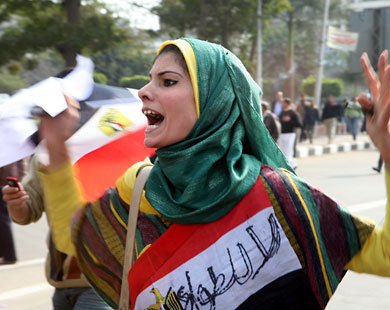
Women figured prominently in the demonstrations that brought down Hosni Mubarak last January/February . But once the government toppled, they were pushed aside, and not included in the constitutional reform committee. Egyptian feminists warn that decades of painstaking advances could be reversed, as religious fundamentalists ascend to power in what has been a nominally secular state.
This week’s protest was spurred my pervasive police and military brutality to women. Attacks on women, called “shocking” by Secretary of State Hillary Clinton. “A new democracy cannot be built on the persecution of women,” she declared.
I was pondering the paradox of a freedom movement that results in less freedom for half the population when radio host Lisa Wexler e-mailed, asking me to come on her show. Lisa’s question to me was: how do you sustain a social movement once it gets started? She asked me to relate what’s happening in Egypt to my experiences in the U.S. women’s movement.
You can listen to the program here. The topic starts at 46 minutes in, my interview at 1:10.
INTENTIONING
Sex, Power, Pandemics, and How Women
Will Take The Lead for (Everyone’s) Good
The new book from Gloria Feldt about the future, taking the leadership lessons learned from this disruption and creating a better world for all through the power of intention.

Here’s how Lisa framed it:
Listen Women, a one day revolt is fabulous, it’s brave, it’s amazing, and it’s wonderful, but it is MEANINGLESS if you go back the next day put the veil on and serve dinner as usual. You CAN’T FADE AWAY. I WANT A MOVEMENT, NOT AN OUTBURST – THAT IS THE ONLY WAY TO AFFECT CHANGE IN YOUR LIFE AND IN THE WORLD – AND IF YOU DON’T SEE THAT – YOU ARE DOOMED TO A SECOND CLASS LIFE, AND SO ARE YOUR DAUGHTERS. The only hope ALL of us have is if women are equal participants in the world.
I told Lisa about cutting my activist teeth in the Civil Rights movement of the 1960’s. Much like the Egyptian women, after working in a movement that was largely led by and for men, I had my “click” moment when I realized that I and other women have civil rights too. That’s when I got involved in the women’s movement.
Decades on the frontlines of movement leadership taught me there are four “M’s” of movement building.
A successful and sustainable movement captures a Moment when people are angry about something. It has a clear Mission (its demands, goals, what it intends to accomplish). It tells its story and delivers its Message effectively through whatever media exists, and most of all, it MOVES.
In No Excuses: 9 Ways Women Can Change How We Think About Power, I call that movement creation process “Sister Courage.”
You create a movement by applying three simple steps to bring about social change, or even to get something changed in the workplace:
1. Be a sister. Reach out to others who share your concerns. Offer help, and ask for help when you need it. By linking up with like-minded colleagues, you create a supportive network, and you are stronger together.
2. Have the courage to put the issues forward. Deliver the message. Tell the story for all to see. The more repressive the culture, the more courage this takes, and that’s why it was so moving to see the Egyptian women marching.
3. Put Sister and Courage together into a systematic plan and execute it. This is the hard part. It’s easy for one person to get mad. It’s not too hard to capture many people’s anger and get them to march. It’s much more difficult to change the system that is angering you, and harder still to give people a positive vision of change to aspire to. This part requires persistence. willingness to have leadership, and organizational structure. All social movements fall down to a certain extent here, because egos get involved and people get co-opted. But movements that are successful capture the fear and anger and use it to fuel aspirations. Aspirations—mission, vision, action goals–keep a movement moving and sustain it for the long term.
In comparison, Occupy Wall Street has done a great job of finding allies, capturing a moment of fear and anger, and creating a story–a narrative that delivers their “We are the 99% message” effectively in the media. But they don’t yet have a clear aspirational mission or leadership that can organize people around it. What are their demands?
Similarly, what exactly are the Egyptian women demanding? Only time will tell if they take that step.
From Tahrir Square and the Arab Spring to Occupy Wall Street this has been a year of astonishing protest movements. No wonder Time Magazine named the anonymous, eponymous protester as person of the year. Said Time’s editor-in-chief, Jim Frederick, “It is a moment of hope and a moment of possibility, but we can’t say with any certainty whatsoever that it is necessarily going to lead to a happy ending.”
In the U.S., as in Egypt, women have often taken bold steps forward only to take steps back after reaching part of their goals.
Linda Tarr Whelan of Demos connects the dots between the various global women’s movements and points out that the U.S. stands almost alone (save for Sudan, Somalia, Iran, and two island nations) in failing to ratify the Convention on the Elimination of All Discrimination Against Women (CEDAW). Now there’s a movement long overdue.
Revolutions usually are started by people who have begun to see that another, freer, better way to live exists. Yet if a movement doesn’t keep moving forward, at best progress will stop and the movement will wither. At worst, freedoms won will be lost.
How do you see the Egyptian women’s protest unfolding from here? What can Sister Courage do for them?

GLORIA FELDT is the New York Times bestselling author of several books including No Excuses: 9 Ways Women Can Change How We Think About Power, a sought-after speaker and frequent contributor to major news outlets, and the Co-Founder and President of Take The Lead. People has called her “the voice of experience,” and among the many honors she has been given, Vanity Fair called her one of America’s “Top 200 Women Legends, Leaders, and Trailblazers,” and Glamour chose her as a “Woman of the Year.”
As co-founder and president of Take The Lead, a leading women’s leadership nonprofit, her mission is to achieve gender parity by 2025 through innovative training programs, workshops, a groundbreaking 50 Women Can Change The World immersive, online courses, a free weekly newsletter, and events including a monthly Virtual Happy Hour program and a Take The Lead Day symposium that reached over 400,000 women globally in 2017.
No Comments
Leave a Comment
You must be logged in to post a comment.
It is not at all clear that a new democracy is being built in Egypt. The military keeps making promises about a transition to civilian rule, but it may turn out that they tricked the revolutionaries, that Mubarak is gone but little else will change. The guys in charge pulled off a coup, hoping that deposing the dictator would defuse the revolution. That did not defuse the revolution, but the military has been dragging its feet about relinquishing any of its power and influence, brutally repressing the continuing protests, and may have allowed these elections to proceed just for show. Time will tell, but meanwhile, both the military and the male revolutionaries have betrayed the women of Egypt.
Aletha, the pattern is similar in a number of revolutions. It is great to see the Egyptian women protesting police brutality, rapes, and such, but I hope we will see them also making demands for parliamentary roles. There has long been a feminist movement in Egypt but this is a moment of opportunity that if not taken could well end up as you suggest, with women actually going backward.