
Posts Tagged ‘Women’s History Month’
9 Ways You Can Find No Excuses in Your Neighborhood
Remember studying Shakespeare’s Julius Caesar in high school? Did you go around warning your friends to “Beware the Ides of March!” like I did?
Fortunately, I have lots of good news this March 15. There are at least 9 Ways I might get to see you at a book reading or other event soon. I extend a warm invitation to you to attend events in your area. And will you help me out by sharing this information with your contacts and on social media? Thank you!
This Week in the Midwest:
I just love Women and Children First bookstore in Chicago. One of the great independent, feminist bookstores. Join me there this Wednesday, March 16, at 7:30pm, at 5233 N. Clark Street. Click here or call 773-769-9299 for more info.
 Cleveland is next up: Friday, March 18. I’m excited to keynote and conduct a 9 Ways Power Tools workshop for Rita Singh’s Elite Women Around the World conference, “Scaling Up…Can I Dream Big?” The answer is “Yes!” 8:30am – 2pm at the Crown Plaza Cleveland South. Register here.
Women's History Open Thread: Fictional Role Models
 I’m thinking a lot about literature this weekend because I’m presenting on “Women in Leadership” on a panel with former White House doctor, Connie Mariano at the Tucson Festival of Books. Fictional characters can play a big part in our lives. Are there fictional women who have been fantasy role models for you?
Edna St. Vincent Millay, First Woman Pulitzer Poetry Winner
 My parents started sending me to Mrs. Fred Day’s charmingly named “Expression” classes when I was three years old. There, over a period of seven or eight years, I learned at least one new word each week, practiced exercises intended to improve my posture and diction, was schooled (or at least she tried to school us) in the social graces of serving refreshments to my classmates, and memorized a variety of poems. Some of the lines that have lodged most memorably in my mind are those of Edna St. Vincent Millay. There was the cheery:
I will be the gladdest thing
Under the sun!
I will touch a hundred flowers
And not pick one.From “Afternoon on a Hill”
…and the dramatic:
All your lovely words are spoken.
Once the ivory box is broken,
Beats the golden bird no more.From “Elegy”
So when Bonnie McEwan of Make Waves sent me Millay’s poem, “Recuerdo,” along with a note that the poet who liked to call herself “Vincent” and took many lovers during her life, had been the first woman to receive a Pulitzer prize for poetry in 1923, I immediately conjured the sights and floral smells of Mrs. Day’s rather formal home in Temple, Texas – walking distance from my elementary school. She always wore her perfectly coiffed grey hair up and fastened with combs, and practiced the graciousness she patiently tried to teach all of us rowdy kids. She would have been Millay’s contemporary–a shocking thought to me now, since I think of the poet as fuzzy history while the teacher remains sharply drawn in my mind.
Read MoreWomen's History Month Open Thread: Family Ties
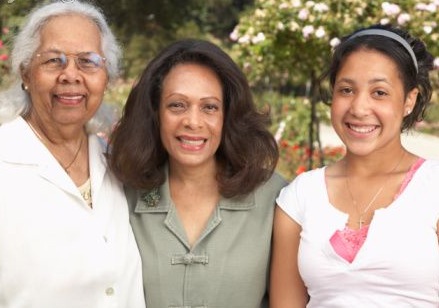 Many of us look to women in our family as our sheroes. Who are the women in your family who have helped shape you and how did they do it?
Know Your History–Create the Future of Your Choice

“If women want any rights more than they got, why don’t they just take them, and not be talking about it.” –-Sojourner Truth, 1797-1883, former slave, abolitionist
During the last 50 years, thanks to feminism and other civil rights movements, reliable birth control, and an economy that requires more brain than brawn, women have broken many barriers that historically prevented us from partaking as equals at life’s table. I feel privileged to be part of this amazing trajectory. All of my Women’s History Month posts come from a place of profound appreciation for the shoulders I stand on. Women like Sojourner Truth who had so much courage, clarity of vision, and leadership savvy.
I found feminism when I was a desperate housewife in Odessa, Texas in the 1960’s. After volunteering for civil rights organizations, I had the epiphany that women should have civil rights too. I “discovered” the new Ms Magazine. Then, I joined the National Organization for Women a few years after its 1966 founding, as an at-large member. Soon, I’d find the half-dozen other at-large members in West Texas’ expanse. It was a heady time of firsts for women; still, few of us could have predicted either the stunning advances or the discouraging setbacks ahead.
Fast forward to Hillary Clinton’s groundbreaking presidential campaign that didn’t take women into the presidency, but came close enough that no one will ever again ask whether women are smart enough or tough enough to do the job. Today even right-wing Republicans realize putting a woman on the ticket symbolizes electrifying change. Women earn 60% of college degrees, reproductive technologies have changed the power balance in personal relationships and we’re closer to parity in earnings than any time in history.
To be sure, women still don’t have full equality in any sphere of political or economic endeavor. Women hold just 17% of seats in Congress–the 2010 elections resulted in the first decline in over a decade–and under 25% of state legislative offices; 3% of top clout positions in mainstream media corporations and 15% of corporate board positions. We’re still waging a battle for reproductive rights, both at the state and federal levels. And despite gender equity laws, women earn 3/4ths of what men do while shouldering the lion’s share of responsibility for child rearing.
Still, the most confounding problem facing women today isn’t that doors aren’t open, but that women aren’t walking through the doors in numbers and with intention sufficient to transform society’s major institutions once and for all. Probing history, there seems to be a recurrent approach-avoidance pattern.
Read MoreWhat Do Academy Awards Have to Do With Women's History Month?
 No, I’m not talking about Melissa Leo’s use of that other-than-feminism “f-bomb” last night. I want to compare two of this year’s Oscar winners and how they illustrate the way women’s history is told—or not.
I’m thrilled that “The King’s Speech” won best picture. I loved this beautifully rendered piece of history. And Colin Firth’s best actor Oscar was supremely deserved for his brilliant and touching portrayal of the shy man with a stutter, the man who not be king had he had his druthers.
But when the historical fluke of his brother’s abdication from the throne propelled him onto the British throne on the eve of world War II, King George VI rose not only to fulfill the ceremonial monarchy, but more importantly, to become a great moral leader in a time of crisis.
He realized that a leader’s first task is to define the terms and then deliver the message effectively. He feared his speech impediment would prevent him doing so. We follow him through the excruciating process of learning to control his stutter in order to fulfill the obligation his office required.
This man, for all his challenges was clearly the protagonist of his story. And his story was one of leadership, courage, and triumph over adversity.
Read MoreWho Will the Woman of Tomorrow Be?
It seems only right that as Women’s History Month draws to a close, we don’t just look backward but that we also focus forward to ask what women of the future might or should become.
Who do you think will be the woman of tomorrow? How would you define her character and characteristics? What external forces will influence her? How will she define herself? What are your aspirations for women’s lives five, ten, 25 years hence? Please post your comments here and let’s discuss these questions. Here’s one to start you off:
Will she be a “Powered Woman”? When I asked this question via Twitter (I’m Heartfeldt there), @MadamaAmbi replied with her ideas about the “powered woman“. I love that we both chose the same adjective–“powered” rather than “empowered” or “powerful”–to describe where we think women are and/or will be. It’s a subtle but significant language shift that to me implies women are at a historic point of choice.
Read MoreAnd Now a Word From the Media
I wanted to write a long and erudite post today about the history of women in the media and the media on women. But the hour is late and the task far larger than I can do with full justice. For the bigger picture, let me refer you to:
- the Women’s Media Center for stats that will knock your socks off and so will their programs to fix the imbalances,
- WIMN for Jenn Pozner’s smart and specific media criticism and a lively group blog
- Media Matters excellent reporting on media treatment of women
- FAIR’s Women’s Desk
- This website that has documented both sung and (mostly) unsung media women through history
In 1970, Time Magazine published this article entitled “Liberating Women”.
Read MoreThe Value of Work Deja Vu All Over Again
There has been a marked change in the estimate of [women’s] position as wealth producers. We have never been “supported” by men; for if all men labored hard every hour of the twenty-four, they could not do all the work of the world. A few worthless women there are, but even they are not so much supported by the men of their family as by the overwork of the “sweated” women at the other end of the social ladder. From creation’s dawn. our sex has done its full share of the world’s work; sometimes we have been paid for it, but oftener not.
Any idea when this statement was made? OK, a clue: I recently ran across it in a speech given by Harriot Stanton Blatch at a suffragist convention–in 1898.
Blatch went on to raise issues much like what Ai-Jen Poo said at the “Unfinished Business” program 111 years later, what Moms Rising has organized itself to organize the troops about now, and what dozens if not hundreds of bloggers will be talking about this weekend over at Fem 2.0:
Unpaid work never commands respect; it is the paid worker who has brought to the public mind conviction of woman’s worth…If we would recognize the democratic side of our cause, and make an organized appeal to industrial women on the ground of their need of citizenship, and to the nation on the ground of its need that all wealth producers should form part of its body politic, the close of the century might witness the building up of a true republic in the United States.
Yep, don’t agonize: organize. Band together to make the workplace and worklife such that people of both genders can both earn a living and have a life. This is the necessary next wave of the feminist movement, one in which both men and women must participate. Because these days, men want to participate in their children’s lives as women have always done.
Read MoreDo Women’s Gains Make Women’s History Month Ho Hum?
I’m finding Women’s History Month this year greeted with yawns. That could mean women and women’s contributions are becoming everywhere recognized as integral to political and social history. If so, it’s not yet a publicly acknowledged fact.
No surprise there.
History has been defined through male lenses and written by male hands. Almost nobody, male or female, ever thought of Women’s History Anything before the 1970’s. Officially, it’s been in existence since 1978 and started on the left coast (as Women’s History Week) in Sonoma County CA. Now it sounds just nice and ordinary. You can even buy Women’s History Month greeting cards.
So it’s hard for many to fathom that the inception of Women’s History Month marked a revolutionary shift in thinking about whose actions are worth recording. An interesting overview is here, and Louise Bernikow’s “Our Story” articles tell me interesting snippets I don’t find elsewhere; your children probably won’t find them in their textbooks either because few history courses even today have caught up with the stunning progress women have made into leadership and influential roles during the past decade.
Read More