
Posts Tagged ‘women’s history’
Aung San Suu Kyi Says Value Change Over Regime Change
“Regime change can be temporary, but value change is a long-term business. We want the values in our country to be changed.”
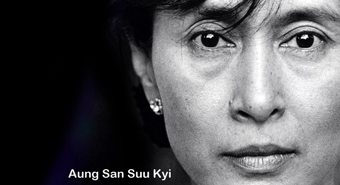
As a contemporary figure making women’s history, Daw Aung San Suu Kyi reflects the kind of ‘power-to’ leadership which is truly earth shattering.
“Regime change can be temporary,” she says, “but value change is a long-term business. We want the values in our country to be changed. “
Winner of the Nobel Peace Prize in 1991 Daw Aung San Suu Kyi is the leading pro-democracy opposition leader in Myanmar, formerly known as Burma, one of the world’s most isolated and repressive nations.
Since a military junta grabbed power of the country in 1962, it has secured its power by rigging elections and suppressing opposition. Ms. Aung San Suu Kyi spent 15 of the last 20 years under house arrest after her party, the National League for Democracy, won an overwhelming victory in the 1990 elections but was denied power. In November 2010 elections, Myanmar’s main military-backed party won in a vote again engineered to assure the military’s continued grip on power. The National League of Democracy boycotted this election and called it what it was—undemocratic.
Ms. Aung San Suu Kyi—who was released from house-arrest November of 2010—and her party, the National League for Democracy, have chosen to participate in elections this time around. On April 1 of this year, Suu Kyi and other pro-democratic candidates will run for 47 of the 48 open seats in Parliament.
Her campaign speech, which will appear on National TV, will mark the first time the Nobel Peace laureate has been given the opportunity to use state media to promote her party’s platform. She calls for amending the 2008 constitution,
Read MoreWear The Shirt And Make Women’s History
“Well behaved women rarely make history” ~ Laurel Thatcher Ulrich

I often wear a t-shirt bearing historian Ulrich’s advice because people react with a chuckle and it starts conversations. Conversations we need because women’s history is rarely given its due.
March is Women’s History Month, so designated because history has largely been framed through the male lens, recorded by male pens, and thus not surprisingly showcases men as the protagonists and the leaders; women, if noticed at all, play supporting roles (unless of course they take “male” personas, such as generals).
Yet women were everywhere, giving birth to everyone, among many other accomplishments. I’ve often wondered whether, if women had been documenting history for the last millennium, keeping peace and making things rather than making war and destroying things would be the central organizing narrative.
Then, once history is made, it seems so normal that it can easily be taken for granted. When I asked my grandson if he would vote for a woman for president, he responded “Yeaaah” in that drawn out way that made it sound as though I had three heads to ask such a dumb question.
And Sunday’s New York Times front page boasted a photo of German Chancellor Angela Merkel and International Monetary Fund head Christine Lagarde—with little comment about what a power shift those two symbolize. Yet, as Lagarde said at the recent Women in the World conference, the global financial meltdown might not have occurred if Lehman Brothers had been Lehman Sisters—or at least Lehman Brothers and Sisters. History has consequences for the future.
Women’s History: A Revolutionary Shift
Read MoreFrom Olympe de Gouges to Women Demanding Rights Worldwide
“A woman has the right to mount the scaffold. She must possess equally the right to mount the rostrum [speaker’s platform].”
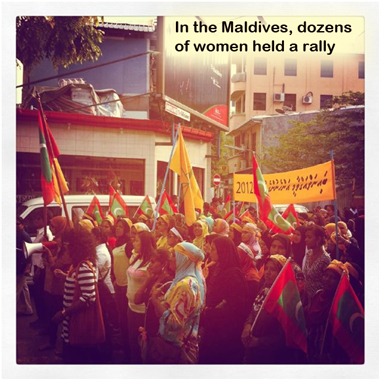
Olympe de Gouges was an 18th Century French playwright and political activist way ahead of her time, and her feminist and abolitionist writings stirred political discourse in ways that presaged uprisings by women around the world last week.
Disenchanted when equal rights were not extended to women after the outbreak of the French Revolution, Olympe de Gouges wrote a Declaration of the Rights of Woman and the Female Citizen. Modeled on the 1789 Declaration of the Rights of Man and of the Citizen by the National Assembly, De Gouges’ Declaration echoed the same language, replacing ‘Man’ with ‘Woman’.
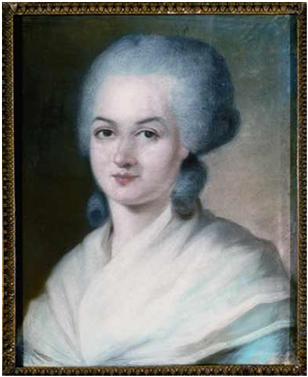 De Gouges argued that the rights revolutionaries were attempting to expand for men should be extended to women as well. She passionately insisted upon universal suffrage, legal equality in marriage, women’s right to divorce in cases of abuse and her right to property and custody of her children, among other things. In her postscript, Gouges exhorted women to awaken to consciousness of their rights to embrace their power. She encouraged them to step up, take action and demand equality.
Sound familiar?
Read MoreWhat's The Next Great Leap For Women?
You can now find me on ForbesWoman.com. My first post will tell you why it took me so long to get started. And now that I’ve jumped into the deep end of the pool, I want to share what I think is the Next Great Leap for women. I’d love to know what your thoughts are. Victoria Pynchon has already weighed in with an amazing piece about sponsorship.
 Because my book, No Excuses: 9 Ways Women Can Change How We Think About Power, came out officially in paperback on Leap Day—a perfect day for a book about women’s relationship with power, no?—I’ve been thinking hard about what the next great leap forward for women should be. So I thought I’d better check out the history of the every-fourth-year calendar adjustment that gives us February 29.
Leap Day inspired a leap of vision and blazing hope for women in 5th Century Ireland when St. Bridget persuaded St. Patrick to declare a woman could do the unthinkable: ask a man to marry her.
At a time when a woman was, for all practical purposes, owned first by her father and then by her husband, marriage meant not love but economic survival for her and her children. No doubt many seized their one chance to override gendered power norms and choose their own fates.
The tradition continued, with merry belittlements to remind women how little power they had the rest of the time. Men had to pay a fine or give a silk dress if they refused marriage proposals. Women on the prowl for husbands sported red petticoats as warning so poor beleaguered men could dash in the other direction. Haha.
You may be laughing because Leap Day privilege now seems an amusing anachronism. Not only do the majority of men and women think it’s perfectly fine for a female to propose marriage, the End of Men has been proclaimed, Women’s Nation declared, and New York Times columnist Nick Kristof dubs women “Mistresses of the Universe.”
But such puffery masks how far women have yet to go to achieve genuine parity. The next norm-changing leap must be women creating and earning wealth that places the female 51 percent of the population into power balance with their male counterparts.
Read MoreSexist Screed Gone Too Far-Now Rush Must Go
It’s Women’ History Month. Let’s make Rush Limbaugh history. Here’s one action you can take. Stay tuned, and scroll down to the bottom of the post for more every day.
Politico Arena asks:
Conservative radio host Rush Limbaugh has been heavily criticized by the Georgetown University law student who he called a “slut” after she testified on Capitol Hill about women’s access to contraception.
“I’m not the first woman to be treated this way by numerous conservative media outlets, and hopefully I’ll be the last,” Sandra Fluke said on MSNBC’s “The Ed Show.” “This is really inappropriate. This is outside the bounds of civil discourse.”
Although Limbaugh infuriated Democrats by calling Fluke both a “prostitute” and a “slut,” he has shown no signs that he’ll issue an apology.
Should Limbaugh issue an apology? Or will the media firestorm blow over?
My Response: No apology is good enough. Rush must go. Period.
Women have had to put up with his “feminazi” epithets for far too long,
Read MoreAnd Then They Came for Birth Control
As the Senate took up the Blunt amendment that would allow any employer to refuse to provide birth control coverage to employees based on an undefined “religious or moral” objection, women and men are asking me every day what in the heck is going on—are we back in the dark ages? Why do we have to keep fighting these battles?
I recently had the chance to give my answer to that question when I talked with with iVillage host Kelly Wallace and 2012 Election Editor and Correspondent Joanne Bamberger (aka Punditmom) about the many attacks on birth control and abortion. On her own blog, Joanne wrote:
“I feel like I’m living in the time of Hester Prynne and her Scarlet Letter in light of the ongoing and escalating attacks on women’s health, especially when it comes to anything concerning our ‘lady parts.’ Some women on the right say birth control has nothing to do with our health. I say, “What?” ...are we headed back to 1850 or is this just a blip on the political radar?”
There are unfortunately some people who never made it out of the 1850’s or at least the 1950’s.
Read MoreWe’ve Come a Long Way, Maybe: Women’s History Creates the Future
“If women want any rights more than they got, why don’t they just take them, and not be talking about it.”
— Sojourner Truth, 1797-1883. Former slave, abolitionist,
women’s rights activist, Methodist minister.
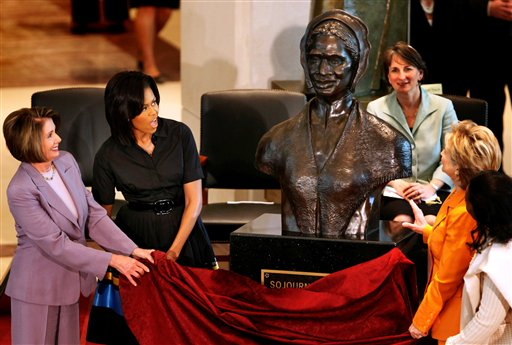
Truth’s admonition seems archaic now. Why are we still “talking about it?”
Is women’s history of struggle for equal rights relevant in a world where women have outpaced men in earning college degrees, equaled their numbers in the workplace, and snatched the family purse to make 85% of consumer purchases?
Since “The End of Men” has been declared and women dubbed “Mistresses of the Universe” shouldn’t young women today, at least those in the industrialized world, feel powerful enough to be and do anything they want?
And shouldn’t more sympathy go to men these days, as the current efforts to gain acceptance for a men’s rights movement have suggested?
Read MoreInspiring Black HERStories
February is Black History Month and March is Women’s History Month. This post by Catherine Engh ties the two together in historical context with links to some amazing but little-known women’s stories. Wow. Feel free to add stories of other such women in the comment section.
And be sure to check back here often as I continue my annual Women’s History Month tradition of highlighting many amazing women—some well known and others not—who have shaped our history. And as you know, No Excuses Power Tool #1 is “Know your history and you can shape the future of your choice.”
Janell Hobson, blogger, social critic and professor of women’s studies, spotlights the lives of various fierce black women throughout history this February on Ms. Magazine’s blog. Hobson’s fascinating posts take as subject black female vocalists, vanguards of the second-wave feminist movement, jazz-age expatriates in Paris, fugitive slaves, civil rights organizers and contemporary environmental justice advocates.
Who knew about Sookie, a slave woman who resisted rape by pushing her master into a soapbox filled with boiling water?
Read MoreSettling the Score: Dorothy Seymour Mills Finally Tells Her Story
“Everyone assumed that he had done all that work by himself — that’s what he wanted them to assume, but we were equal partners” –Dorothy Seymour Mills
- Photo source: Dorothy Jane Mills
Dorothy Seymour Mills is one of the great baseball historians of all time. But you probably never heard of her.
Instead, she worked alongside her late husband, Harold Seymour. From 1960-1990; he received all the credit and did become famous in his field. Together they completed three of the earliest and most widely read books on baseball history.
First in the Field is Dorothy’s belated claim to her own life’s work. In it, she reveals her approach to baseball history, pervasive attitudes about woman interested in baseball, her reasons for finally demanding the credit she deserves so late in life and her struggle for recognition after her husband’s death.
The short eBook reads more like a research paper than a memoir. But then, the author is after all first and foremost a historical researcher. First in the Field moves through her personal and professional history much as an encyclopedia entry might, chronologically from fact to fact, event to event. Readers will not find much in the way of literary language: Dorothy’s narrative is told without literary flourish or thematic subtlety.
Yet despite the stylistic simplicity, or perhaps because of its straightforwardness and lack of pretense, the story will tug at the heartstrings of anyone who has experienced discrimination. And in recognition that one’s personal story is also political, Dorothy ties the personal injustices she faced to the widespread marginalization of women
Read MoreHeartfeldt Leadership: What’s the #1 Leadership Attribute?
 I know I said this column would explore what we can learn about leadership from the presidential candidates’ endless mud-wrestling on our television screens these days. That’s a fascinating analysis I’ll get to eventually—we’ll have plenty of time since the election is still fourteen months away!
But when I realized I’d be writing this column on September 14, the birthday of a significant mentor in my life, I chose instead to focus on the most important leadership lesson I learned from her…
Read More