
Posts Tagged ‘power’
Wear The Shirt And Make Women’s History
“Well behaved women rarely make history” ~ Laurel Thatcher Ulrich

I often wear a t-shirt bearing historian Ulrich’s advice because people react with a chuckle and it starts conversations. Conversations we need because women’s history is rarely given its due.
March is Women’s History Month, so designated because history has largely been framed through the male lens, recorded by male pens, and thus not surprisingly showcases men as the protagonists and the leaders; women, if noticed at all, play supporting roles (unless of course they take “male” personas, such as generals).
Yet women were everywhere, giving birth to everyone, among many other accomplishments. I’ve often wondered whether, if women had been documenting history for the last millennium, keeping peace and making things rather than making war and destroying things would be the central organizing narrative.
Then, once history is made, it seems so normal that it can easily be taken for granted. When I asked my grandson if he would vote for a woman for president, he responded “Yeaaah” in that drawn out way that made it sound as though I had three heads to ask such a dumb question.
And Sunday’s New York Times front page boasted a photo of German Chancellor Angela Merkel and International Monetary Fund head Christine Lagarde—with little comment about what a power shift those two symbolize. Yet, as Lagarde said at the recent Women in the World conference, the global financial meltdown might not have occurred if Lehman Brothers had been Lehman Sisters—or at least Lehman Brothers and Sisters. History has consequences for the future.
Women’s History: A Revolutionary Shift
Read MoreFrom Olympe de Gouges to Women Demanding Rights Worldwide
“A woman has the right to mount the scaffold. She must possess equally the right to mount the rostrum [speaker’s platform].”
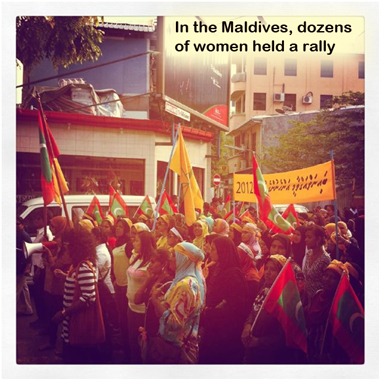
Olympe de Gouges was an 18th Century French playwright and political activist way ahead of her time, and her feminist and abolitionist writings stirred political discourse in ways that presaged uprisings by women around the world last week.
Disenchanted when equal rights were not extended to women after the outbreak of the French Revolution, Olympe de Gouges wrote a Declaration of the Rights of Woman and the Female Citizen. Modeled on the 1789 Declaration of the Rights of Man and of the Citizen by the National Assembly, De Gouges’ Declaration echoed the same language, replacing ‘Man’ with ‘Woman’.
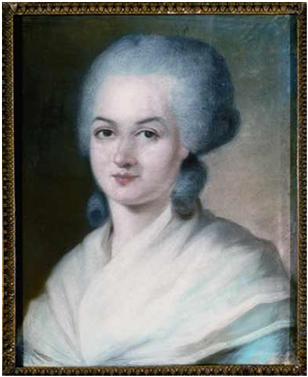 De Gouges argued that the rights revolutionaries were attempting to expand for men should be extended to women as well. She passionately insisted upon universal suffrage, legal equality in marriage, women’s right to divorce in cases of abuse and her right to property and custody of her children, among other things. In her postscript, Gouges exhorted women to awaken to consciousness of their rights to embrace their power. She encouraged them to step up, take action and demand equality.
Sound familiar?
Read MoreShe’s Doing It: Jen Nedeau and the Joy of Media
Are there generational differences in women’s relationship with power?
When I started writing No Excuses, I wanted to interview young women in their 20’s to learn about their relationships with power. Media relations professional and digital strategist Jen Nedeau, then 24, brought together several of her friends for a frank and far reaching conversation.
Jen, who seems to have been born knowing her power, blew me away with her poise, sense of balance, and that power of intention that many women of all ages need to be urged to pursue. See what I mean in her update—she must keep those power tools in her purse, because she uses them so proficiently to deal with the ups and downs of life. (As befitting a digital strategist, you can follow Jen on Twitter @JenNedeau.)

Gloria Feldt: In No Excuses, I asked, “When did you know you had the power to_____?” What have you learned about your power to ______ during the past year or so?
Jen Nedeau: When I spoke to you for the book, we talked about finding the “power source. ” For me, few experiences have been more profound in discovering my own source of power than the past three years I’ve spent in New York. Since moving here, I watched a company I once worked for go bankrupt, I’ve been robbed three times, lived with far too many random roommates and I had to stare down an army of cockroaches on a regular basis in my old apartment in the Lower East Side.
I would definitely say that I had to employ Power Tool #5: Carpe the Chaos on a regular basis.
But if the company I worked for hadn’t gone bankrupt, I probably would not have started my own consultancy and secured a variety of clients in the arts, media and non-profit worlds—proving to myself that I could make it on my own—before taking a job with a major magazine publisher. After two years of living here, I was able to move out of my cramped apartment in the Lower East Side and into a studio apartment, which I am glad to say is thus far, free of Manhattan’s favorite pests.
All of these challenges, big and small, helped me learn that I have the power not only to survive life’s challenges, but succeed despite them. Now, at age 27, I can say that even a bit of struggle can reap big rewards. I am enjoying my life here, meeting amazing people and working on interesting projects, but more importantly, I know that no matter what happens, I have the ability to make it on my own. And independence, in any form, is one of the most empowering tools in the toolbox.
GF: Was there a moment when you felt very powerful recently? Was there a moment when you felt powerless?
How Far Women Have Come and Where They’re Going
“As an activist for women through almost four decades, I know that no movement for social justice moves forward without struggle, nor does forward movement necessarily go in a straight line.”
Today, March 8, is celebrated around the globe as International Women’s Day . Some decry its commercialization, as corporate sponsors have realized it’s in their best interests to appeal to women who make over 85 percent of consumer purchases around the globe.
But it’s a day whose meaning inspires me to think back to a very special moment on September, 1995.
I was attending the United Nations Fourth World Conference on Women, where hugely ambitious and thrilling goals were set for improving the lives of women, and by extension their families and the world.
The official conference was in Beijing, but the much larger convocation of activists from nongovernmental organizations—40,000 enthusiastic women and a few good men like my husband—was literally stuck in the mud in Huairu, a suburb an hour’s drive from the city.
Thousands of sleepy people had arrived at dawn on the morning of Sept. 6, to stand packed together under a roof of brightly colored umbrellas, jockeying for the few hundred seats inside the auditorium where then first lady of the United States Hillary Clinton was slated to give a speech.
Thanks to my training in clinic defense, which had taught me how to form a wedge and move expeditiously through even the most aggressive crowd, I was fortunate not only to get inside but to get a seat. The program was running late; Hillary was running even later and the crowd was getting restless.
Just as it seemed a revolt might be brewing, Shirley May Springer Stanton, the cultural coordinator of the conference, sauntered onto the stage and began to sing a capella, ever so softly: “Gonna keep on moving forward. Never turning back, never turning back.”
Then she asked the audience to join her. Pretty soon the house was rocking. By the time the first lady arrived and gave her brilliant “human rights are women’s rights and women’s rights are human rights” speech, it truly felt like the global movement for women’s rights was unstoppable.
It was, you might say, an ovular moment.
Where are women today? How far have we come?
Read MoreWhat's The Next Great Leap For Women?
You can now find me on ForbesWoman.com. My first post will tell you why it took me so long to get started. And now that I’ve jumped into the deep end of the pool, I want to share what I think is the Next Great Leap for women. I’d love to know what your thoughts are. Victoria Pynchon has already weighed in with an amazing piece about sponsorship.
 Because my book, No Excuses: 9 Ways Women Can Change How We Think About Power, came out officially in paperback on Leap Day—a perfect day for a book about women’s relationship with power, no?—I’ve been thinking hard about what the next great leap forward for women should be. So I thought I’d better check out the history of the every-fourth-year calendar adjustment that gives us February 29.
Leap Day inspired a leap of vision and blazing hope for women in 5th Century Ireland when St. Bridget persuaded St. Patrick to declare a woman could do the unthinkable: ask a man to marry her.
At a time when a woman was, for all practical purposes, owned first by her father and then by her husband, marriage meant not love but economic survival for her and her children. No doubt many seized their one chance to override gendered power norms and choose their own fates.
The tradition continued, with merry belittlements to remind women how little power they had the rest of the time. Men had to pay a fine or give a silk dress if they refused marriage proposals. Women on the prowl for husbands sported red petticoats as warning so poor beleaguered men could dash in the other direction. Haha.
You may be laughing because Leap Day privilege now seems an amusing anachronism. Not only do the majority of men and women think it’s perfectly fine for a female to propose marriage, the End of Men has been proclaimed, Women’s Nation declared, and New York Times columnist Nick Kristof dubs women “Mistresses of the Universe.”
But such puffery masks how far women have yet to go to achieve genuine parity. The next norm-changing leap must be women creating and earning wealth that places the female 51 percent of the population into power balance with their male counterparts.
Read MoreSexist Screed Gone Too Far-Now Rush Must Go
It’s Women’ History Month. Let’s make Rush Limbaugh history. Here’s one action you can take. Stay tuned, and scroll down to the bottom of the post for more every day.
Politico Arena asks:
Conservative radio host Rush Limbaugh has been heavily criticized by the Georgetown University law student who he called a “slut” after she testified on Capitol Hill about women’s access to contraception.
“I’m not the first woman to be treated this way by numerous conservative media outlets, and hopefully I’ll be the last,” Sandra Fluke said on MSNBC’s “The Ed Show.” “This is really inappropriate. This is outside the bounds of civil discourse.”
Although Limbaugh infuriated Democrats by calling Fluke both a “prostitute” and a “slut,” he has shown no signs that he’ll issue an apology.
Should Limbaugh issue an apology? Or will the media firestorm blow over?
My Response: No apology is good enough. Rush must go. Period.
Women have had to put up with his “feminazi” epithets for far too long,
Read MoreAnd Then They Came for Birth Control
As the Senate took up the Blunt amendment that would allow any employer to refuse to provide birth control coverage to employees based on an undefined “religious or moral” objection, women and men are asking me every day what in the heck is going on—are we back in the dark ages? Why do we have to keep fighting these battles?
I recently had the chance to give my answer to that question when I talked with with iVillage host Kelly Wallace and 2012 Election Editor and Correspondent Joanne Bamberger (aka Punditmom) about the many attacks on birth control and abortion. On her own blog, Joanne wrote:
“I feel like I’m living in the time of Hester Prynne and her Scarlet Letter in light of the ongoing and escalating attacks on women’s health, especially when it comes to anything concerning our ‘lady parts.’ Some women on the right say birth control has nothing to do with our health. I say, “What?” ...are we headed back to 1850 or is this just a blip on the political radar?”
There are unfortunately some people who never made it out of the 1850’s or at least the 1950’s.
Read MoreDid Franklin Graham Damn Obama or Santorum?
Were you as appalled at Franklin Graham’s interview on Morning Joe as I was?

Politico Arena asked:
Evangelist Franklin Graham yesterday called President Obama’s religious views into question, stating he does not know if Obama is a Christian. http://huff.to/xEEBXb
Are Graham’s comments a sign that religious voters are questioning Obama’s faith? Or will the comments lose steam before the election?
My Response: As I watched that interview with Franklin Graham yesterday, I felt I was seeing the worst of fundamentalist arrogance unfolding for all the world to see. Republicans are going to regret ever letting this man open his mouth on their behalf. Every sound bite in his disgusting attempt to create doubt about the President’t religious beliefs made Graham look more bigoted and less like the moral beacon one expects a man of the cloth to be.
His hypocritical endorsement of Santorum (and even Gingrich!) while damning Obama with faint praise showed Graham to be the morally compromised person.
Read MoreGood Move, MSNBC: Buchanan’s Out, Harris Perry’s In
Was MSNBC wrong to move Pat Buchanan out? I think that’s good news, but the better news is that Melissa Harris Perry is moving in. I had the pleasure of doing a practice run with her recently and look forward to the launch of her show this weekend. Vigilant media advocacy for fair treatment by groups like the Women’s Media Center (where I’m on the board) does pay off eventually.
Arena asks: Was Pat Buchanan’s Firing Fair?
My response: It’s time for these men, like Pat Buchanan, Foster Friess, and Rick Santorum to climb back under the prehistoric rock from whence they came.
Read MoreFierce and Female: A Self-Defense Expert Challenges Women To Define What is Non-Negotiable
We often think of power as being a concept that is disembodied and theoretical. But it’s also very physical.
I previously posted here about Ellen Snortland, whose book, Beauty Bites Beast, about the psychological value as well as the physical importance of women becoming proficient at self-defense I always recommend to my students when I teach Women, Power, and Leadership.
Now comes Dr. Ruthless with yet more practical tools for what she refers to as the “Killer Instinct…to preserve and protect life.” And, she says, women need to forge their fear into fire. Read on…and share your experiences with physical fear and strength.
Q&A With Dr. Ruthless on her “Dharma of Defense” and Why we Must Venerate the Warrior Spirit
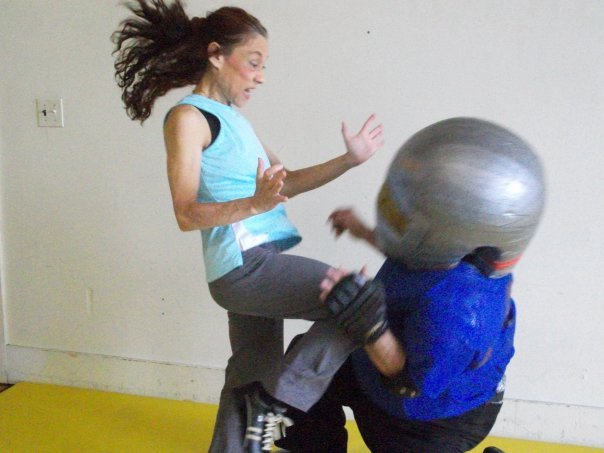
What happens when you combine primal self-defense methods with the insights of a psychotherapist and the heart of a warrior?
Meet Dr. Ruthless, also known as Melissa Soalt. An award-winning women’s self-defense expert and Black Belt Hall of Fame recipient, Dr. Ruthless emerged at the forefront of the women’s self defense movement in the mid 1980’s and has created her own “Dharma of Defense.” You can see her in action in her acclaimed DVD, Fierce & Female.
Her teachings encompass the physical and spiritual dimensions of self-defense. She unabashedly advocates for women to leverage their Killer Instinct —not for the sake of destruction, but to preserve and protect life. In this interview, Dr. Ruthless shares her perspective on the female warrior spirit and why we must learn to mobilize our survival instinct and forge fear into fire.
Brooke Axtell: What attracted you to training in self-defense and teaching other women how to defend themselves?
Dr. Ruthless: In my late teens, I lived in the Middle East and traveled around Asia. I was attacked multiple times and violently groped. I learned I was a scrappy bitch. I successfully fought off rape attempts in Israel and Pakistan and I suffered a lot of indignities. Women who have been violated know what it’s like to be reduced to anti-matter. It’s utterly dehumanizing. I also witnessed appalling inequities, the ways women are controlled by men. This birthed my undying reverence for female disobedience and the need for women’s self defense.
Read More