
Posts Tagged ‘No Excuses’
Rometty’s Epic #FAIL to Lead at Augusta
Talk show bloviator Rush Limbaugh calls 30-year-old Georgetown University law student Sandra Fluke a slut for advocating insurance coverage of contraceptives. Republican National Committee chair Reince Priebus compares women to caterpillars. And the Augusta National Golf Club’s perfectly manicured greens remain firmly planted among those last bastions protecting male hegemony over society’s most powerful economic and political institutions. 
The all-male golf club, based in Augusta, Georgia, has failed once again to award its coveted green jacket to a woman who clearly deserves club membership—IBM’s president and CEO Virginia “Ginni” Rometti. IBM is one of three major corporate sponsors of the club’s vaunted Masters golf tournament, and Rometty is Big Blue’s first female CEO.
But as much as I’ve excoriated Augusta’s male leaders for perpetuating this exclusionary practice, and as much as I believe IBM’s board is culpable for not standing up for their own CEO, I’m even more distressed over Rometty’s failure to take this unprecedented opportunity to lift up not only herself but all women aspiring to the upper echelons of corporate leadership.
Read MoreShe's Doing It: Jamia Wilson Learns Resilience and Power of Inter-generational Bonds
I’m a little biased about Jamia Wilson having had the pleasure of knowing her and working with her as we both went through several career transitions during the last decade.
She’s an inspiration to me because of her seamless commitment to social justice and her positive way of putting her ideas into action.
Her responses to my questions continue the series in which I ask people I interviewed for No Excuses what they’ve learned since then. You can connect with Jamia on Facebook and Twitter.
Gloria Feldt: In No Excuses, I asked, “When did you know you had the power to _____?” What have you learned about your power to _____ during the past year or so?
Jamia Wilson: In the past year or so, I have learned so much about faith and perseverance. I have faced many triumphs and challenges during a transitional time in my life and have learned so much.
The rough edges and moments where I stared fear in the face taught me about the importance of courage and authenticity above all else. I have learned that I have the power to choose to be who I am authentically without apology and let that guide me towards realizing my dreams and my highest power.
As Janis Joplin said, “Don’t compromise yourself, you’re all you’ve got”. 2010-2011’s greatest gift to me was an appreciation for my own resilience and that to me is one of my most sacred superpowers.
GF: Was there a moment when you felt very powerful recently?
Read MoreSlutwalks and Such: Who's Making Women's History Today?
Big thanks and kudos to Catherine Engh for contributing some terrific posts this Women’s History Month. As we end WHM for 2012, here’s one more from Catherine that I know you’ll enjoy, and I hope you’ll think about and take a moment to share your comments. I’ve written a different take on Slutwalk but Catherine has almost persuaded me…
This last year, women around the world made history, protesting victim-blaming online as well as on foot. The Slutwalk movement began after a Toronto police officer told a group of college women that if they hoped to escape sexual assault, they should avoid dressing like “sluts.”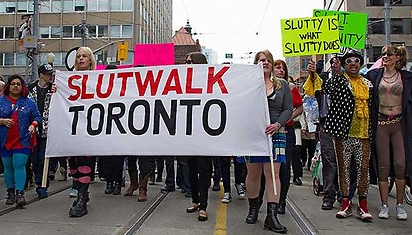
Victim-blaming last year was by no means isolated to this public incident. A young woman who pressed rape charges against two New York City police officers could not be believed, in part, because she was drunk. When an 11-year-old Texas girl was allegedly gang-raped by 19 men, The New York Times ran a story quoting neighbors saying that she habitually wore makeup and dressed in clothes more appropriate for a 20-year-old. The maid who accused Dominique Strauss-Kahn of rape has been discredited for being a liar, and The New York Post claimed she was a prostitute.
The women and men who marched in Slutwalks in more than 70 cities around the world last year were fed up with this kind of symbolic violence. The Slutwalk movement was organized around one central message:
Read MoreShe's Doing It: Kristal Brent Zook Defines Her Own Chaos
Continuing the series of asking women I interviewed when I was writing No Excuses “What have you learned about your relationship with power since we talked?” here is a beautiful essay from Kristal Brent Zook explaining her answer about a very personal choice.
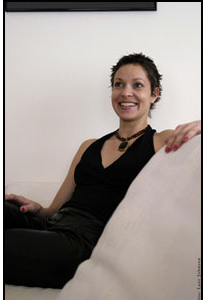
How Gloria Feldt’s No Excuses Reminded Me of My Power
Not long ago, my friend Gloria Feldt, author of No Excuses, asked me to take another look at her 9 ways women can embrace power to see if any of the strategies had resonated lately, in the year or so since the initial release of her book.
Since we all know how political the personal will always be, I thought immediately about the upheavals of the past year in my home life.
Last February, my husband and I decided—on a whim, really—to relocate from Manhattan to the suburbs of Long Island.
“Why not leave the city?” we asked ourselves. It seemed like a good idea at the time. Get some fresh air. A yard. A real house. It would shorten my commute to Hofstra University; and of course, we would be saving all that money.
A charming, two-story 1923 Colonial about 30 miles east of the city caught our eye: it was more than 5,000 square feet, with two sun rooms and front and back yards. The rent was $1,200 less than our midtown high-rise, and ditching New York City taxes meant another $1,000 a month in savings.
“Let’s do it!” we agreed excitedly, handing over a check for the first month’s rent.
Read MoreWho Will the Woman of Tomorrow Be?
“What do you want to be?” we ask our daughters and sons when they are growing up.
It seems only right that as Women’s History Month draws to a close, we don’t just look backward but that we also focus forward to ask what we as women want to be and what women of the future might or should become.
This article on Canadian women’s economic power indicates economic parity is on the way. A new study published in the Harvard Business Review says women are better leaders than men on almost every measure of leadership. But does that translate to women moving from the current 18% to parity in top leadership positions?
Since the power to define the woman of tomorrow is to a large extent in our hands (See Power Tool #3) and based upon the history we make today (see power tool #1), I’m asking what you think:
Read MoreAre You Angry Enough to Embrace Your Power To Act? (3 Signs You Are)
In decades of experience as a women’s advocate, I’ve learned people can be inspired to action by one of two things: anger or aspiration.
 A roiling, boiling anger is propelling women — even many who’ve never been activists before — to embrace their “power to” to take leadership and make change. They’re making their voices heard over the din of political rhetoric they might shun under other circumstances.
There was no one trigger, rather a succession of insults. I talked with Richard Lui about them this week on MSNBC’s Jansing & Co. Here’s a smattering:
- After 30-year-old Georgetown University law student Sandra Fluke was denied the chance to speak about why contraceptives should be covered by insurance…
- After the stunning optics of an all-male “expert” panel pontificating on women’s reproductive health before a Senate committee (also all-male because the women on the committee were so incensed they walked out)…
- After shock jock Rush Limbaugh denigrated Fluke, calling her a slut and a prostitute (can one be both—don’t sluts give it away?) and demanding to see videos of her having sex…
- After bills like those in Texas and Virginia forcing women seeking abortions to submit to 10″ ultrasound “shaming wands” (as Doonesbury dubbed them), an AZ bill requiring women to bring notes to their employers verifying they take birth control for health reasons not pregnancy prevention or risk being fired, and a Tennessee bill that mandates public reporting of the doctors by name and the demographics of each patient…
Women are rightly furious.
Why is this happening?
Read MoreShe’s Doing It: What Courtney Martin Learned This Year
Read MoreWhen I speak on college campuses, I score points with students when they find out I know Courtney Martin, author, among several books, of Perfect Girls, Starving Daughters and Do It Anyway. Though she’s the youngest of the four of us on the WomenGirlsLadies intergenerational feminist panel, she is usually the most together. The one who knows where we’re supposed to be when, gets the power point together, and remains calm when things go awry.
Follow Courtney @courtwrites and find her commentaries on The American Prospect and many other publications. Courtney is the Founding Director of the Solutions Journalism Network, along with New York Times columnist David Bornstein. In addition, she is the leader of the Op-Ed Project’s Public Voices Fellowship Program at Princeton University–coaching women academics to become part of public debate. She is a partner in Valenti Martin Media, a communications consulting firm focused on making social justice organizations more effective in movement building and making change and is an Editor Emeritus at Feministing.com.
Here’s what Courtney says she learned since I interviewed her for No Excuses:
Aung San Suu Kyi Says Value Change Over Regime Change
“Regime change can be temporary, but value change is a long-term business. We want the values in our country to be changed.”
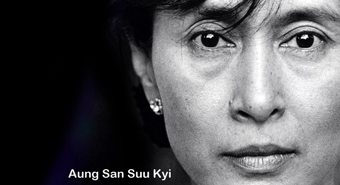
As a contemporary figure making women’s history, Daw Aung San Suu Kyi reflects the kind of ‘power-to’ leadership which is truly earth shattering.
“Regime change can be temporary,” she says, “but value change is a long-term business. We want the values in our country to be changed. “
Winner of the Nobel Peace Prize in 1991 Daw Aung San Suu Kyi is the leading pro-democracy opposition leader in Myanmar, formerly known as Burma, one of the world’s most isolated and repressive nations.
Since a military junta grabbed power of the country in 1962, it has secured its power by rigging elections and suppressing opposition. Ms. Aung San Suu Kyi spent 15 of the last 20 years under house arrest after her party, the National League for Democracy, won an overwhelming victory in the 1990 elections but was denied power. In November 2010 elections, Myanmar’s main military-backed party won in a vote again engineered to assure the military’s continued grip on power. The National League of Democracy boycotted this election and called it what it was—undemocratic.
Ms. Aung San Suu Kyi—who was released from house-arrest November of 2010—and her party, the National League for Democracy, have chosen to participate in elections this time around. On April 1 of this year, Suu Kyi and other pro-democratic candidates will run for 47 of the 48 open seats in Parliament.
Her campaign speech, which will appear on National TV, will mark the first time the Nobel Peace laureate has been given the opportunity to use state media to promote her party’s platform. She calls for amending the 2008 constitution,
Read MoreFrom Olympe de Gouges to Women Demanding Rights Worldwide
“A woman has the right to mount the scaffold. She must possess equally the right to mount the rostrum [speaker’s platform].”
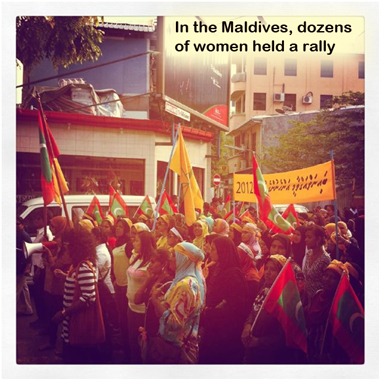
Olympe de Gouges was an 18th Century French playwright and political activist way ahead of her time, and her feminist and abolitionist writings stirred political discourse in ways that presaged uprisings by women around the world last week.
Disenchanted when equal rights were not extended to women after the outbreak of the French Revolution, Olympe de Gouges wrote a Declaration of the Rights of Woman and the Female Citizen. Modeled on the 1789 Declaration of the Rights of Man and of the Citizen by the National Assembly, De Gouges’ Declaration echoed the same language, replacing ‘Man’ with ‘Woman’.
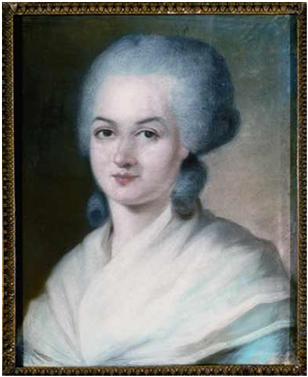 De Gouges argued that the rights revolutionaries were attempting to expand for men should be extended to women as well. She passionately insisted upon universal suffrage, legal equality in marriage, women’s right to divorce in cases of abuse and her right to property and custody of her children, among other things. In her postscript, Gouges exhorted women to awaken to consciousness of their rights to embrace their power. She encouraged them to step up, take action and demand equality.
Sound familiar?
Read MoreShe’s Doing It: Jen Nedeau and the Joy of Media
Are there generational differences in women’s relationship with power?
When I started writing No Excuses, I wanted to interview young women in their 20’s to learn about their relationships with power. Media relations professional and digital strategist Jen Nedeau, then 24, brought together several of her friends for a frank and far reaching conversation.
Jen, who seems to have been born knowing her power, blew me away with her poise, sense of balance, and that power of intention that many women of all ages need to be urged to pursue. See what I mean in her update—she must keep those power tools in her purse, because she uses them so proficiently to deal with the ups and downs of life. (As befitting a digital strategist, you can follow Jen on Twitter @JenNedeau.)

Gloria Feldt: In No Excuses, I asked, “When did you know you had the power to_____?” What have you learned about your power to ______ during the past year or so?
Jen Nedeau: When I spoke to you for the book, we talked about finding the “power source. ” For me, few experiences have been more profound in discovering my own source of power than the past three years I’ve spent in New York. Since moving here, I watched a company I once worked for go bankrupt, I’ve been robbed three times, lived with far too many random roommates and I had to stare down an army of cockroaches on a regular basis in my old apartment in the Lower East Side.
I would definitely say that I had to employ Power Tool #5: Carpe the Chaos on a regular basis.
But if the company I worked for hadn’t gone bankrupt, I probably would not have started my own consultancy and secured a variety of clients in the arts, media and non-profit worlds—proving to myself that I could make it on my own—before taking a job with a major magazine publisher. After two years of living here, I was able to move out of my cramped apartment in the Lower East Side and into a studio apartment, which I am glad to say is thus far, free of Manhattan’s favorite pests.
All of these challenges, big and small, helped me learn that I have the power not only to survive life’s challenges, but succeed despite them. Now, at age 27, I can say that even a bit of struggle can reap big rewards. I am enjoying my life here, meeting amazing people and working on interesting projects, but more importantly, I know that no matter what happens, I have the ability to make it on my own. And independence, in any form, is one of the most empowering tools in the toolbox.
GF: Was there a moment when you felt very powerful recently? Was there a moment when you felt powerless?