
Posts Tagged ‘leadership’
Lesser-Known Women Often Make History
Today in the Women’s History Month series, let’s shine a light on lesser known women. 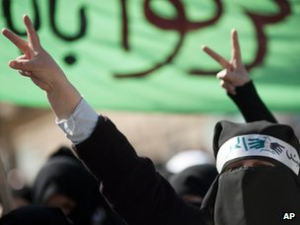
In the spirit of the month, here are links to articles drawing attention to women you may not have heard of—and the awesome things they are doing today.
- Anna Clark has compiled a list of underrated women writers of novels, stories, poems, and graphic novels from around the globe.
- The BBC has profiled some of the women activists involved in Syria’s uprising.
- Bitch Flicks recommends 11 films about trailblazing women.
- Houston Press lists ten of their favorite Female Artists making music today. Rock on ladies!
Aung San Suu Kyi Says Value Change Over Regime Change
“Regime change can be temporary, but value change is a long-term business. We want the values in our country to be changed.”
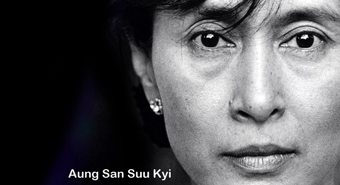
As a contemporary figure making women’s history, Daw Aung San Suu Kyi reflects the kind of ‘power-to’ leadership which is truly earth shattering.
“Regime change can be temporary,” she says, “but value change is a long-term business. We want the values in our country to be changed. “
Winner of the Nobel Peace Prize in 1991 Daw Aung San Suu Kyi is the leading pro-democracy opposition leader in Myanmar, formerly known as Burma, one of the world’s most isolated and repressive nations.
Since a military junta grabbed power of the country in 1962, it has secured its power by rigging elections and suppressing opposition. Ms. Aung San Suu Kyi spent 15 of the last 20 years under house arrest after her party, the National League for Democracy, won an overwhelming victory in the 1990 elections but was denied power. In November 2010 elections, Myanmar’s main military-backed party won in a vote again engineered to assure the military’s continued grip on power. The National League of Democracy boycotted this election and called it what it was—undemocratic.
Ms. Aung San Suu Kyi—who was released from house-arrest November of 2010—and her party, the National League for Democracy, have chosen to participate in elections this time around. On April 1 of this year, Suu Kyi and other pro-democratic candidates will run for 47 of the 48 open seats in Parliament.
Her campaign speech, which will appear on National TV, will mark the first time the Nobel Peace laureate has been given the opportunity to use state media to promote her party’s platform. She calls for amending the 2008 constitution,
Read MoreWear The Shirt And Make Women’s History
“Well behaved women rarely make history” ~ Laurel Thatcher Ulrich

I often wear a t-shirt bearing historian Ulrich’s advice because people react with a chuckle and it starts conversations. Conversations we need because women’s history is rarely given its due.
March is Women’s History Month, so designated because history has largely been framed through the male lens, recorded by male pens, and thus not surprisingly showcases men as the protagonists and the leaders; women, if noticed at all, play supporting roles (unless of course they take “male” personas, such as generals).
Yet women were everywhere, giving birth to everyone, among many other accomplishments. I’ve often wondered whether, if women had been documenting history for the last millennium, keeping peace and making things rather than making war and destroying things would be the central organizing narrative.
Then, once history is made, it seems so normal that it can easily be taken for granted. When I asked my grandson if he would vote for a woman for president, he responded “Yeaaah” in that drawn out way that made it sound as though I had three heads to ask such a dumb question.
And Sunday’s New York Times front page boasted a photo of German Chancellor Angela Merkel and International Monetary Fund head Christine Lagarde—with little comment about what a power shift those two symbolize. Yet, as Lagarde said at the recent Women in the World conference, the global financial meltdown might not have occurred if Lehman Brothers had been Lehman Sisters—or at least Lehman Brothers and Sisters. History has consequences for the future.
Women’s History: A Revolutionary Shift
Read MoreFrom Olympe de Gouges to Women Demanding Rights Worldwide
“A woman has the right to mount the scaffold. She must possess equally the right to mount the rostrum [speaker’s platform].”
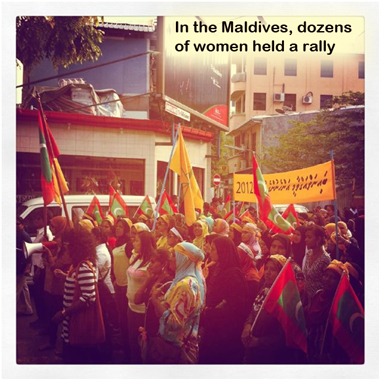
Olympe de Gouges was an 18th Century French playwright and political activist way ahead of her time, and her feminist and abolitionist writings stirred political discourse in ways that presaged uprisings by women around the world last week.
Disenchanted when equal rights were not extended to women after the outbreak of the French Revolution, Olympe de Gouges wrote a Declaration of the Rights of Woman and the Female Citizen. Modeled on the 1789 Declaration of the Rights of Man and of the Citizen by the National Assembly, De Gouges’ Declaration echoed the same language, replacing ‘Man’ with ‘Woman’.
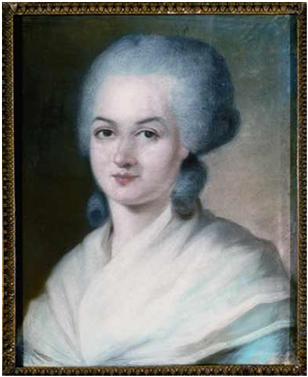 De Gouges argued that the rights revolutionaries were attempting to expand for men should be extended to women as well. She passionately insisted upon universal suffrage, legal equality in marriage, women’s right to divorce in cases of abuse and her right to property and custody of her children, among other things. In her postscript, Gouges exhorted women to awaken to consciousness of their rights to embrace their power. She encouraged them to step up, take action and demand equality.
Sound familiar?
Read MoreShe’s Doing It: Jen Nedeau and the Joy of Media
Are there generational differences in women’s relationship with power?
When I started writing No Excuses, I wanted to interview young women in their 20’s to learn about their relationships with power. Media relations professional and digital strategist Jen Nedeau, then 24, brought together several of her friends for a frank and far reaching conversation.
Jen, who seems to have been born knowing her power, blew me away with her poise, sense of balance, and that power of intention that many women of all ages need to be urged to pursue. See what I mean in her update—she must keep those power tools in her purse, because she uses them so proficiently to deal with the ups and downs of life. (As befitting a digital strategist, you can follow Jen on Twitter @JenNedeau.)

Gloria Feldt: In No Excuses, I asked, “When did you know you had the power to_____?” What have you learned about your power to ______ during the past year or so?
Jen Nedeau: When I spoke to you for the book, we talked about finding the “power source. ” For me, few experiences have been more profound in discovering my own source of power than the past three years I’ve spent in New York. Since moving here, I watched a company I once worked for go bankrupt, I’ve been robbed three times, lived with far too many random roommates and I had to stare down an army of cockroaches on a regular basis in my old apartment in the Lower East Side.
I would definitely say that I had to employ Power Tool #5: Carpe the Chaos on a regular basis.
But if the company I worked for hadn’t gone bankrupt, I probably would not have started my own consultancy and secured a variety of clients in the arts, media and non-profit worlds—proving to myself that I could make it on my own—before taking a job with a major magazine publisher. After two years of living here, I was able to move out of my cramped apartment in the Lower East Side and into a studio apartment, which I am glad to say is thus far, free of Manhattan’s favorite pests.
All of these challenges, big and small, helped me learn that I have the power not only to survive life’s challenges, but succeed despite them. Now, at age 27, I can say that even a bit of struggle can reap big rewards. I am enjoying my life here, meeting amazing people and working on interesting projects, but more importantly, I know that no matter what happens, I have the ability to make it on my own. And independence, in any form, is one of the most empowering tools in the toolbox.
GF: Was there a moment when you felt very powerful recently? Was there a moment when you felt powerless?
How Far Women Have Come and Where They’re Going
“As an activist for women through almost four decades, I know that no movement for social justice moves forward without struggle, nor does forward movement necessarily go in a straight line.”
Today, March 8, is celebrated around the globe as International Women’s Day . Some decry its commercialization, as corporate sponsors have realized it’s in their best interests to appeal to women who make over 85 percent of consumer purchases around the globe.
But it’s a day whose meaning inspires me to think back to a very special moment on September, 1995.
I was attending the United Nations Fourth World Conference on Women, where hugely ambitious and thrilling goals were set for improving the lives of women, and by extension their families and the world.
The official conference was in Beijing, but the much larger convocation of activists from nongovernmental organizations—40,000 enthusiastic women and a few good men like my husband—was literally stuck in the mud in Huairu, a suburb an hour’s drive from the city.
Thousands of sleepy people had arrived at dawn on the morning of Sept. 6, to stand packed together under a roof of brightly colored umbrellas, jockeying for the few hundred seats inside the auditorium where then first lady of the United States Hillary Clinton was slated to give a speech.
Thanks to my training in clinic defense, which had taught me how to form a wedge and move expeditiously through even the most aggressive crowd, I was fortunate not only to get inside but to get a seat. The program was running late; Hillary was running even later and the crowd was getting restless.
Just as it seemed a revolt might be brewing, Shirley May Springer Stanton, the cultural coordinator of the conference, sauntered onto the stage and began to sing a capella, ever so softly: “Gonna keep on moving forward. Never turning back, never turning back.”
Then she asked the audience to join her. Pretty soon the house was rocking. By the time the first lady arrived and gave her brilliant “human rights are women’s rights and women’s rights are human rights” speech, it truly felt like the global movement for women’s rights was unstoppable.
It was, you might say, an ovular moment.
Where are women today? How far have we come?
Read MoreLoretta Lynn, The Pill, and Family Planning: Happy International Women’s Day!
Just in time to celebrate International Woman’s Day, Catherine Eng contributes this blog post that celebrates a medical solution to family planning that many take for granted and yet remains out of reach 52 years later to millions of women around the world.
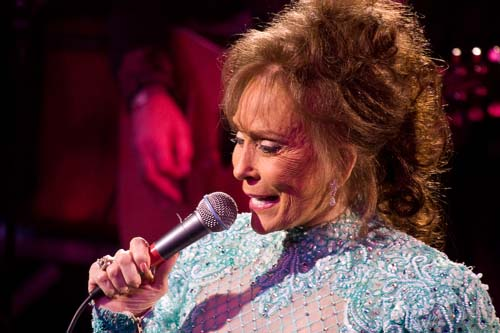
Country music legend Loretta Lynn was known for lyrics that bluntly addressed issues in the lives of many women. She believed no topic was off limits, as long as it spoke to other women.
In 1975, Lynn released The Pill, a single considered to be the first song to discuss birth control. The song tells a story of a wife who is upset about her husband getting her pregnant year after year, but is now happy because she can control her own reproductive choices. The song’s frank discussion of birth control was unprecedented at a time when many would have considered contraception a risqué subject matter. Some radio stations refused to play her song on these grounds.
“There’s gonna be some changes made right here on nursery hill…‘cause now I’ve got the pill.”
Be sure to click on the video link below to listen and laugh.
In an interview later in life, Lynn recounted how she had been congratulated after the song’s success by a number of rural physicians, telling her how The Pill had done more to highlight the availability of birth control in isolated, rural areas, than all the literature they’d released.
Fifty-two years after the inception of the pill in America, conservative newscaster Rush Limbaugh felt free to call Sandra Fluke, a Georgetown university student who asked her university to cover hormonal birth-control, a prostitute and a whore. His ignorant comment reminds us that there still exist widespread misconceptions and stigmas surrounding contraception. Let’s take the opportunity on International Women’s day to clear up any misconceptions, to examine the many social benefits of contraception and family planning.
Read MoreShe's Doing It: Philactivist Barbara Lee Sparks Power of Intention
Yes, I made up “philactivist.” But what else do you call someone who combines philanthropy with political activism in a unique way, driven by her power of intention. Barbara Lee is one of the women I profiled in No Excuses because I so admire her drive, her vision, and her commitment to women’s advancement in politics. This continues my series of “She’s Doing It” columns in which I ask women what they have learned since I interviewed them.
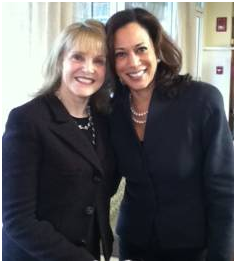
Barbara Lee pictured with California Attorney General Kamala Harris
Gloria Feldt: In No Excuses, I asked, “When did you know you had the power to_____?”
What have you learned about your power to _____ during the past year or so?
Going to Girl Scout camp at age 12 was my first time away from home. I vividly recall the sound and smell of fresh pine needles crunching under my feet as I gathered twigs to build a fire to earn my campfire badge. I remember rubbing two sticks together for what seemed like forever and with each spark I learned more and more about the power of intention. I was determined to start that fire. It was the first step for me in knowing my own power. Ever since I have kindled my belief in myself and have used the power of intention to make the world a better place for women.
Barbara Lee: Was there a moment when you felt very powerful recently? If so, please describe the circumstances, what you did, and why you were aware of your power. Was there a moment when you felt powerless recently? If so, please describe the circumstances, what you did, and why you felt your lack of power.
Read MoreHas the “War on Women” Gone Too Far?
Surely Politico jests. I’m sure you can add to my examples:
Politico Arena asks:
 Democrats are raising money with a petition against the “Republican War on Women.” Rep. Debbie Wasserman Schultz, the DNC chair, repeated the jibe Sunday on “Meet the Press” when asked about Rush Limbaugh’s recent comments on contraception.
Now that Limbaugh has apologized, will voters see “war on women” language as overkill? Particularly those who oppose the Obama administration’s contraception coverage policy on moral/religious grounds?
My Response: You’re kidding, right? There’s hardly even a truce.
Rush Limbaugh calling Georgetown University student Sandra Fluke a slut and a prostitute as she asked her university to cover hormonal birth-control and the subsequent fury that caused many of his advertisers to abandon him (and his very lame non-apology apology) was one small skirmish in the much larger and ongoing war on women being waged by an ideologically driven minority who would much prefer that women had remained barefoot and pregnant in the kitchen.
Just this past week, Roy Blunt and other Senate Republicans sought to pass legislation that would allow any employer to deny preventive contraceptive health services to their employees on the basis of any religious or “moral” objections. As though women are wanton hussies with no morals or religion.
Read MoreWhat's The Next Great Leap For Women?
You can now find me on ForbesWoman.com. My first post will tell you why it took me so long to get started. And now that I’ve jumped into the deep end of the pool, I want to share what I think is the Next Great Leap for women. I’d love to know what your thoughts are. Victoria Pynchon has already weighed in with an amazing piece about sponsorship.
 Because my book, No Excuses: 9 Ways Women Can Change How We Think About Power, came out officially in paperback on Leap Day—a perfect day for a book about women’s relationship with power, no?—I’ve been thinking hard about what the next great leap forward for women should be. So I thought I’d better check out the history of the every-fourth-year calendar adjustment that gives us February 29.
Leap Day inspired a leap of vision and blazing hope for women in 5th Century Ireland when St. Bridget persuaded St. Patrick to declare a woman could do the unthinkable: ask a man to marry her.
At a time when a woman was, for all practical purposes, owned first by her father and then by her husband, marriage meant not love but economic survival for her and her children. No doubt many seized their one chance to override gendered power norms and choose their own fates.
The tradition continued, with merry belittlements to remind women how little power they had the rest of the time. Men had to pay a fine or give a silk dress if they refused marriage proposals. Women on the prowl for husbands sported red petticoats as warning so poor beleaguered men could dash in the other direction. Haha.
You may be laughing because Leap Day privilege now seems an amusing anachronism. Not only do the majority of men and women think it’s perfectly fine for a female to propose marriage, the End of Men has been proclaimed, Women’s Nation declared, and New York Times columnist Nick Kristof dubs women “Mistresses of the Universe.”
But such puffery masks how far women have yet to go to achieve genuine parity. The next norm-changing leap must be women creating and earning wealth that places the female 51 percent of the population into power balance with their male counterparts.
Read More