
Posts Tagged ‘courage’
Ma McDonough Was No Ordinary Woman
Another great guest post. All of them have made this my best WHM series ever. Today’s post is from Liz O’Donnell from Hello Ladies. I hope you enjoy reading about her great-grandmother as much as I do.
 I live in the house where I was raised. Some may think of me as a “townie,” one of those New England creatures who never leaves home. And when they look at my house, I’m sure they see a place that needs lots of work. The yard needs landscaping, the upstairs bathroom needs plumbing, and the kitchen has a gaping hole in the ceiling over the sink (see upstairs bathroom). But what they can’t see is the foundation. Not the cement that supports the frame of the house, but the history that holds me up.
This Women’s History Month. While I honor the women who have, should or will make the history books – Rosa Parks, Lilly Ledbetter, Hillary Clinton and so many others, I find myself thinking about my personal history and one of the women who shaped my life. The National Women’s History Project writes, “Learning about women’s tenacity, courage, and creativity throughout the centuries is a tremendous source of strength.” I know this is true.
Eighty years ago, my great-grandmother Ma McDonough bought the house where I live. At that time, women didn’t purchase property, but Ma McDonough was no ordinary woman.
My great-grandmother came from a well-to-do family in Ireland. As was the tradition then, her older brother was set to inherit the family farm and she would inherit nothing. So Ma McDonough left for Boston, rather than be dependent on someone else. She married, raised four children and somehow managed to save money. When her husband died, she moved out of the city and bought herself and three of her then adult children a new house in the suburbs. It was the Great Depression and the builder had run out of money. Ma McDonough had cash and moved in.
Read MoreAlice Paul's Equal Rights Amendment Back at the Plow
“I never doubted that equal rights was the right direction. Most reforms, most problems are complicated. But to me there is nothing complicated about ordinary equality.” – Alice Paul, suffragist and author of the still-not-ratified Equal Rights Amendment
Yesterday, March 22, was World Water Day. That got a modicum of press. But did you 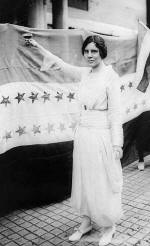 know it was also the 39th anniversary of the date on which Equal Rights Amendment (ERA) passed out of the U. S. Congress and was sent to the states to be ratified? Probably not. And yet, if there is a resource women need as much as clean water, it must be the guarantee of equality under the law.
The original ERA, introduced in Congress in 1923, was written by Alice Paul, a women’s rights activist instrumental in the 1920 ratification of the 19th amendment, which guaranteed women’s right to vote. Paul also started the National Women’s Party, believing that without a political organization’s clout, women’s concerns would never be taken seriously by politicians. Paul was also one of the few women’s suffrage leaders who realized that getting the right to vote was necessary but not sufficient to enable women to be equal partners in society. She argued that those who had fought for suffrage should then shift their work to getting laws passed that would continue to expand women’s rights.
“When you put your hand to the plow,” Paul said, “you can’t put it down until you get to the end of the row.”
How right she was! And we aren’t there yet.
Read MoreThe 7 C’s of Why We Must Embrace Controversy to Change the World
I have the pleasure of speaking to each “class” of Progressive Women’s Voices, an exciting program of the Women’s Media Center, where I serve on the board. This started during the first class two years ago when I was asked about the lessons I learned leading a social movement where I worked a great deal with the media and messages as vehicles of social change. My comments have evolved over time from the conversations I’ve had with PWV participants and Heartfeldt Politics readers. So as I prepared today to speak to the final 2009 class tomorrow evening, I decided to share the latest iteration here on my blog. Please let me know your thoughts.
The angry, gunslinging, mobs opposing President Obama’s healthcare plan at town halls have created quite a stir. Screaming confrontations aren’t just great political theater that captures media attention, did you know they literally make your blood pressure rise and cause other involuntary physical anxiety-fear-pain-fight-flight reactions?
If you’re a live-and-let-live sort of person, as most Americans are, your first reaction to public controversy might be a racing heartbeat, but it won’t be long before you’ll probably want to race away. We have millennia of rape and pillage warnings in our brains, after all. Who needs it?
Well, actually you do if you’re interested in getting health reform in our time, or if you’re advancing any personal or organizational mission that you care about through the democratic process. Your voice is essential.
Public disruptions succeed not because they are necessarily proposing valid points of view, but for two other reasons:
- The people are organized, passionate, and persistent. They know that if they can cause enough discomfort, the rest of us will probably back away, go silent, and leave the field to them.
- They take charge of the conversation, frame the issue as they see it, and change the terms of the debate.
Let’s look deeper at these two dynamics.
With regard to public discourse: You can’t change eggs into omelets without breaking them. It’s not surprising that change will always upset some people. That causes controversy. It’s just the nature of the beasts social change movements have to dance with. As Dr. Joycelyn Elders, the former Surgeon General who was pushed out of her job when she said controversial things about the positive value of masturbation, told me one time, “When you are dancing with the bear, you don’t get to sit down until he’s ready.”
Since we can’t avoid controversy when we’re changing the world, we have to learn to love it, embrace it, not back away but rather use the energy to advance our cause.
Read MoreCourageous Leadership and the Equal Rights Amendment
Today, March 22, is the anniversary of the U.S. Senate’s passage in 1972 of the Equal Rights Amendment (ERA), a constitutional amendment that would–IF it had been ratified by 3/4 of the states by its ten-year deadline in 1982– have ensured equal rights could not be denied on the basis of gender.
Let me tell you a story about leadership, persistence, and courage.
The original ERA, first introduced in Congress in 1923, was written by Alice Paul, a women’s rights activist Alice Paul toasting the passage of the 19th amendment to the Constitution giving women the right to votewho was instrumental in the 1920 ratification of the 19th amendment, which guaranteed women’s right to vote. Paul also started the National Women’s Party, believing that otherwise women’s concerns would never be taken seriously by politicians.
The ERA has been re-introduced in nearly every session of Congress since then. Bet you didn’t know that, did you? We don’t hear too much about it, bu it’s still very much alive and with the election of Barack Obama there’s a resurging movement to restart the ratification process and get the three additional states needed to give women equal rights in the Constitution that didn’t even consider them citizens when it was written.
Read More