
Define Your Own Terms
Fierce and Female: A Self-Defense Expert Challenges Women To Define What is Non-Negotiable
We often think of power as being a concept that is disembodied and theoretical. But it’s also very physical.
I previously posted here about Ellen Snortland, whose book, Beauty Bites Beast, about the psychological value as well as the physical importance of women becoming proficient at self-defense I always recommend to my students when I teach Women, Power, and Leadership.
Now comes Dr. Ruthless with yet more practical tools for what she refers to as the “Killer Instinct…to preserve and protect life.” And, she says, women need to forge their fear into fire. Read on…and share your experiences with physical fear and strength.
Q&A With Dr. Ruthless on her “Dharma of Defense” and Why we Must Venerate the Warrior Spirit
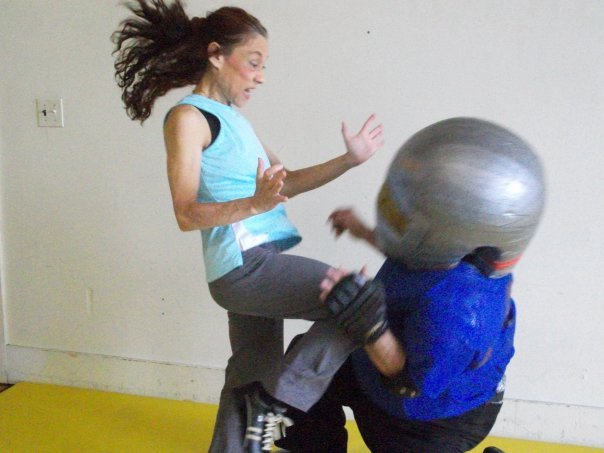
What happens when you combine primal self-defense methods with the insights of a psychotherapist and the heart of a warrior?
Meet Dr. Ruthless, also known as Melissa Soalt. An award-winning women’s self-defense expert and Black Belt Hall of Fame recipient, Dr. Ruthless emerged at the forefront of the women’s self defense movement in the mid 1980’s and has created her own “Dharma of Defense.” You can see her in action in her acclaimed DVD, Fierce & Female.
Her teachings encompass the physical and spiritual dimensions of self-defense. She unabashedly advocates for women to leverage their Killer Instinct —not for the sake of destruction, but to preserve and protect life. In this interview, Dr. Ruthless shares her perspective on the female warrior spirit and why we must learn to mobilize our survival instinct and forge fear into fire.
Brooke Axtell: What attracted you to training in self-defense and teaching other women how to defend themselves?
Dr. Ruthless: In my late teens, I lived in the Middle East and traveled around Asia. I was attacked multiple times and violently groped. I learned I was a scrappy bitch. I successfully fought off rape attempts in Israel and Pakistan and I suffered a lot of indignities. Women who have been violated know what it’s like to be reduced to anti-matter. It’s utterly dehumanizing. I also witnessed appalling inequities, the ways women are controlled by men. This birthed my undying reverence for female disobedience and the need for women’s self defense.
Read MoreThey're Doing It: Jaclyn Friedman Knows What You Really Really Want (Jenn Pozner Interview and Excerpts)
Read More
I am thrilled to share with 9 Ways readers this post generously contributed by Jenn Pozner and posted originally on her WIMN Blog. In it, she interviews Jaclyn Friedman, author of an important new book, What You Really Really Want: The Smart Girl’s Shame-Free Guide to Sex and Safety. The title gives you a great intro, so I won’t embellish except to say that Jenn did a great interview, embellished with her own media critique expertise, and you should read her book Reality Bites Back too!
What power tool is being used here? Oh so many–Define your own terms (about sex) for one and Create a Movement (these two are a powerhouse media justice movement), for sure. See what you think–and read all the way to the latter half of the post for an excerpt from Jaclyn’s book that will make you want to buy it right away.
Friday Round Up: On 40th Anniversary of Women’s Rights Decision, Reed v Reed, Justice Ginsburg Defines Her Legacy
Forty years ago, for the first time in the Fourteenth Amendment’s 103-year history, the U.S. Supreme Court ruled that its Equal Protection Clause protected women’s rights in the case of Reed v. Reed.
In honor of this anniversary and to assess where constitutional protections for women stand today, the National Women’s Law Center co-hosted a panel, entitled “Reed v. Reed at 40: Equal Protection and Women’s Rights.”
Justice Ruth Bader Ginsburg, who was the principal author of the brief (while working for the ACLU) on behalf of the plaintiff in Reed v. Reed led off, followed by this panel moderated by NPR’s legal affairs correspondent, Nina Totenberg…
Read MoreShe's Doing It: Young Women of The Loud Empresses Declare Their Power To!
My heart bursts with joy when people tell me what No Excuses and the message of changing how we think about power so that we can embrace it in a positive way has meant to them.
When I speak to organizations or conferences, I often ask the question “When did you know you had the power to_____.” Each person fills in the blank for herself. Then we discuss the answers with one another. Try it, and talk about it with your friend, sister, mother, or whoever you can requisition.
So after my keynote speech for the New Directions Career Center in Columbus OH (a fantastic organization that helps low income women gain economic self-sufficiency), I had one of those joyful moments. Why?
Read this post by Rae Reed in The Loud Empresses blog, Living Life OutLoud and you’ll see some young women who are embracing their power TO.
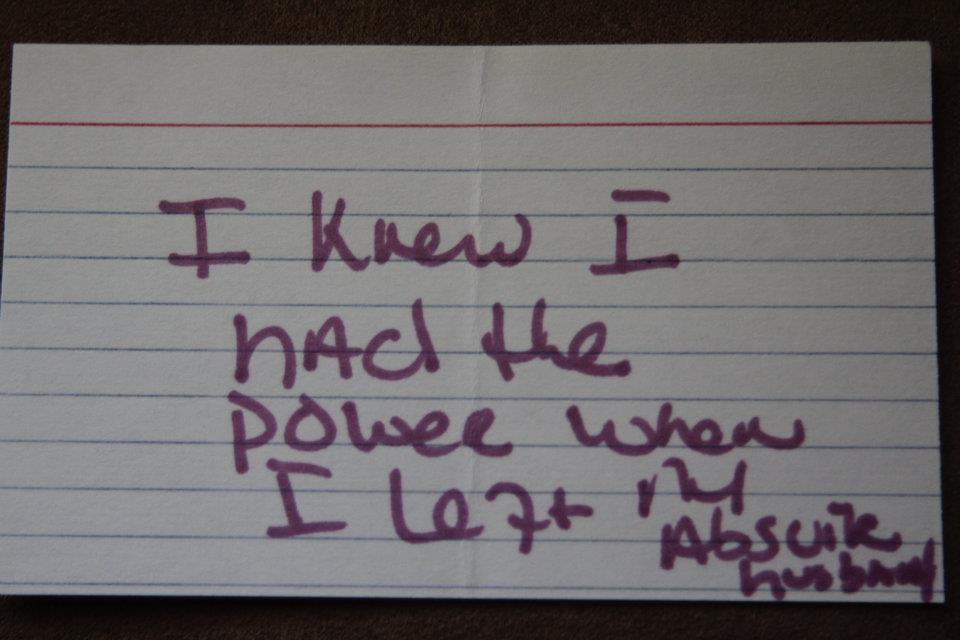
I attended an event last week, Gloria Feldt presenting “No Excuses: 9 Ways Women Can Change How We Think About Power,” hosted by The Center for New Directions.
I’ll be honest. I had no freaking idea what to expect. Young, wearing jeans and a V-neck, I sat amongst women with ears perked, eagerly anticipating the night’s featured speaker.
It wasn’t long before I figured out why. Wisdom poured from her lips like my brain begged for more…
Read MoreShe’s Doing It: Joanne Tombrakos Taking the Non-Traditional Route
I can’t wait to read Joanne Tombrakos’s new and first novel, The Secrets They Kept and you are going to see why below. After reading Joanne’s story, I think you’ll join me in running out to buy her book. At least I hope so.
Joanne and I met at an 85 Broads breakfast a couple of years ago when we shared our stories of making purposeful life transitions. I’ve admired her writing on her blog ever since. And just look at how she’s applied the 9 Ways Power Tools!
Read More
When Gloria Feldt extended the invitation for me to be profiled in this column I quickly accepted. And who wouldn’t? After all this was Gloria Feldt. Best selling author and activist for whom I hold such high esteem.
I was honored. I was excited. Until the waves of nausea washed over me. What was I doing that was worthy of a profile in this column? Certainly not curing cancer or feeding the starving in Africa.
Not a particularly commanding statement when invited to write on a blog whose subject matter is about women and power.
But forced, as I have been to think about it, the truth is I am doing it. My way…
Seriously? Must a Woman Be Like a Man to Get Ahead?
 That question comes up every time I speak with women about their career aspirations.
A second question just as surely follows: if we can’t be authentically who we are, why would we want to “succeed” in male-dominated organizations or professions? Many women who leave the corporate world to stay home with children or enter entrepreneurial or nonprofit fields—or alternately, remain quietly in their jobs put only to find themselves doing the work but not getting the promotions—say they do so because they don’t want to become like men.
Yet all signs point to a potential breakthrough moment for women even as we debate the pros and cons of taking on male camouflage.
Read MoreKate Swift Obit: The Language of Power and the Power of Language
Have you ever heard of Barbara Peabody Smith, who went by her nickname Kate? I hadn’t until I read her obituary last week. Her story is an inspiring reminder of how we can define our own terms. Defining terms by making language nonsexist changes everything–how people think and therefore how people act. Little wonder that this daughter of journalists understood the power of language. But what was groundbreaking about Smith’s life work is that she translated her understanding into the language of political power to secure gender equality laws in her home state.
Guest post by Rosalie Maggio reprinted with permission of the Women’s Media Center.
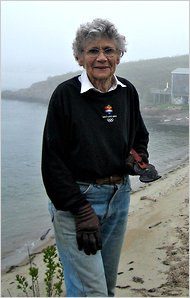 Award winning author and creator of WMC’s “Hot Button Words” series Rosalie Maggio recalls the journalist and activist who alerted the modern women’s movement to the dangers of sexist language.
Nonsexist-language pioneer Kate Swift, 87, died early Saturday morning after a brief encounter with abdominal cancer. Her generous legacy to the world includes her revolutionary influence on our language as well as her productive activism (she helped effect Connecticut’s marriage equality act, protect prochoice legislation, promote progressive candidates, protest the war on Iraq, and conserve the environment). She also leaves numerous admirers who all somehow numbered themselves among her closest and best friends.
Barbara Peabody Swift, always known as Kate, was born in 1923 to parents who were newspaper and magazine journalists, and she obtained her own journalism degree from the University of North Carolina in 1944. Thereafter, she worked as a newswriter, science writer for the Museum of Natural History, editor for the Army’s information and education department, public relations officer for the Girl Scouts of America, press liaison for the Hayden Planetarium, and, in 1965, director of the news bureau of the school of medicine at Yale.
Read MoreWomen's History Friday Roundup: The Rally Edition
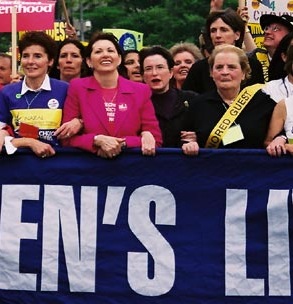 In 2004, women made history by descending on Washington in droves to March for Women’s Lives. Estimates vary about how many people attended the march, but it’s safe to say that there were over 1 million pro-choice activists in D.C. in 2004, myself included.
Last weekend a Walk for Choice was held in cities across the globe. Here is a roundup of photos from rallies across the country–the decentralized nature of the walk made it impossible to get exact numbers, but the geographic dispersion was impressive.
This Is a Sampling of What a Pro-Choice Rally Looks Like:
NYC – Feministing
Boston Walk for Choice
Walk for Choice Chicago – Feministing
Tucson Walks for Choice – Feminists for Choice
But we should not have to fight these battles over and over…
If you’ve got photos that you would like to add to our historical record (however “unofficial” it might be), please leave a link in the comments section. And by all means, take a moment to share your most proactive and innovative thoughts about what history you want to write for the future of reproductive rights, health, and justice.
Read MoreDo You Value Yourself?
Nicole Baute from The Star asked me to share some of the central messages of No Excuses when she interviewed me last week. I posted part of the interview Tuesday on the 9 Ways Blog. Here is another excerpt from that interview.
One of the things in the book that struck me was the stat that women are four times less likely to ask for a raise. Why?
I don’t think we always value our worth as much as men value their worth. Men are pretty ruthless about valuing their worth, they’re not at all timid about it. In fact, they tend to overstate their worth. Women understate their worth.
Why do women isolate themselves and try to fix things on their own?
We’re working in a workplace culture that was designed by men for men, who could work day and night because they had a woman at home taking care of the house and the kids. And that paradigm no longer works for anybody, I don’t think. So as women have entered that workplace culture, if you’re the first one, if you’re the only one in a department, you tend to try to fit yourself into the predominant culture.
That’s exactly why we need to consciously un-isolate ourselves and reach out with what I call Sister Courage. Ask another woman for help if you need it. Ask a man for help if you need it. Offer help if you think someone else needs it.
Do you think that competition — women competing with each other and women competing with men — is a barrier to asking for help?
Read MoreWhat Does Power-To Look Like?
On Monday I asked you when you first realized that you had the power to . . . And I gave you a brief glimpse at my definition of what power-to looks like. Here’s another look at what power-to means:
Power-over focuses on tactics for gaining compliance, while leadership focuses on getting answers and solutions in order to be able to accomplish something for mutual good.
Power-over makes people feel powerless. Even if it isn’t force or brute power, but a manipulative power such as political dominance, the feeling that one has no control over one’s choices makes her disgruntled, angry, or passive-aggressive.
Power-to makes us feel powerfull.
Power-to supports and enhances whatever power the individual brings to a project, workplace, relationship, or civic activity. It abhors coercion. It opens up the possibility of choices; the ability to choose is what makes us human. Choosing is the basis of morality.
Power-over is amoral. Power-to is responsibility.
Power-over is oppression. Power-to is leadership.
What are your thoughts about this definition? How does it change your ideas about power and leadership? Can you give examples of the use of either definitioneof power?
Read More