
Create a Movement
She and He Are Doing It: Earl and Suzanne de Berge Lead Their Dreams in Guatemala, Part II
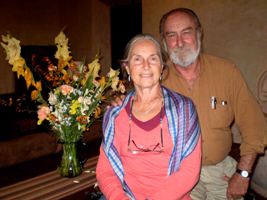
Read MoreIn Part Two of this “She & He are Doing It” series, I spoke further with both Earl and Suzanne de Berge to learn more about the incredible work Seeds for the Future (Semillas para el Futuro) is doing in rural Guatemala and the challenges they face there.
She and He Are Doing It: Earl and Suzanne de Berge Lead Their Dreams in Guatemala, Part I
[/caption]
Read MoreThis week’s “She’s Doing It” column features both a he and a she: a couple who have worked together throughout their adult lives in their Arizona-based business and now are devoting their skills to amazing community development work in rural Guatemala. First of a two-part series.
Suzanne and Earl de Berge founded the public opinion research firm Behavior Research Center in 1965, with Suzanne running the business end and Earl the research end. Politically independent, I met them when BRC began doing opinion research for Planned Parenthood in Arizona in the early 1980’s. They were usually correct in their recommendations, helping us win ballot initiatives and score some big wins in a tough political climate. Here’s Earl’s description of what they are doing now, why this is their dream, and how they are leading–not following–it.
Friday Round Up: The X's have IT!

While the flurry of puns and bad jokes are still ringing in our ears, it has finally happened that another high-ranking, supposedly tech-savvy Congressman resigned in a press conference that hearkened back to the days of Richard Nixon’s resignation.
Read MoreWomen's History Roundup: Create a Movement
Throughout history, men with leadership proclivities have tended to start businesses to create wealth or/and to go into politics. They take the direct path to power for its own sake. Women, on the other hand, tend to start social movements. Susan B. Anthony and women’s rights, Jane Addams and the Settlement House movement, Margaret Sanger and birth control, Candy Lightner and Mothers Against Drunk Driving, and today’s Emily May and Hollaback just to name a few.
The 9 Ways Women’s History Month posts this week are all examples of women starting social movements large and small:
Burning Women: Triangle Fire 100th Anniversary Illuminates Wisconsin Union-Busting
Alice Paul’s Equal Right Amendment Back at the Plow
Violence Against Women: Not in My Backyard – Er, Subway Car
Inspiration from Sin City
What are some other examples of woman-initiated social movements that inspire you?
What new social movement would you start if you could?
Alice Paul's Equal Rights Amendment Back at the Plow
“I never doubted that equal rights was the right direction. Most reforms, most problems are complicated. But to me there is nothing complicated about ordinary equality.” – Alice Paul, suffragist and author of the still-not-ratified Equal Rights Amendment
Yesterday, March 22, was World Water Day. That got a modicum of press. But did you 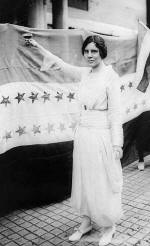 know it was also the 39th anniversary of the date on which Equal Rights Amendment (ERA) passed out of the U. S. Congress and was sent to the states to be ratified? Probably not. And yet, if there is a resource women need as much as clean water, it must be the guarantee of equality under the law.
The original ERA, introduced in Congress in 1923, was written by Alice Paul, a women’s rights activist instrumental in the 1920 ratification of the 19th amendment, which guaranteed women’s right to vote. Paul also started the National Women’s Party, believing that without a political organization’s clout, women’s concerns would never be taken seriously by politicians. Paul was also one of the few women’s suffrage leaders who realized that getting the right to vote was necessary but not sufficient to enable women to be equal partners in society. She argued that those who had fought for suffrage should then shift their work to getting laws passed that would continue to expand women’s rights.
“When you put your hand to the plow,” Paul said, “you can’t put it down until you get to the end of the row.”
How right she was! And we aren’t there yet.
Read MoreInspiration from Sin City
This guest post comes to us from Emmily Bristol, the creator of The Sin City Siren and The Tired Feminist. She is an award-winning writer, a community organizer and a new mom in Las Vegas.
 For Women’s History Month, I knew just who I wanted to talk about: The Westside Mothers of Las Vegas. To me, they embody the power of women and grassroots organizing.
Even as Rat Pack names twinkled in the lights of the 1960s Las Vegas Strip, blacks were segregated into a section of town called the Westside and times were desperate. Among those struggling were single mothers Ruby Duncan, Rosie Lee Seals and many others. They were uneducated, poor and black. They didn’t have any experience as community organizers, but they were motivated to help their hungry children.
In just a few years, they would create an organization — Operation Life — that would grow far beyond their initial neighborhood meetings in living rooms and laundromats. Operation Life opened a community center providing healthcare, poverty programs and home-grown economic development to West Las Vegas for the first time. And they managed to bring the glittering Strip to a stand-still in one of the largest protest marches in Las Vegas Boulevard’s history.
Read MoreThe Value of Women's Work
There has been a marked change in the estimate of [women’s] position as wealth producers. We have never been “supported” by men; for if all men labored hard every hour of the twenty-four, they could not do all the work of the world. A few worthless women there are, but even they are not so much supported by the men of their family as by the overwork of the “sweated” women at the other end of the social ladder. From creation’s dawn. our sex has done its full share of the world’s work; sometimes we have been paid for it, but oftener not.
Any idea when this statement was made? OK, a clue: I recently ran across it in a speech given by Harriot Stanton Blatch at a suffragist convention–in 1898.
 Isn’t it amazing that Blatch made this argument 113 years ago? Her point still resonates today. A study released by the Center for American Progress shows that in the down economy, women increasingly became the sole breadwinners, despite the persistent wage gap, since men were being laid off at higher rates to trim companies’ bottom line. More and more men became “stay-at-home fathers.” And yet we aren’t seeing a change in workplace culture as a result.
Women's History Friday Roundup: The Rally Edition
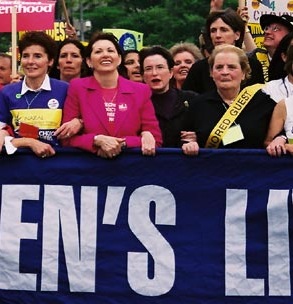 In 2004, women made history by descending on Washington in droves to March for Women’s Lives. Estimates vary about how many people attended the march, but it’s safe to say that there were over 1 million pro-choice activists in D.C. in 2004, myself included.
Last weekend a Walk for Choice was held in cities across the globe. Here is a roundup of photos from rallies across the country–the decentralized nature of the walk made it impossible to get exact numbers, but the geographic dispersion was impressive.
This Is a Sampling of What a Pro-Choice Rally Looks Like:
NYC – Feministing
Boston Walk for Choice
Walk for Choice Chicago – Feministing
Tucson Walks for Choice – Feminists for Choice
But we should not have to fight these battles over and over…
If you’ve got photos that you would like to add to our historical record (however “unofficial” it might be), please leave a link in the comments section. And by all means, take a moment to share your most proactive and innovative thoughts about what history you want to write for the future of reproductive rights, health, and justice.
Read MoreIt Takes Persistence to Move a Mountain
Blogger Beth Terry of Fake Plastic Fish is an amazing woman. I was so moved by her how she used the three principles of movement building: be a sister by reaching out to others with similar concerns, have the courage to raise issues that you feel are important, and put the two together systematically to create movement. Watch the video of Beth telling her story of why and how she persuaded Brita to offer recyclable water filters to US consumers. I knew I had to highlight it in No Excuses the moment I heard about her.
What’s your story? How have you been able to use movement building principles to achieve a goal? What was the issue you wanted to take on? What was the result?
Read MorePower Tool #7: Create a Movement
In this video, women wearing their virtual shirts put their convictions into action. But they didn’t do it alone.
In No Excuses, I show how to apply movement building principles to any area of life. Those principles can be described as Sister Courage: be a sister. Reach out and ask for help when you need it. give help when someone else needs it. Have the courage to raise issues. Put the two together with action and you have a movement.
Think about it. When you needed to plan Thanksgiving dinner, didn’t you call on your sisters to help you plan the menu and distribute the workload? Those same skills can be incorporated into the workplace and in politics.
Read More