
Politics
Equal Pay Day 2011: Are Republicans in Congress Trying to Make Women “Barefoot and Pregnant” Again?
Check out the fair pay flash mob on the steps of the Lincoln Memorial:
Arkansas State Senator Paul Van Dalsem got a roaring laugh in 1963 at the then all-male Optimist Club when he railed at women from the American Association of University Women (AAUW) who were lobbying to improve educational opportunities. He said his home county’s solution would be to get an uppity woman an extra milk cow. “And if that’s not enough, we get her pregnant and keep her barefoot.”
Sounds quaint, doesn’t it? Not so much, though.
Fast forward please to April 11, 2011—the day designated as Equal Pay Day by the National committee on Pay Equity to call attention to the pay gap between men and women. Women currently make about 20% less than men even when the numbers are controlled for education and experience. In other words, the pay disparity does not stem from childbearing as is often assumed, but rather from deeper systemic biases that are reflected in women’s own lack of skills and confidence in negotiating for their pay and promotions.
Read MoreBella Abzug and Florence Feldt: Contrasts in Women's History
Since we’re wrapping up Women’s History Month, this tribute to my mother, Florence Feldt, and feminist icon Bella Abzug–two very different women from the same generation who died on this day in 1998–seems a fitting close.
I hope that you’ve been inspired by this month’s posts, and that they help you create the future of your choice!
My mother Florence Feldt died March 31, 1998.
[caption id="attachment_4037" align="alignright" width="300" caption="Me, my cutie pie sister Candy, and our mother, Florence"][/caption] Read More

Indira Gandhi: World Leader or Witch?
The late Bella Abzug used to say that we would know women have made it when a mediocre woman was as likely to be promoted as a mediocre man. Similarly, we know women have made great strides as leaders when we have to acknowledge imperfections at the same time that we celebrate elevations to power. Thanks to The Daily Femme writer Sara Messelaar, whose thoughtful piece asks important questions about how women leaders–or any historical figures–should be judged. Be sure to read to the end of it and then share your thoughts!
 Just around the corner from my home here in Berlin, the tram stops at the intersection of Berliner Alley and Indira-Gandhi Street. For a long time, whenever the voice in the tram announced “Indira Gandhi Straße,” I thought: “she must have been a really great politician.” That feeling of her “greatness” quietly settled into my subconscious–the very reaction public memorials are supposed to foster in the first place. Mission Public Remembrance Accomplished. Woman’s History Month finally got me to take a real look at Gandhi’s story. I’m really glad I did, because Gandhi’s story is a complicated, unsettling, shocking chapter in women’s history.
Gandhi (who is not related in any way shape or form to Mahatma, by the way) served as the Prime Minister of India for four terms—longer than any other female Prime Minister in the world. Her position as the leader of the world’s largest democracy was especially impressive, since even today women in India struggle for equal treatment. As Cristen wrote, women are so disregarded in India that they don’t even have adequate public bathrooms for them. Gandhi, however, never let any of that get in her way.
Read MoreThank you, Geraldine Ferraro (1935—2011), First Female Major Party VP Candidate
“If we can do this, we can do anything.” –Geraldine Ferraro, accepting the Democratic Party nomination for vice president in 1984
Geraldine Ferraro’s place in history is assured. The smart mouthed tough talking Queens Congresswoman tapped to be Walter Mondale’s vice presidential running mate shattered a particularly stubborn glass ceiling. As I mourned her passing following a valiant 12-year battle with multiple myeloma, I found myself watching her acceptance speech again, not with nostalgia but with celebration, appreciation—and a sense of urgency for the next generation of progressive women political leaders to step forward and continue her legacy.
Read MoreWomen's History Open Thread: Infamous Women
In No Excuses, not all of the women I talk about have had a positive impact on women’s lives. In fact, I share a quote from Madeleine Albright that says “There’s a special place in hell for women who don’t help other women.” But should women support women like Michelle Bachmann and Sarah Palin, who oppose policies that help women, such as reproductive rights, fair pay legislation, and social programs that are most likely to help women and children who constitute the majority of those living in poverty?
Read MoreAlice Paul's Equal Rights Amendment Back at the Plow
“I never doubted that equal rights was the right direction. Most reforms, most problems are complicated. But to me there is nothing complicated about ordinary equality.” – Alice Paul, suffragist and author of the still-not-ratified Equal Rights Amendment
Yesterday, March 22, was World Water Day. That got a modicum of press. But did you 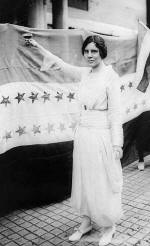 know it was also the 39th anniversary of the date on which Equal Rights Amendment (ERA) passed out of the U. S. Congress and was sent to the states to be ratified? Probably not. And yet, if there is a resource women need as much as clean water, it must be the guarantee of equality under the law.
The original ERA, introduced in Congress in 1923, was written by Alice Paul, a women’s rights activist instrumental in the 1920 ratification of the 19th amendment, which guaranteed women’s right to vote. Paul also started the National Women’s Party, believing that without a political organization’s clout, women’s concerns would never be taken seriously by politicians. Paul was also one of the few women’s suffrage leaders who realized that getting the right to vote was necessary but not sufficient to enable women to be equal partners in society. She argued that those who had fought for suffrage should then shift their work to getting laws passed that would continue to expand women’s rights.
“When you put your hand to the plow,” Paul said, “you can’t put it down until you get to the end of the row.”
How right she was! And we aren’t there yet.
Read More[Video] Wonder Woman Again Puts Political Into Personal Media Images
Wonder Woman: who she is has morphed many times during her seven decades of existence. Depending on who was in control of her image, and what role the prevailing culture wanted women to play in society, she has been a superhero and a boutique owner, her muscles and attire symbolic of strength and courage and of bombshell sexiness. This latest documentary being developed by filmmakers Kristy Guevara-Flanagan & Kelcey Edwards, is called The History of the Universe as Told by Wonder Woman. It’s a project worth supporting–which you can do here.
Read MoreHow Can Women Reach Parity in Elected Office?
I just finished recording this Blogtalk Radio program “Feisty Side of Fifty” hosted by the wonderful Eileen Williams. The other guest was Terry Nagel, currently mayor of Burlingame CA, now running for San Mateo County Supervisor–a woman who walks her talk.
Feisty Side of Fifty Blogtalk Radio 3/15/11
Give it a listen and let me know your thoughts on Eileen’s main question: How can the U.S. get more women in elected office?
Read MoreRemembering Jeannette Rankin, First US Congresswoman
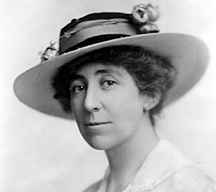 If women had held the preponderance of political leadership roles for the last few millennia, would peace have become more of a central organizing theme of history than war?
Jeannette Rankin, a Montana Republican and lifelong pacifist, was elected to Congress in 1916; that’s four years before the Constitution gave all women the right to vote. Not only did Rankin lead the way as a first for women, she defied all semblance of political tradition by opposing both World War I and World War II.
Rankin’s leadership style has many lessons for us today, especially since she did not shy away from controversy. The subject of Rankin’s very first Congressional vote (against President Wilson’s WWI war resolution) set the stage for her destiny. Rankin lost the support of most of the women’s suffragists who had campaigned for her, because they feared her anti-war vote made women look weak and hurt the suffrage movement. Embracing controversy can be tough when we ruffle the feathers of our opponents, but it’s even tougher when we lose the support of our closest friends and allies.
Read MoreWe Need a Million for a Billion
Today’s guest post comes to us from The Population Institute. I highlight it because the 100th anniversary of International Women’s Day is being celebrated at events around the world today. The best way I can think of to celebrate IWD is to petition the U.S. Congress and other world leaders to make good on their commitments to fund international family planning. In No Excuses, I show why reproductive self-determination is essential for women to have any other kind of power. But the Republicans are trying to eliminate or drastically cut family planning funds in the U.S. and globally. Even if you don’t have time to read the whole post, please click here to sign the petition now. You’ll be saving women’s lives.
It’s time to hold world leaders accountable for their promises. Seventeen years ago world leaders gathered in Cairo, Egypt, and declared access to reproductive health care to be a universal right, but for many that right has not been realized. An estimated 215 million married women in the developed world want to avoid a pregnancy, but are not using a modern method of birth control. Tens of millions of young men and women are at risk of acquiring HIV/AIDS and other sexually transmitted diseases.
It’s time to make access to contraceptives and reproductive health care a reality, not just a right. Need another reason? By giving women the power to prevent unwanted and unintended pregnancies we save lives. Every year 365,000 women, many of them too young to bear children, die as a result of pregnancy-related causes.