
Leadership
Here's Your "Taking AAUW Home" Personal Reflections and Action Guide

Read MoreIt’s been great to be in Washington DC and an honor to give the closing keynote at the American Association of University Women (AAUW) National Convention. AAUW features in an important part of women’s history I share in No Excuses (page 175 if you have the book). That makes it extra special to be here.
Friday Round Up: The X's have IT!

While the flurry of puns and bad jokes are still ringing in our ears, it has finally happened that another high-ranking, supposedly tech-savvy Congressman resigned in a press conference that hearkened back to the days of Richard Nixon’s resignation.
Read MoreShe’s Doing It: Victoria Pynchon “She Negotiates” to Improve Dispute Resolution

Ever meet someone you instantly know is a force of nature and will be a great friend forever? I met Vickie Pynchon –attorney, mediator and arbitrator, partner in the She Negotiates Consulting and Training firm, prolific Forbes.com blogger, and author of A is for A**hole: the Grownups’ ABC’s of Conflict Resolution–during the worst icy snowstorm I’ve ever witnessed in New York City.
I’d blown off a chance to meet
Read MoreFriday Roundup: Will Women Leaders Carpe the Chaos?

Earlier this week, I came across an article titled “Why ‘Female’ Skills Are Worth More.”
This week’s roundup reflects the news that in the current financial chaos, with a little help sex scandals here and there, women are taking important leading roles in journalism, finance, and government. It’s a really big deal that the New York Times has its first female executive editor–check out these takes on Jill Abramson’s appointment:
Read MoreIndira Gandhi: World Leader or Witch?
The late Bella Abzug used to say that we would know women have made it when a mediocre woman was as likely to be promoted as a mediocre man. Similarly, we know women have made great strides as leaders when we have to acknowledge imperfections at the same time that we celebrate elevations to power. Thanks to The Daily Femme writer Sara Messelaar, whose thoughtful piece asks important questions about how women leaders–or any historical figures–should be judged. Be sure to read to the end of it and then share your thoughts!
 Just around the corner from my home here in Berlin, the tram stops at the intersection of Berliner Alley and Indira-Gandhi Street. For a long time, whenever the voice in the tram announced “Indira Gandhi Straße,” I thought: “she must have been a really great politician.” That feeling of her “greatness” quietly settled into my subconscious–the very reaction public memorials are supposed to foster in the first place. Mission Public Remembrance Accomplished. Woman’s History Month finally got me to take a real look at Gandhi’s story. I’m really glad I did, because Gandhi’s story is a complicated, unsettling, shocking chapter in women’s history.
Gandhi (who is not related in any way shape or form to Mahatma, by the way) served as the Prime Minister of India for four terms—longer than any other female Prime Minister in the world. Her position as the leader of the world’s largest democracy was especially impressive, since even today women in India struggle for equal treatment. As Cristen wrote, women are so disregarded in India that they don’t even have adequate public bathrooms for them. Gandhi, however, never let any of that get in her way.
Read MoreWomen's History Open Thread: Infamous Women
In No Excuses, not all of the women I talk about have had a positive impact on women’s lives. In fact, I share a quote from Madeleine Albright that says “There’s a special place in hell for women who don’t help other women.” But should women support women like Michelle Bachmann and Sarah Palin, who oppose policies that help women, such as reproductive rights, fair pay legislation, and social programs that are most likely to help women and children who constitute the majority of those living in poverty?
Read MoreAlice Paul's Equal Rights Amendment Back at the Plow
“I never doubted that equal rights was the right direction. Most reforms, most problems are complicated. But to me there is nothing complicated about ordinary equality.” – Alice Paul, suffragist and author of the still-not-ratified Equal Rights Amendment
Yesterday, March 22, was World Water Day. That got a modicum of press. But did you 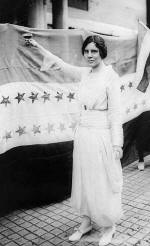 know it was also the 39th anniversary of the date on which Equal Rights Amendment (ERA) passed out of the U. S. Congress and was sent to the states to be ratified? Probably not. And yet, if there is a resource women need as much as clean water, it must be the guarantee of equality under the law.
The original ERA, introduced in Congress in 1923, was written by Alice Paul, a women’s rights activist instrumental in the 1920 ratification of the 19th amendment, which guaranteed women’s right to vote. Paul also started the National Women’s Party, believing that without a political organization’s clout, women’s concerns would never be taken seriously by politicians. Paul was also one of the few women’s suffrage leaders who realized that getting the right to vote was necessary but not sufficient to enable women to be equal partners in society. She argued that those who had fought for suffrage should then shift their work to getting laws passed that would continue to expand women’s rights.
“When you put your hand to the plow,” Paul said, “you can’t put it down until you get to the end of the row.”
How right she was! And we aren’t there yet.
Read MoreWomen's History Open Thread: Honoring Our Mentors
 Mentors are particularly important for helping us develop a leadership style, and to shape our professional development. Who have been your mentors? What role have they played in your life? A new study released by Catalyst suggests that women need more than mentors, they need people who will sponsor them proactively into top leadership roles.
Do you agree? Have you had a sponsor? Have you been a sponsor?
Read MoreBeyond the Headlines: How to Find Role Models with Expertise
Emily Jasper writes this guest post for 9 Ways. Emily Jasper’s blog was chosen as one of ForbesWoman’s top 100 websites for women. Here’s the bio she sent to accompany this inspiring guest post:
Known to rip apart magazines to write in the white space, I’m constantly thinking about what to write next. I write about my own observations at my blog From the Gen Y Perspective. In addition to questioning the various perspectives different from my own and those of my generation, I am passionate about filling my time with ways to connect with the world.

Women’s History Month always gets me thinking about role models. It’s been argued that finding women who are role models for our future female leaders can be a little tricky. When reports include the fact that women still make up only 3% of Fortune 500 CEOs, I see what the proverbial they are saying. Most of us look to our mothers, teachers, and community leaders if we feel like it’s hard to find someone else in the limelight who really is a role model.
I realized about a year ago, however, the women who are my role models are leaders because of their expertise and what they do with it.
Most of my role models are female journalists and writers. While they are successful at reporting, I’m really attracted to their proficiency and passion. These women take all the education and wisdom they’ve learned from being on the leading edge of news or research, and they share it with us in the telling of stories.
Read MoreRemembering Jeannette Rankin, First US Congresswoman
 If women had held the preponderance of political leadership roles for the last few millennia, would peace have become more of a central organizing theme of history than war?
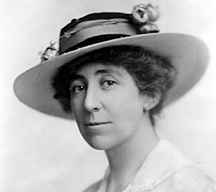
Jeannette Rankin, a Montana Republican and lifelong pacifist, was elected to Congress in 1916; that’s four years before the Constitution gave all women the right to vote. Not only did Rankin lead the way as a first for women, she defied all semblance of political tradition by opposing both World War I and World War II.
Rankin’s leadership style has many lessons for us today, especially since she did not shy away from controversy. The subject of Rankin’s very first Congressional vote (against President Wilson’s WWI war resolution) set the stage for her destiny. Rankin lost the support of most of the women’s suffragists who had campaigned for her, because they feared her anti-war vote made women look weak and hurt the suffrage movement. Embracing controversy can be tough when we ruffle the feathers of our opponents, but it’s even tougher when we lose the support of our closest friends and allies.
Read More