
Inspiration
From Olympe de Gouges to Women Demanding Rights Worldwide
“A woman has the right to mount the scaffold. She must possess equally the right to mount the rostrum [speaker’s platform].”
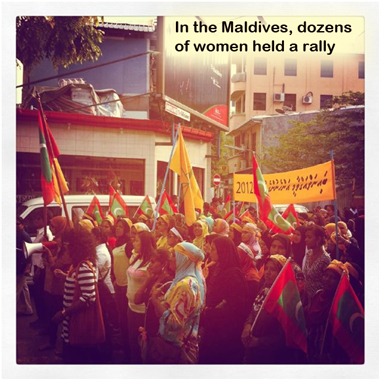
Olympe de Gouges was an 18th Century French playwright and political activist way ahead of her time, and her feminist and abolitionist writings stirred political discourse in ways that presaged uprisings by women around the world last week.
Disenchanted when equal rights were not extended to women after the outbreak of the French Revolution, Olympe de Gouges wrote a Declaration of the Rights of Woman and the Female Citizen. Modeled on the 1789 Declaration of the Rights of Man and of the Citizen by the National Assembly, De Gouges’ Declaration echoed the same language, replacing ‘Man’ with ‘Woman’.
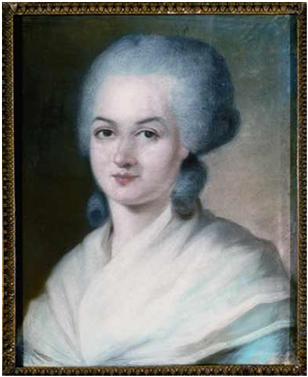 De Gouges argued that the rights revolutionaries were attempting to expand for men should be extended to women as well. She passionately insisted upon universal suffrage, legal equality in marriage, women’s right to divorce in cases of abuse and her right to property and custody of her children, among other things. In her postscript, Gouges exhorted women to awaken to consciousness of their rights to embrace their power. She encouraged them to step up, take action and demand equality.
Sound familiar?
Read MoreLoretta Lynn, The Pill, and Family Planning: Happy International Women’s Day!
Just in time to celebrate International Woman’s Day, Catherine Eng contributes this blog post that celebrates a medical solution to family planning that many take for granted and yet remains out of reach 52 years later to millions of women around the world.
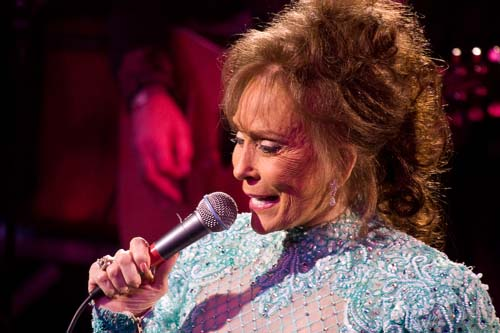
Country music legend Loretta Lynn was known for lyrics that bluntly addressed issues in the lives of many women. She believed no topic was off limits, as long as it spoke to other women.
In 1975, Lynn released The Pill, a single considered to be the first song to discuss birth control. The song tells a story of a wife who is upset about her husband getting her pregnant year after year, but is now happy because she can control her own reproductive choices. The song’s frank discussion of birth control was unprecedented at a time when many would have considered contraception a risqué subject matter. Some radio stations refused to play her song on these grounds.
“There’s gonna be some changes made right here on nursery hill…‘cause now I’ve got the pill.”
Be sure to click on the video link below to listen and laugh.
In an interview later in life, Lynn recounted how she had been congratulated after the song’s success by a number of rural physicians, telling her how The Pill had done more to highlight the availability of birth control in isolated, rural areas, than all the literature they’d released.
Fifty-two years after the inception of the pill in America, conservative newscaster Rush Limbaugh felt free to call Sandra Fluke, a Georgetown university student who asked her university to cover hormonal birth-control, a prostitute and a whore. His ignorant comment reminds us that there still exist widespread misconceptions and stigmas surrounding contraception. Let’s take the opportunity on International Women’s day to clear up any misconceptions, to examine the many social benefits of contraception and family planning.
Read MoreYour Invitation to The No Excuses "Power To You" Virtual Book Tour
I’m celebrating the paperback release of No Excuses: Nine Ways Women Can Change How We Think About Power and most cordially invite you to join me on my No Excuses “Power To You” Virtual Book Tour.
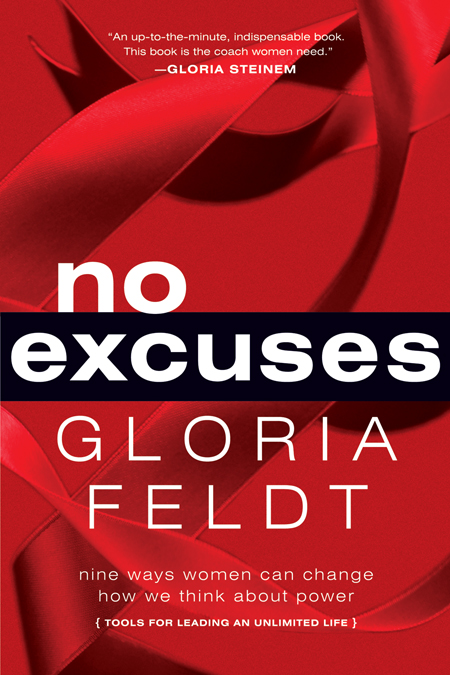
There are two ways you can participate in an in-person chat with me
Read MoreWhat's The Next Great Leap For Women?
You can now find me on ForbesWoman.com. My first post will tell you why it took me so long to get started. And now that I’ve jumped into the deep end of the pool, I want to share what I think is the Next Great Leap for women. I’d love to know what your thoughts are. Victoria Pynchon has already weighed in with an amazing piece about sponsorship.
 Because my book, No Excuses: 9 Ways Women Can Change How We Think About Power, came out officially in paperback on Leap Day—a perfect day for a book about women’s relationship with power, no?—I’ve been thinking hard about what the next great leap forward for women should be. So I thought I’d better check out the history of the every-fourth-year calendar adjustment that gives us February 29.
Leap Day inspired a leap of vision and blazing hope for women in 5th Century Ireland when St. Bridget persuaded St. Patrick to declare a woman could do the unthinkable: ask a man to marry her.
At a time when a woman was, for all practical purposes, owned first by her father and then by her husband, marriage meant not love but economic survival for her and her children. No doubt many seized their one chance to override gendered power norms and choose their own fates.
The tradition continued, with merry belittlements to remind women how little power they had the rest of the time. Men had to pay a fine or give a silk dress if they refused marriage proposals. Women on the prowl for husbands sported red petticoats as warning so poor beleaguered men could dash in the other direction. Haha.
You may be laughing because Leap Day privilege now seems an amusing anachronism. Not only do the majority of men and women think it’s perfectly fine for a female to propose marriage, the End of Men has been proclaimed, Women’s Nation declared, and New York Times columnist Nick Kristof dubs women “Mistresses of the Universe.”
But such puffery masks how far women have yet to go to achieve genuine parity. The next norm-changing leap must be women creating and earning wealth that places the female 51 percent of the population into power balance with their male counterparts.
Read MoreWe’ve Come a Long Way, Maybe: Women’s History Creates the Future
“If women want any rights more than they got, why don’t they just take them, and not be talking about it.”
— Sojourner Truth, 1797-1883. Former slave, abolitionist,
women’s rights activist, Methodist minister.
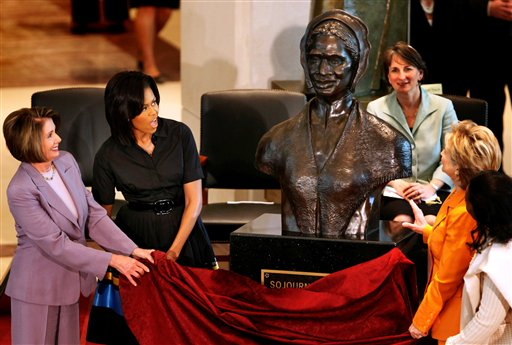
Truth’s admonition seems archaic now. Why are we still “talking about it?”
Is women’s history of struggle for equal rights relevant in a world where women have outpaced men in earning college degrees, equaled their numbers in the workplace, and snatched the family purse to make 85% of consumer purchases?
Since “The End of Men” has been declared and women dubbed “Mistresses of the Universe” shouldn’t young women today, at least those in the industrialized world, feel powerful enough to be and do anything they want?
And shouldn’t more sympathy go to men these days, as the current efforts to gain acceptance for a men’s rights movement have suggested?
Read MoreInspiring Black HERStories
February is Black History Month and March is Women’s History Month. This post by Catherine Engh ties the two together in historical context with links to some amazing but little-known women’s stories. Wow. Feel free to add stories of other such women in the comment section.
And be sure to check back here often as I continue my annual Women’s History Month tradition of highlighting many amazing women—some well known and others not—who have shaped our history. And as you know, No Excuses Power Tool #1 is “Know your history and you can shape the future of your choice.”
Janell Hobson, blogger, social critic and professor of women’s studies, spotlights the lives of various fierce black women throughout history this February on Ms. Magazine’s blog. Hobson’s fascinating posts take as subject black female vocalists, vanguards of the second-wave feminist movement, jazz-age expatriates in Paris, fugitive slaves, civil rights organizers and contemporary environmental justice advocates.
Who knew about Sookie, a slave woman who resisted rape by pushing her master into a soapbox filled with boiling water?
Read MoreShe's Doing It: Merle Hoffman – "It Takes Bad Girls to Get Good Things Done"
Often when I speak about No Excuses, I ask “When did you know you had the power to __(fill in the blank)___?”
This question intrigues people, but rarely does anyone have as clear and direct answer as Merle Hoffman, this week’s “She’s Doing It.” She seems to have been born knowing, and born quite willing to buck the norm of being the archetypical nice and compliant “good girl” in favor of getting done the things she believes are important.
Merle, the President and CEO of Choices Women’s Medical Center, has recently published a memoir I highly recommend, Intimate Wars: The Life and Times of the Woman Who Brought Abortion Out of the Back Alley and Into the Boardroom.
Merle was kind enough to answer some questions about her life and times for 9 Ways:
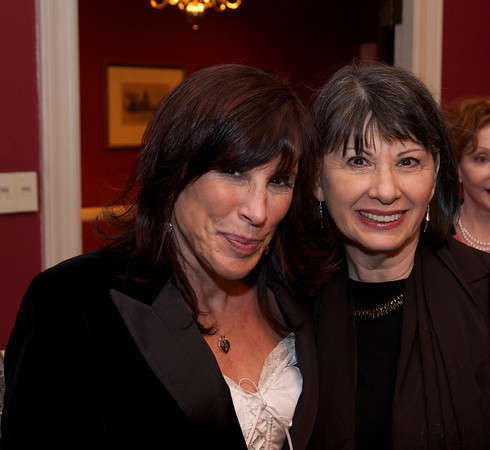
Tell me your personal story…why and how did you come to be doing what you a doing?
I really fell into it serendipitously. My early years and adolescence were spent preparing to become a concert pianist. After I graduated from Music and Art, I also dabbled in painting and drama. When I finally decided to go to college at the age of 22, I need three part time jobs to pay for tuition—and one was with an internist , Dr. Martin Gold, for whom I worked as a medical assistant. At just this time (1970), abortion was decriminalized in New York which was three years before Roe v. Wade legalized abortion nationally. Dr. Gold, one of the architects of HIP, wanted to start a service for women subscribers. I got involved in the beginning of this project and it has become my life’s work.
What motivates you? What’s your passion?
I am motivated by very deep feelings of responsibility which began with the first patient who came to Choices.
Read MoreSettling the Score: Dorothy Seymour Mills Finally Tells Her Story
“Everyone assumed that he had done all that work by himself — that’s what he wanted them to assume, but we were equal partners” –Dorothy Seymour Mills
- Photo source: Dorothy Jane Mills
Dorothy Seymour Mills is one of the great baseball historians of all time. But you probably never heard of her.
Instead, she worked alongside her late husband, Harold Seymour. From 1960-1990; he received all the credit and did become famous in his field. Together they completed three of the earliest and most widely read books on baseball history.
First in the Field is Dorothy’s belated claim to her own life’s work. In it, she reveals her approach to baseball history, pervasive attitudes about woman interested in baseball, her reasons for finally demanding the credit she deserves so late in life and her struggle for recognition after her husband’s death.
The short eBook reads more like a research paper than a memoir. But then, the author is after all first and foremost a historical researcher. First in the Field moves through her personal and professional history much as an encyclopedia entry might, chronologically from fact to fact, event to event. Readers will not find much in the way of literary language: Dorothy’s narrative is told without literary flourish or thematic subtlety.
Yet despite the stylistic simplicity, or perhaps because of its straightforwardness and lack of pretense, the story will tug at the heartstrings of anyone who has experienced discrimination. And in recognition that one’s personal story is also political, Dorothy ties the personal injustices she faced to the widespread marginalization of women
Read MoreWorkshop Invitation for You – No Excuses: 9 Ways to Boost Your Power in 2012

I’m excited to invite you to a No Excuses: 9 Ways to Boost Your Power in 2012 workshop I’ll be offering in collaboration with Digitistas in New York on 1/31. The deets- are below–please click here to register. (Oh, and as a Friend of Gloria, if you use the code NoExcuses when you sign up, you’ll get a $10 discount in addition to a copy of the book and many practical tools to boost your power in your career and relationships.)
No Excuses: 9 Ways to Boost Your Power in 2012
Tuesday, January 31, 2012 from 7:00 PM to 9:00 PM (ET)
Fenton Studios
630 9th Avenue
Suite 910
New York, NY
Workshop description:
Have you ever offered an idea in a meeting and no one acknowledged you, then ten minutes later a man said the same thing and people thought it was a great idea? Do you wonder why women are stuck at 18% of the top leadership positions across all sectors, earning $1million less than men over a career, despite being half the workplace and 54% of the voters?
Do you have big ambitions but aren’t sure how to achieve them? Learn practical tools from the woman People Magazine called “the voice of experience” for how you can embrace your power, enhance your leadership skills, and lead your dreams forward.
It’s a new year and a great time to get inspired while learning 9 Power Tools—practical bite-sized tips you’ll use to clarify your intentions and make an action plan that will enable you to reach your goals for work, civic life, or personal relationships. During the workshop, you will have a chance to give and get feedback on your application of the Power Tools to a goal or goals you will define, and you’ll leave energized for the year ahead.
Please note the ticket price for this class includes a copy of Gloria’s book No Excuses: 9 Ways Women Can Change How We Think About Power.
Read MoreMy New Year Revolution: Owning the Power of “Yes”
 Happy New Year! Personally, I like these round numbered years. They make me feel optimistic for no apparent reason.
What about you? What’s your frame of mind as you start 2012?
Read More