
Leadership
The Young Politica: The 2012 Youth Vote
After a low youth voter turnout in 2010, projections for the youth vote in 2012 seemed to be less than that of the momentous turnout in 2008. 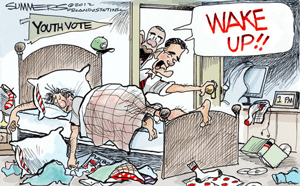 Democrats made it a point to make the youth vote become an important factor in the 2008 election, but as many students, saw soon after inauguration day, change didn’t come as easily as we had expected. To many voters’ surprise, the youth vote was higher in 2012 than it was in 2008.
Paul Ryan’s dig on fading Obama posters may have been a bit extreme, but it did shed light on the election’s youth voter’s perspective, and the voter climate overall. Would the next four years be worth the another Obama term? Would change for our generation be financially sustainable?
This election was far different from the 2008 election that promised some generic change. It wasn’t about who had the spiffiest graphics or best campaign t-shirts. It was about our future, about how much we would have to pay in loans after college, about what jobs we could find, and about what our futures would shape into.
Read MoreSex and the Married General: 3 Reasons Petraeus Had to Go
When CIA director David Petraeus stepped down from his post, citing an extramarital affair, the political birds of prey immediately started talking about who should replace him. And the usual battleground map was drawn.
On the one side are those who say any leader caught in such a compromising position has to go. On the other side are those who contend private consensual sexual behavior is just that and as long as it is not interfering with a leader’s ability to do the job, it should not factor into whether he or she remains in power.
Petraeus’s romance with his biographer and former military officer, Paula Broadwell, is hardly a new circumstance in American politics.
General Dwight Eisenhower had a well-known affair with his driver while commanding the US Army in Europe, and this did not prevent him from becoming president. Franklin Roosevelt had a long-running affair with Lucy Mercer while he was president without any hints that he should resign the presidency. JFK was a well-known womanizer, including in the White House. And then of course there is Bill Clinton who despite his foolish high risk dalliance with Monica Lewinsky handily won reelection and remains (perhaps second only to his wife) the most popular politician in the country.
So you might think I am going to defend Petraeus. Most definitely not, for three reasons.
Read MoreTwo Generations Dissect Election 2012 and What’s Next for Women’s Rights
On election night, journalism major Maegan Vazquez joined about one hundred fellow New York University students over the beer soaked floorboards of Brad’s, a popular site for locals and college 20-somethings alike. Keenly interested in politics, she’s been writing a terrific weekly column for my Heartfeldt Blog, titled “The Young Politica.”
Across town, I chatted with a couple dozen men and women at my friend Loretta’s Upper East Side apartment. As guests slipped into spaces on the elegant couch and chairs, like the old game of Sardines, each sighed, “I’m so nervous about the outcome of this election.”
Nov. 7, 2012 – New York, USA – Young women celebrate the result of the 2012 US Presidential election at Times Square in New York, USA, 07 November 2012. Democratic President Obama defeated Republican candidate Mitt Romney in the US elections. Photo: Rainer Jensen (Credit Image: © Rainer Jensen/DPA/ZUMAPRESS.com)
The pundits had us convinced that what turned out to be a rout would be a cliffhanger.
Read MoreIn Which I Answer POLITICO Arena’s Election Day Question: What were the campaigns’ biggest mistakes?
A friend posted a photo on Facebook of a long line at her polling place this morning with the comment that “it’s a good sign when voters are treating an election like Black Friday at Walmart.” Now we have to wait all day to learn which of the candidates brought forth this outpouring of interest: do voters think Obama or Romney is the better bargain?
Both campaigns have made mistakes galore, balancing each other out in about the same horserace numbers as the daily polls have recently shown the race to be. Romney’s worst was hoisting himself on his own petard of Etch-a-Sketch positions, thus eroding voter trust, then nailing his coffin with the deliberately false Jeep ad.
Obama’s worst mistake was four years in the making. He failed to run, as Harry Truman successfully did, against the “do nothing Congress” that is more at fault for the lack of economic progress than the president who at least put forward some ideas. He had to re-energize many discouraged 2008 supporters as a result. But thanks to the Republican War on Women which Romney could not separate himself from, Obama was able to seize a set of issues that resonate with progressive women who make up almost 60% of the Democratic base.
Romney’s mistakes were mistakes of character and likability; Obama’s were mistakes of leadership style.
Read MoreOutsider Fits No Political Box, but Declares Choice Because “I Hope It Gets Better”
This is a powerful personal essay guest post on American culture and politics from my colleague, Tamara Fagin. Her title was “Random Musings From the Frontline” but I don’t think it’s random at all. I believe most Americans feel like outsiders at some time in their lives, and who have had the experience of being bullied or feeling like we have been treated unfairly because of our birth origins.
We are a nation of diverse heritages, a salad bowl of tossed differences rather than a melting pot where we all blend in together.
How does Fagin tie her personal experience as a one-woman salad bowl of cultures who always felt “different” with how she came to choose a candidate for president? Read on…and tell us your experiences.

All or for much of my life I have felt like an outsider. Bullied in a sense for giving a damn. I have early memories of eye-rolling, smirks or quiet taunts. This was not the punching, hair-pulling, tripping garden variety of physical bullying and worse, rather the insidious kind that eats at one’s insides and makes one eat lunch in the high school bathroom (it was clean and a friend joined me).
It was the one-off comment from the popular, All-American high school cheerleader that goes unanswered by one’s peers and one’s teacher. When I answered a question in A.P. U.S. History class, our teacher asked the class, “Why can’t you guys answer that question? Tamara just moved here from Japan.“ The cute blonde cheerleader girl shouted, “She’s an import!” I can’t remember what happened after that.…
I just remember that I wished that we were back in Japan. And, I wished that she knew the deal. But, c’est la vie or shikataganai, as the Japanese say.
Note to Mr. M.: you should have called her on that. You should have never made that comment to the class about me being able to answer the question. I was new to the school. I was miserable. I missed my old school, my old friends, my old beaches, my old Japanese nightclubs, my old routine and I missed Okinawa, Japan.
Note to educators everywhere: you make the bullying problem worse when you do this kind of comparison thing. It doesn’t work for parents when they say to their kids, “Why can’t you be more like your big brother, Johnny?” Why the hell do you think it is going to make your domestic darlings try harder? It just doesn’t. It breeds resentment. It pits us against them. U.S. blonde, blue-eyed and beautiful against different. But, to borrow a phrase from my LGBT brothers and sisters, IT GETS BETTER.
Read MoreThe Young Politica: How to Vote During Hurricane
We Lower-Manhattanites are a scrappy bunch of people. We are starving artists, college students, writers, and Wall Street bankers. This past week, after Hurricane Sandy hit, all of lower Manhattan was out of power for days.
I am writing this after being evacuated from my dorm and living out of NYU’s Kimmel Center for days—a building that offered food, shelter, and power to students. For those not seeking refuge outside of their ‘South of Power’ apartments, I’ve heard stories of raw ramen for dinner and pilgrimages north for cell phone service. Luckily, power resumed for much of my neighborhood recently, so I have a bed to sleep in again.
Rather than thinking about where I would be relocated after the storm on Monday, my concerns shifted to how Sandy would affect the upcoming election. Perhaps my priorities need adjusting.
Read MoreIf Obama Wins Ohio, Fair Voting and Jennifer Brunner Get Credit
My grandparents were all immigrants from tyrant-ruled Eastern Europe during the early decades of the 20th century. They treasured their voting rights as only new citizens can, and they instilled in me their almost sappy love of the American ideals of liberty, justice, and fairness.
Having struggled to get to their promised land, they considered voting their sacred duty. Every election, no matter what. They weren’t naïve about politics, nor did they expect their favored candidates to win every time. They just wanted their votes counted honestly and their voices heard fairly.
They would have loved Jennifer Brunner, Ohio’s first female Secretary of State who served from 2007-2011. She’s a true American hero for cleaning up the state’s election system after its 2004 debacle, one that is remembered as one of the most sordid chapters in our nation’s history.
Read MoreThe Young Politica: The Wage Gap Starts Soon After You Receive Your Diploma
For many college-aged readers, loans are the reason we get the opportunity to get to college.  We spend thousands of dollars in virtual money to get an education in the hopes that it will begin to pay off as soon as we get a job. Yet, despite the fact that we advance in our career fields, it seems like women’s investments aren’t paying off as quickly as our male counterparts.
A recent report released by the American Association of University Women, Graduating to Pay a Gap, found that the pay gap persists and even begins soon after graduation
—“women one year out of college who were working full-time earned, on average, just 82 percent of what their male peers earned.”
It is important to note that even after variances like college majors, number of hours worked, and career industries were accounted for, women still earned less than men. One third of the gap cannot be explained by differences in education or unemployment, according to AAUW.
Read MoreFaith-based Support for Abortion Rights
The Gallup poll is showing abortion as the #1 voting issue for women in key swing states, with the economy second. Though the pollster didn’t indicate whether the female registered voters polled were pro or anti choice, it’s clear there is a heightened awareness of the consequences of a Romney/Ryan presidency as well as the…
Read MoreThe Young Politica: Do the Presidential Candidates ‘Walk the Walk’ on Student Issues?
If you watched the presidential debate this past week, you probably remember Jeremy Epstein, a 20-year-old college student who attends Adelphi University. He opened up the town hall question session by asking:
“Mr. President, Governor Romney, as a 20-year-old college student, all I hear from professors, neighbors and others is that when I graduate, I will have little chance to get employment. Can — what can you say to reassure me, but more importantly my parents, that I will be able to sufficiently support myself after I graduate?”
This question is the basis of concern for many young Americans. And it correlates to other questions we have about student loans and the economy. In 2008, 51% of young voters came out to the polls and helped swing the vote. An overwhelming amount of students—68 %—voted for Barack Obama.
Now that there is some unrest on how he has handled the economy over the past four years, recognizing the student vote on both sides should be key to snagging the presidency. Here are some issues the candidates need to address:
Read More