
She's Doing It: Jamia Wilson Learns Resilience and Power of Inter-generational Bonds
I’m a little biased about Jamia Wilson having had the pleasure of knowing her and working with her as we both went through several career transitions during the last decade.
She’s an inspiration to me because of her seamless commitment to social justice and her positive way of putting her ideas into action.
Her responses to my questions continue the series in which I ask people I interviewed for No Excuses what they’ve learned since then. You can connect with Jamia on Facebook and Twitter.
Gloria Feldt: In No Excuses, I asked, “When did you know you had the power to _____?” What have you learned about your power to _____ during the past year or so?
Jamia Wilson: In the past year or so, I have learned so much about faith and perseverance. I have faced many triumphs and challenges during a transitional time in my life and have learned so much.
The rough edges and moments where I stared fear in the face taught me about the importance of courage and authenticity above all else. I have learned that I have the power to choose to be who I am authentically without apology and let that guide me towards realizing my dreams and my highest power.
As Janis Joplin said, “Don’t compromise yourself, you’re all you’ve got”. 2010-2011’s greatest gift to me was an appreciation for my own resilience and that to me is one of my most sacred superpowers.
GF: Was there a moment when you felt very powerful recently?
Read MoreSlutwalks and Such: Who's Making Women's History Today?
Big thanks and kudos to Catherine Engh for contributing some terrific posts this Women’s History Month. As we end WHM for 2012, here’s one more from Catherine that I know you’ll enjoy, and I hope you’ll think about and take a moment to share your comments. I’ve written a different take on Slutwalk but Catherine has almost persuaded me…
This last year, women around the world made history, protesting victim-blaming online as well as on foot. The Slutwalk movement began after a Toronto police officer told a group of college women that if they hoped to escape sexual assault, they should avoid dressing like “sluts.”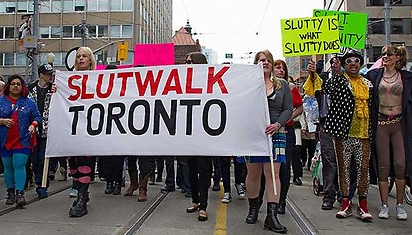
Victim-blaming last year was by no means isolated to this public incident. A young woman who pressed rape charges against two New York City police officers could not be believed, in part, because she was drunk. When an 11-year-old Texas girl was allegedly gang-raped by 19 men, The New York Times ran a story quoting neighbors saying that she habitually wore makeup and dressed in clothes more appropriate for a 20-year-old. The maid who accused Dominique Strauss-Kahn of rape has been discredited for being a liar, and The New York Post claimed she was a prostitute.
The women and men who marched in Slutwalks in more than 70 cities around the world last year were fed up with this kind of symbolic violence. The Slutwalk movement was organized around one central message:
Read MoreHoodies, Gender, and Telling Truths
Politico Arena Asks:
Congressional Black Caucus Chairman Emanuel Cleaver (D-Mo.) plans to send House Speaker John Boehner a letter requesting that the House chamber’s dress code be more strictly enforced after Rep. Bobby Rush (D-Ill.) was booted from the House floor yesterday for wearing a hoodie. 
Rush sported the sweatshirt and a pair of sunglasses to bring attention to the shooting of Trayvon Martin. However, some members argue that Rush was unfairly treated as it is fairly common practice for members to ignore attire rules.
Is this incident a sign that the Trayvon Martin case has become too politicized? If so, who is responsible?
My Response:
Between Trayvon Martin, Sandra Fluke, and women’s reaction to the Komen Foundation’s epic fail, the world is splitting open and making way for many previously untold truths about race and gender.
Read MoreHillel Keynote, Tempe AZ
Keynote Speaking Event
Women’s Power and Possibilities: Implications for Women, Men and Relationships
What a great way to honor and celebrate Women’s History Month!
Arizona State University
 Hillel Keynote and panel discussion “Women’s Power and Possibilities: Implications for Women, Men and Relationships”
Tempe AZ, March 28, 2012
Check out these great pictures from a great event!
(Click here to read event details)

Read More
She's Doing It: Kristal Brent Zook Defines Her Own Chaos
Continuing the series of asking women I interviewed when I was writing No Excuses “What have you learned about your relationship with power since we talked?” here is a beautiful essay from Kristal Brent Zook explaining her answer about a very personal choice.

How Gloria Feldt’s No Excuses Reminded Me of My Power
Not long ago, my friend Gloria Feldt, author of No Excuses, asked me to take another look at her 9 ways women can embrace power to see if any of the strategies had resonated lately, in the year or so since the initial release of her book.
Since we all know how political the personal will always be, I thought immediately about the upheavals of the past year in my home life.
Last February, my husband and I decided—on a whim, really—to relocate from Manhattan to the suburbs of Long Island.
“Why not leave the city?” we asked ourselves. It seemed like a good idea at the time. Get some fresh air. A yard. A real house. It would shorten my commute to Hofstra University; and of course, we would be saving all that money.
A charming, two-story 1923 Colonial about 30 miles east of the city caught our eye: it was more than 5,000 square feet, with two sun rooms and front and back yards. The rent was $1,200 less than our midtown high-rise, and ditching New York City taxes meant another $1,000 a month in savings.
“Let’s do it!” we agreed excitedly, handing over a check for the first month’s rent.
Read MoreWho Will the Woman of Tomorrow Be?
“What do you want to be?” we ask our daughters and sons when they are growing up.
It seems only right that as Women’s History Month draws to a close, we don’t just look backward but that we also focus forward to ask what we as women want to be and what women of the future might or should become.
This article on Canadian women’s economic power indicates economic parity is on the way. A new study published in the Harvard Business Review says women are better leaders than men on almost every measure of leadership. But does that translate to women moving from the current 18% to parity in top leadership positions?
Since the power to define the woman of tomorrow is to a large extent in our hands (See Power Tool #3) and based upon the history we make today (see power tool #1), I’m asking what you think:
Read MorePower to You Facebook Chat
Webinar Event
Power To You Facebook Chat
Even if you don’t want to get out of bed on a Sunday, you can join me for a Power to You Facebook chat about No Excuses: 9 Ways Women Can Change How We Think About Power. It’s easy!
March 25, 2012 –3-4pm, Gloria Feldt Facebook Fanpage. Find out how
(Click here to read event details)
Read More
The Power Hour: Leadership and Women's Health
Leadership and Women’s Health Event
The Power Hour: Leadership and Women’s Health

Gloria interviews Dr. Nieca Goldberg on the controversial topics of Leadership and Women’s Health.
Free admission. RSVP 203-226-0199 or PowerHour@mediamuscle.com
March 26, 2012 –
(Click here to read event details)
Read More
Are You Angry Enough to Embrace Your Power To Act? (3 Signs You Are)
In decades of experience as a women’s advocate, I’ve learned people can be inspired to action by one of two things: anger or aspiration.
 A roiling, boiling anger is propelling women — even many who’ve never been activists before — to embrace their “power to” to take leadership and make change. They’re making their voices heard over the din of political rhetoric they might shun under other circumstances.
There was no one trigger, rather a succession of insults. I talked with Richard Lui about them this week on MSNBC’s Jansing & Co. Here’s a smattering:
- After 30-year-old Georgetown University law student Sandra Fluke was denied the chance to speak about why contraceptives should be covered by insurance…
- After the stunning optics of an all-male “expert” panel pontificating on women’s reproductive health before a Senate committee (also all-male because the women on the committee were so incensed they walked out)…
- After shock jock Rush Limbaugh denigrated Fluke, calling her a slut and a prostitute (can one be both—don’t sluts give it away?) and demanding to see videos of her having sex…
- After bills like those in Texas and Virginia forcing women seeking abortions to submit to 10″ ultrasound “shaming wands” (as Doonesbury dubbed them), an AZ bill requiring women to bring notes to their employers verifying they take birth control for health reasons not pregnancy prevention or risk being fired, and a Tennessee bill that mandates public reporting of the doctors by name and the demographics of each patient…
Women are rightly furious.
Why is this happening?
Read More"Black Woman Novelist" -Toni Morrison Defines Her Own Terms
“I’ve just insisted – insisted! – upon being called a black woman novelist…And I decided what that meant, because I have claimed it. As a black and a woman, I have had access to a range of emotions and perceptions that were unavailable to people who were neither.”
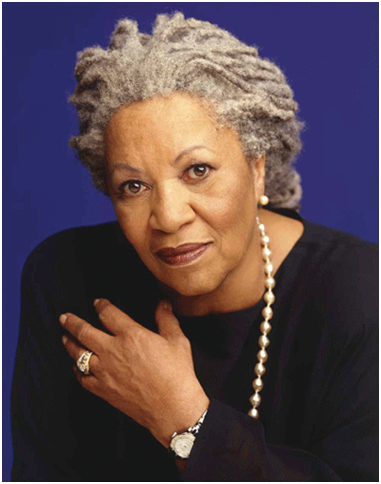
It’s Women’s History Month and I can’t resist profiling Toni Morrison, a prolific writer who has worked to represent through fiction the experience of black people—particularly women–in America. Ms. Morrison’s novels focus on marginalized characters struggling to find their place in a society built upon the legacy of slavery and the violence of racial prejudice. Most known for her imaginative fiction, Morrison has also written essays, non-fiction, plays, a libretti, and children’s books.
Ms. Morrison developed her first novel, The Bluest Eye (1970), while raising two children and teaching at Howard University. She later took a job as an editor at Random House, where she played a vital role in bringing black literature into the mainstream, editing books by authors such as Toni Cade Bambara, Angela Davis, and Gayl Jones.
Commercially successful and critically acclaimed, her 1987 Pulitzer Prize winning novel “Beloved” was chosen by a New York Times survey of prominent writers to be the best work of American fiction of the previous 25 years. In “Beloved”, Morrison imagines what it would have felt like to be Margaret Garner, a fugitive slave woman who chose to kill her infant daughter rather than see her grow up in slavery.
In an interview with the Paris Review, Morrison says about Margaret Garner:
Read More