
My Little Red Book
 Today’s Women’s History Month post deals with one of the most universal women’s issues: menstruation.
Nora Ephron got this sage advice in her novel Heartburn: invest in something people use once and throw away. So she invested in tampons and made a lot of money.
I thought of that when I met a young woman named Toyna Chin, whose company produces Petite Amie, an appealingly designed kit containing a custom designed mix of products a tween or teen needs when she has her monthly period. Not only was Toyna investing in products people use once and throw away, she was packaging them as a stylish health and beauty product rather than a tacky sterile necessity that smacks of embarrassment when plucked from the shelf.
Petite Amie is perfectly in synch with changes in how girls approach menstruation now compared to previous generations. In the same way that girls today learn to compete because Title IX increased their access to competitive sports (Think Sarah “Barracuda” Palin), they are much more likely to embrace and talk frely about the tangible evidence of puberty than the women who birthed them, and certainly more than their grandmothers, for whom “the curse” was just that.
Read MoreCourageous Leadership and the Equal Rights Amendment
Today, March 22, is the anniversary of the U.S. Senate’s passage in 1972 of the Equal Rights Amendment (ERA), a constitutional amendment that would–IF it had been ratified by 3/4 of the states by its ten-year deadline in 1982– have ensured equal rights could not be denied on the basis of gender.
Let me tell you a story about leadership, persistence, and courage.
The original ERA, first introduced in Congress in 1923, was written by Alice Paul, a women’s rights activist Alice Paul toasting the passage of the 19th amendment to the Constitution giving women the right to votewho was instrumental in the 1920 ratification of the 19th amendment, which guaranteed women’s right to vote. Paul also started the National Women’s Party, believing that otherwise women’s concerns would never be taken seriously by politicians.
The ERA has been re-introduced in nearly every session of Congress since then. Bet you didn’t know that, did you? We don’t hear too much about it, bu it’s still very much alive and with the election of Barack Obama there’s a resurging movement to restart the ratification process and get the three additional states needed to give women equal rights in the Constitution that didn’t even consider them citizens when it was written.
Read MoreHow to Reverse That “Perverse Cosmic Myopia”
Guest blog today by Jane Roberts, cofounder 34 Million Friends of the United Nations Population Fund and author of the book “34 Million Friends of the Women of the World”. Though written in present and future tense terms, the post reminds us that we can rewrite the history of women’s global economic and reproductive subjugation.
The term PERVERSE COSMIC MYOPIA (PCM) was used by David Brooks in a New York Times column on March 20, 2009 which intimated that the world economic and financial crisis was so bad that President Obama needed to concentrate his attention on this single tiger sinking its teeth into the world’s neck and forego at least for now health care, energy, immigration, and education.
To me PCM is a fitting term for only one all encompassing area of concern. Gender inequality, the neglect of women’s and girls’education, health, economic empowerment, and human rights, and the coming 9.1 billion people on the planet by 2050, fighting over resources and for survival, and living on a planet with a down-spiraling environment, now that, and only that is COSMIC!
Hillary Clinton at her Senate confirmation hearings: Of particular concern to me is the plight of women and girls who comprise the majority of the world’s unhealthy, unschooled, unfed, and unpaid.
Ban Ki-Moon, Secretary General of the United Nations: In women the world has the most significant but untapped potential for development and peace.
Stephen Lewis, former U.N. ambassador to Africa for AIDS: I challenge you to enter the fray against gender inequality. There is no more honorable or productive calling. There is nothing of greater import in the world. All roads lead from women to social change.
Read MoreSex, Washing Machines, and The Politics of Liberation
Margaret Sanger, founder of the American birth control movement and of the organizaton that became Planned Parenthood, called birth control “the liberation of human development.”
Nor surprisingly, Pope Benedict begs to differ with the all-time papal nemesis, Ms. Sanger.
The Times of London did a great riff on the Pope’s recent pronouncement that it was the washing machine, not the ability to control fertility and separate childbearing from sex that has been most liberating, listing the top ten ways women throughout history have been freed by various sudsy technologies:
Read MoreEdna St. Vincent Millay, First Woman Pulitzer Poetry Winner
 My parents started sending me to Mrs. Fred Day’s charmingly named “Expression” classes when I was three years old. There, over a period of seven or eight years, I learned at least one new word each week, practiced exercises intended to improve my posture and diction, was schooled (or at least she tried to school us) in the social graces of serving refreshments to my classmates, and memorized a variety of poems. Some of the lines that have lodged most memorably in my mind are those of Edna St. Vincent Millay. There was the cheery:
I will be the gladdest thing
Under the sun!
I will touch a hundred flowers
And not pick one.From “Afternoon on a Hill”
…and the dramatic:
All your lovely words are spoken.
Once the ivory box is broken,
Beats the golden bird no more.From “Elegy”
So when Bonnie McEwan of Make Waves sent me Millay’s poem, “Recuerdo”, along with a note that the poet who liked to call herself “Vincent” and took many lovers during her life, had been the first woman to receive a Pulitzer prize for poetry in 1923, I immediately conjured the sights and floral smells of Mrs. Day’s rather formal home in Temple, Texas–perhaps 3rd Street?–walking distance from my elementary school.
Read MoreCourageous Leadership for Women Religious – First Bat Mitzvah
Thanks to the Jewish Women’s Archive for this article. I serve on the board of this terrific organization. Check out their blog, Jewesses with Attitude, where you’ll find podcasts in addition to vibrant articles. They’ve recently published the Jewish Women’s Encyclopedia, an invaluable resource for educators and anyone who likes fascinating stories about women who have done extraordinary things with their lives. But enough of this …read on about how and why the first bat mitzvah occurred. It always takes someone to be the boundary breaker, and then all the rest of us can follow suit, embellish, make a once sweeping change seem just normal. The last paragraph brought me to tears.
Judith Kaplan, at age 12, became the first American to celebrate a Bat Mitzvah on March 18, 1922. Judith was the oldest daughter of Rabbi Mordecai Kaplan, the founder of Reconstructionist Judaism. Believing that girls should have the same religious opportunities as their brothers, Rabbi Kaplan arranged for his daughter to read Torah on a Shabbat morning at his synagogue, the Society for the Advancement of Judaism.
The Kaplan Bat Mitzvah marked a turning point for Conservative Judaism in America. Always torn between tradition and modernity, the movement struggled for many decades with women’s roles in the synagogue. Judith Kaplan herself did not read from the Torah scroll, as modern Bat Mitzvah celebrants do; instead, she read a passage in Hebrew and English from a printed Chumash (the first five books of the Bible) after the regular Torah service. Still, Rabbi Kaplan’s innovation gained followers. By 1948, about a third of Conservative congregations had conducted Bat Mitzvah ceremonies. By the 1960s, Bat Mitzvah was a regular feature of Conservative congregational life; today it is a mainstay in synagogues from Reform to Modern Orthodox.
Read MoreUpdate: Do Women’s Gains Make Women’s History Month Ho Hum?
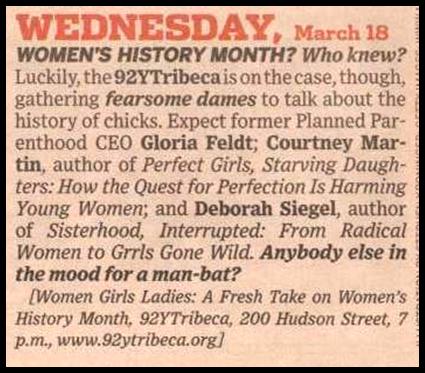
Hello! If you thought maybe the answer to this question I posed a couple of days ago is “yes”, take a gander at how the NY observer wrote up the WomenGirlsLadies’ upcoming event March 18 @ the 92Y Tribeca! Elizabeth Hines is the fourth member of our panel. Come join us. Bring your thoughts about feminism’s unfinished business–and your man-bat, just in case someone from the Observer shows up 🙂
Irish Women Leaders
Do you know about Mairead Corigan and Betty Williams who won the Nobel Peace Prize in 1977 for leading peace marches where Catholics and Protestants together protested against the violence that was splitting the country? Or Grace O’Malley, a famous 16th Century pirate, seafarer, trade, and chieftain? What about Maria Edgeworth, 18/19th century Irish Writer perhaps a precursor to Virginia Woolf’s notion that women need a room of their own; Edgeworth said: “Some people talk of morality, and some of religion, but give me a little snug property.”
These and many other fascinating women leaders are chronicled on this Famous Irish Women website. The graphics are quite charming, cozy Irish country home style. But the stories tell of grit and glory, wisdom and courage. Take a look and give a tip the hat.
More likely, you have heard and seen Mary Robinson, Ireland’s seventh president and the first woman to serve in that capacity. “I was elected by the women of Ireland, who instead of rocking the cradle, rocked the system,” she said. Elected in 1990, she served until 1977 when she became the United Nations High Commissioner for Human Rights, a post she held from 1997 to 2002. Continuing to rock the systen through her work to advance peace, human rights, and women’s leadership in all arenas, Robinson, a lawyer, is a founding member and currently the Chair of the Council of Women World Leaders.
Read MoreDo Women’s Gains Make Women’s History Month Ho Hum?
I’m finding Women’s History Month this year greeted with yawns. That could mean women and women’s contributions are becoming everywhere recognized as integral to political and social history. If so, it’s not yet a publicly acknowledged fact.
No surprise there.
History has been defined through male lenses and written by male hands. Almost nobody, male or female, ever thought of Women’s History Anything before the 1970’s. Officially, it’s been in existence since 1978 and started on the left coast (as Women’s History Week) in Sonoma County CA. Now it sounds just nice and ordinary. You can even buy Women’s History Month greeting cards.
So it’s hard for many to fathom that the inception of Women’s History Month marked a revolutionary shift in thinking about whose actions are worth recording. An interesting overview is here, and Louise Bernikow’s “Our Story” articles tell me interesting snippets I don’t find elsewhere; your children probably won’t find them in their textbooks either because few history courses even today have caught up with the stunning progress women have made into leadership and influential roles during the past decade.
Read MorePow! Bam! Comic Books on Today’s Women Leaders Pack a Strong Message
Superheroines, Quemosabe! If art imitates life and pop culture depicts contemporary life most real and raw, then these new Female Force comic books deliver a powerful message that women in top political leadership have truly saturated our cultural consciousness. Embedded video from CNN Video There’s irony in that Female Force’s creators at Bluewater Productions are male,…
Read More